Brain-like Functional Organization within Large Language Models
Abstract: The human brain has long inspired the pursuit of AI. Recently, neuroimaging studies provide compelling evidence of alignment between the computational representation of artificial neural networks (ANNs) and the neural responses of the human brain to stimuli, suggesting that ANNs may employ brain-like information processing strategies. While such alignment has been observed across sensory modalities--visual, auditory, and linguistic--much of the focus has been on the behaviors of artificial neurons (ANs) at the population level, leaving the functional organization of individual ANs that facilitates such brain-like processes largely unexplored. In this study, we bridge this gap by directly coupling sub-groups of artificial neurons with functional brain networks (FBNs), the foundational organizational structure of the human brain. Specifically, we extract representative patterns from temporal responses of ANs in LLMs, and use them as fixed regressors to construct voxel-wise encoding models to predict brain activity recorded by functional magnetic resonance imaging (fMRI). This framework links the AN sub-groups to FBNs, enabling the delineation of brain-like functional organization within LLMs. Our findings reveal that LLMs (BERT and Llama 1-3) exhibit brain-like functional architecture, with sub-groups of artificial neurons mirroring the organizational patterns of well-established FBNs. Notably, the brain-like functional organization of LLMs evolves with the increased sophistication and capability, achieving an improved balance between the diversity of computational behaviors and the consistency of functional specializations. This research represents the first exploration of brain-like functional organization within LLMs, offering novel insights to inform the development of artificial general intelligence (AGI) with human brain principles.
- Mostafa Abdou. Connecting neural response measurements & computational models of language: a non-comprehensive guide. arXiv preprint arXiv:2203.05300, 2022.
- Low-dimensional structure in the space of language representations is reflected in brain responses. Advances in Neural Information Processing Systems, 34:8332–8344, 2021.
- Scaling laws for language encoding models in fmri. Advances in Neural Information Processing Systems, 36, 2024.
- Understanding complexity in the human brain. Trends in cognitive sciences, 15(5):200–209, 2011.
- Danielle Smith Bassett and Ed Bullmore. Small-world brain networks. The neuroscientist, 12(6):512–523, 2006.
- Neuroscience: exploring the brain, enhanced edition: exploring the brain. Jones & Bartlett Learning, 2020.
- Functional mapping of the human visual cortex by magnetic resonance imaging. Science, 254(5032):716–719, 1991.
- Spatial and linguistic aspects of visual imagery in sentence comprehension. Cognitive Science, 31(5):733–764, 2007. doi: https://doi.org/10.1080/03640210701530748.
- Language models can explain neurons in language models. https://openaipublic.blob.core.windows.net/neuron-explainer/paper/index.html, 2023.
- Korbinian Brodmann. Vergleichende Lokalisationslehre der Grosshirnrinde in ihren Prinzipien dargestellt auf Grund des Zellenbaues. Barth, 1909.
- Language models are few-shot learners. In Proceedings of the 34th International Conference on Neural Information Processing Systems, NIPS ’20, Red Hook, NY, USA, 2020. Curran Associates Inc. ISBN 9781713829546.
- Language processing in brains and deep neural networks: computational convergence and its limits. BioRxiv, pp. 2020–07, 2021.
- Brains and algorithms partially converge in natural language processing. Communications biology, 5(1):134, 2022.
- Bert: Pre-training of deep bidirectional transformers for language understanding. arXiv preprint arXiv:1810.04805, 2018.
- Alexey Dosovitskiy. An image is worth 16x16 words: Transformers for image recognition at scale. arXiv preprint arXiv:2010.11929, 2020.
- The llama 3 herd of models. arXiv preprint arXiv:2407.21783, 2024.
- The language network as a natural kind within the broader landscape of the human brain. Nature Reviews Neuroscience, pp. 1–24, 2024.
- Angela D Friederici. The brain basis of language processing: from structure to function. Physiological reviews, 91(4):1357–1392, 2011.
- Deep residual learning for image recognition. In Proceedings of the IEEE conference on computer vision and pattern recognition, pp. 770–778, 2016.
- Brain network interactions in auditory, visual and linguistic processing. Brain and language, 89(2):377–384, 2004.
- Brain mechanisms of vision. Scientific American, 241(3):150–163, 1979.
- A network correspondence toolbox for quantitative evaluation of novel neuroimaging results, 2024. URL https://doi.org/10.1101/2024.06.17.599426.
- Nikolaus Kriegeskorte. Deep neural networks: a new framework for modeling biological vision and brain information processing. Annual review of vision science, 1(1):417–446, 2015.
- Dissecting neural computations in the human auditory pathway using deep neural networks for speech. Nature Neuroscience, 26(12):2213–2225, 2023.
- Coupling artificial neurons in bert and biological neurons in the human brain. In Proceedings of the AAAI Conference on Artificial Intelligence, volume 37, pp. 8888–8896, 2023.
- Brain intelligence: go beyond artificial intelligence. Mobile Networks and Applications, 23:368–375, 2018.
- Online dictionary learning for sparse coding. In Proceedings of the 26th Annual International Conference on Machine Learning, ICML ’09, pp. 689–696, New York, NY, USA, 2009. Association for Computing Machinery. ISBN 9781605585161. doi: 10.1145/1553374.1553463. URL https://doi.org/10.1145/1553374.1553463.
- Toward a realistic model of speech processing in the brain with self-supervised learning. Advances in Neural Information Processing Systems, 35:33428–33443, 2022.
- The “narratives” fmri dataset for evaluating models of naturalistic language comprehension. Scientific data, 8(1):1–22, 2021.
- Nils J Nilsson. The quest for artificial intelligence. Cambridge University Press, 2009.
- Joint processing of linguistic properties in brains and language models. Advances in Neural Information Processing Systems, 36, 2024.
- Dinov2: Learning robust visual features without supervision. arXiv preprint arXiv:2304.07193, 2023.
- Structural and functional brain networks: From connections to cognition. Science, 342(6158):579, 2013.
- Functional network organization of the human brain. Neuron, 72(4):665–678, 2011.
- Explaining deep neural networks and beyond: A review of methods and applications. Proceedings of the IEEE, 109(3):247–278, 2021. doi: 10.1109/JPROC.2021.3060483.
- Frequency-specific directed interactions in the human brain network for language. Proceedings of the National Academy of Sciences, 114(30):8083–8088, 2017.
- The neural architecture of language: Integrative modeling converges on predictive processing. Proceedings of the National Academy of Sciences, 118(45):e2105646118, 2021.
- Explaining black box text modules in natural language with language models. arXiv preprint arXiv:2305.09863, 2023.
- Correspondence of the brain’s functional architecture during activation and rest. Proceedings of the national academy of sciences, 106(31):13040–13045, 2009.
- The role of visual imagery in story reading: Evidence from aphantasia. Consciousness and Cognition, 118:103645, 2024. ISSN 1053-8100. doi: https://doi.org/10.1016/j.concog.2024.103645.
- Connectivity and complexity: the relationship between neuroanatomy and brain dynamics. Neural networks, 13(8-9):909–922, 2000.
- Llama: Open and efficient foundation language models. arXiv preprint arXiv:2302.13971, 2023a.
- Llama 2: Open foundation and fine-tuned chat models. arXiv preprint arXiv:2307.09288, 2023b.
- Many but not all deep neural network audio models capture brain responses and exhibit correspondence between model stages and brain regions. PLOS Biology, 21(12):1–70, 12 2023. doi: 10.1371/journal.pbio.3002366.
- Ashish Vaswani. Attention is all you need. Advances in Neural Information Processing Systems, 2017.
- Semattack: Natural textual attacks via different semantic spaces. arXiv preprint arXiv:2205.01287, 2022.
- Analyzing chain-of-thought prompting in large language models via gradient-based feature attributions. arXiv preprint arXiv:2307.13339, 2023.
- Using goal-driven deep learning models to understand sensory cortex. Nature neuroscience, 19(3):356–365, 2016.
- Attentionviz: A global view of transformer attention. IEEE Transactions on Visualization and Computer Graphics, 2023.
- The organization of the human cerebral cortex estimated by intrinsic functional connectivity. Journal of neurophysiology, 2011.
- The default mode network: where the idiosyncratic self meets the shared social world. Nature Reviews Neuroscience, 22(3):181–192, 2021.
- Probing gpt-3’s linguistic knowledge on semantic tasks. In Proceedings of the Fifth BlackboxNLP Workshop on Analyzing and Interpreting Neural Networks for NLP, pp. 297–304, 2022.
- Explainability for large language models: A survey. ACM Transactions on Intelligent Systems and Technology, 15(2):1–38, 2024.
- Coupling visual semantics of artificial neural networks and human brain function via synchronized activations. IEEE Transactions on Cognitive and Developmental Systems, 16(2):584–594, 2023a.
- When brain-inspired ai meets agi. Meta-Radiology, pp. 100005, 2023b.
- Fine-grained artificial neurons in audio-transformers for disentangling neural auditory encoding. In Findings of the Association for Computational Linguistics: ACL 2023, pp. 7943–7956, 2023.
- Rolf A Zwaan. The immersed experiencer: Toward an embodied theory of language comprehension. Psychology of Learning and Motivation, 44:35–62, 2003. ISSN 0079-7421. doi: https://doi.org/10.1016/S0079-7421(03)44002-4.
Paper Prompts
Sign up for free to create and run prompts on this paper using GPT-5.
Top Community Prompts
Explain it Like I'm 14
Brain-like Functional Organization within LLMs — A Simple Guide
1. What is this paper about?
This paper explores a big question: Do LLMs like BERT and Llama organize their “artificial neurons” in a way that’s similar to how the human brain organizes itself into networks for different jobs (like understanding language or seeing images)? The authors compare patterns inside LLMs to patterns in people’s brains while listening to a story.
2. What questions were the researchers asking?
The researchers set out to find answers to a few simple questions:
- Do groups of artificial neurons in LLMs act like teams in the human brain (called functional brain networks) that handle specific tasks?
- Can we link specific groups of LLM neurons to specific brain networks?
- As LLMs get more advanced (from BERT to Llama 1–3), do they become more “brain-like” in how they organize their functions?
- Which brain networks are most involved when people listen to stories, and do similar patterns appear in LLMs reading the same story?
3. How did they study it? (Methods in everyday language)
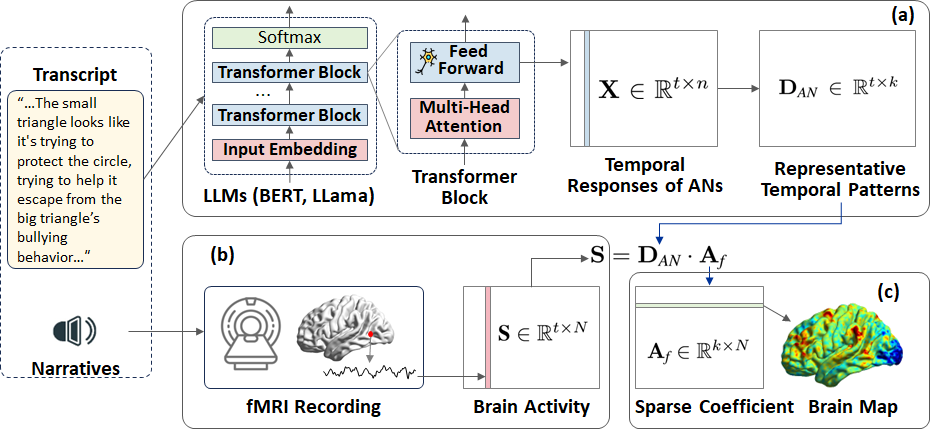
Here’s the basic idea: The team showed the same story to both people and LLMs, then compared how each “responded” over time.
- People: Volunteers listened to an audio story inside an fMRI scanner. fMRI is like a camera that takes pictures of brain activity by measuring blood flow. Each tiny 3D unit the scanner sees is called a voxel (think of it as a 3D pixel).
- LLMs: The same story (as text) was fed into LLMs (BERT, Llama 1, Llama 2, and Llama 3). Inside these models are many “artificial neurons” that light up in different ways as they read the words.
To fairly compare the two:
- Timing: The brain scanner takes snapshots every few seconds, but words come faster. So the researchers averaged the model’s responses across the words that happened during each brain snapshot. They also adjusted for the delay in blood flow (a standard step called the hemodynamic response).
- Too many neurons? Summarize them: LLMs have thousands of artificial neurons, which is a lot to handle. So the researchers used a technique called “dictionary learning.” You can think of this like finding a small playlist of common “rhythms” or patterns that can be mixed to recreate many different songs. Here:
- Each “atom” in the dictionary is one typical time-pattern.
- “Sparse” means the model tries to explain each neuron’s behavior using only a few of these patterns, not all of them at once.
- Linking to the brain: They then asked, “Can these same patterns from the LLMs predict what the brain’s voxels are doing?” They built simple predictive models to see which patterns best matched activity in different brain areas. This produced “brain maps” showing where each pattern fits in the brain.
- Naming the brain networks: A tool matched each brain map to known brain networks (like language, visual, attention, and default mode networks). That way, the team could say which LLM patterns corresponded to which brain networks.
Key details:
- Data: 59 people listening to one story (“Shapes”) from the Narratives fMRI dataset.
- Models: BERT and Llama 1–3.
- Patterns: They summarized LLM neuron activity into 64 common time-patterns.
4. What did they find?
Here are the main takeaways:
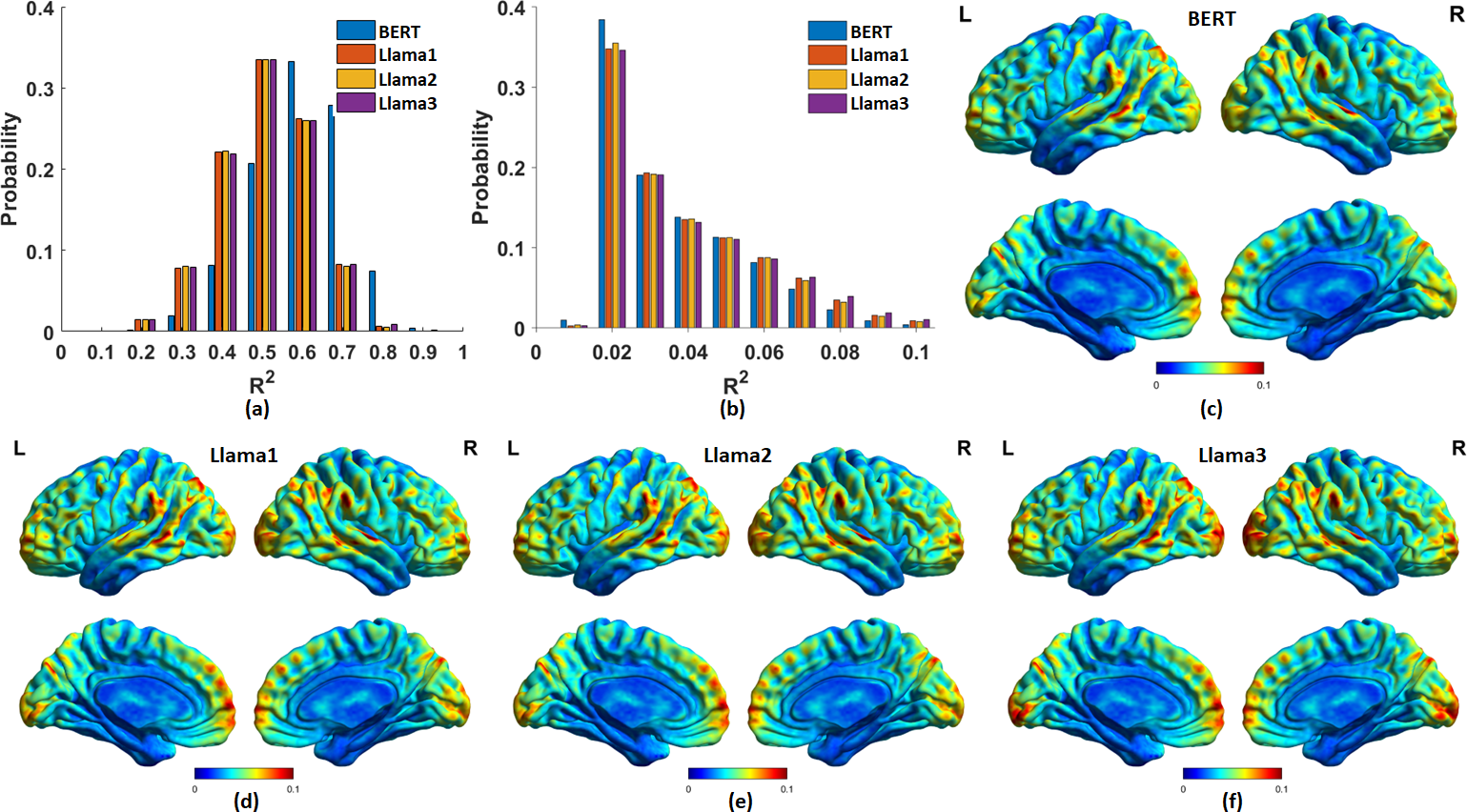
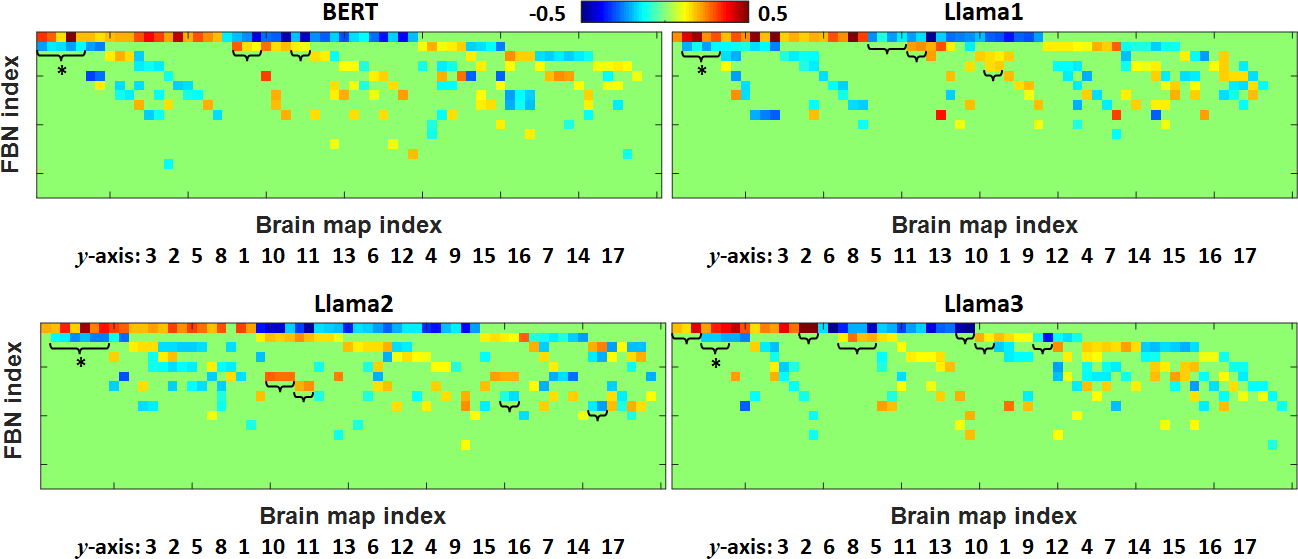
- The LLM patterns predicted brain activity well. Overall, the Llama models matched brain data better than BERT, which makes sense since Llama models are stronger LLMs.
- The brain areas that matched best included:
- Auditory cortex (hearing the story),
- Language areas,
- Visual areas,
- Attention networks,
- Frontoparietal and salience networks (help with control and importance),
- The default mode network (DMN), which helps connect new information to what you already know and think about big-picture meaning.
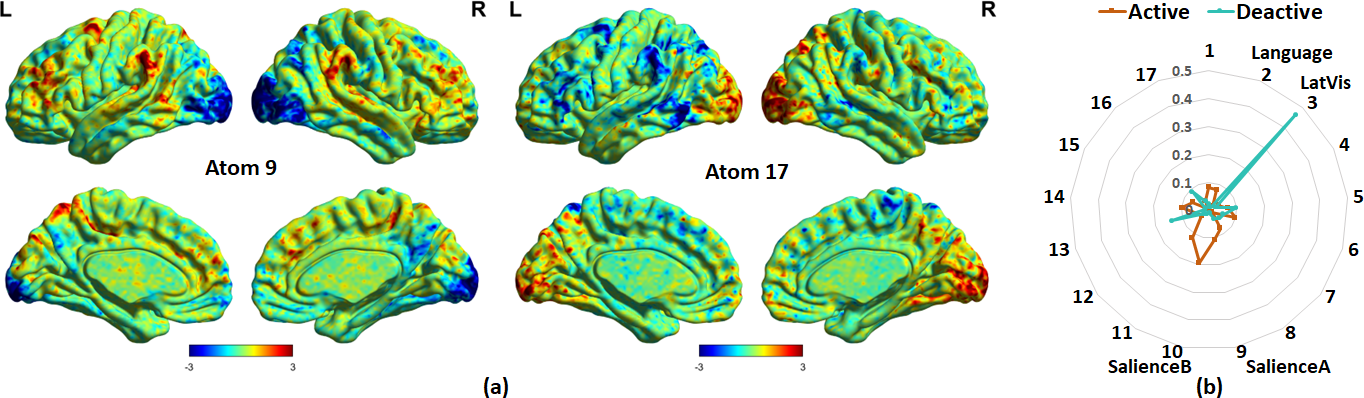
- Brain networks worked together and sometimes in opposition. Many brain maps showed multiple networks being active at once, or some turning up while others turned down. For example, sometimes visual areas increased while language areas decreased, or vice versa. This shows the brain—and the LLM patterns—coordinate across different teams, not just one at a time.
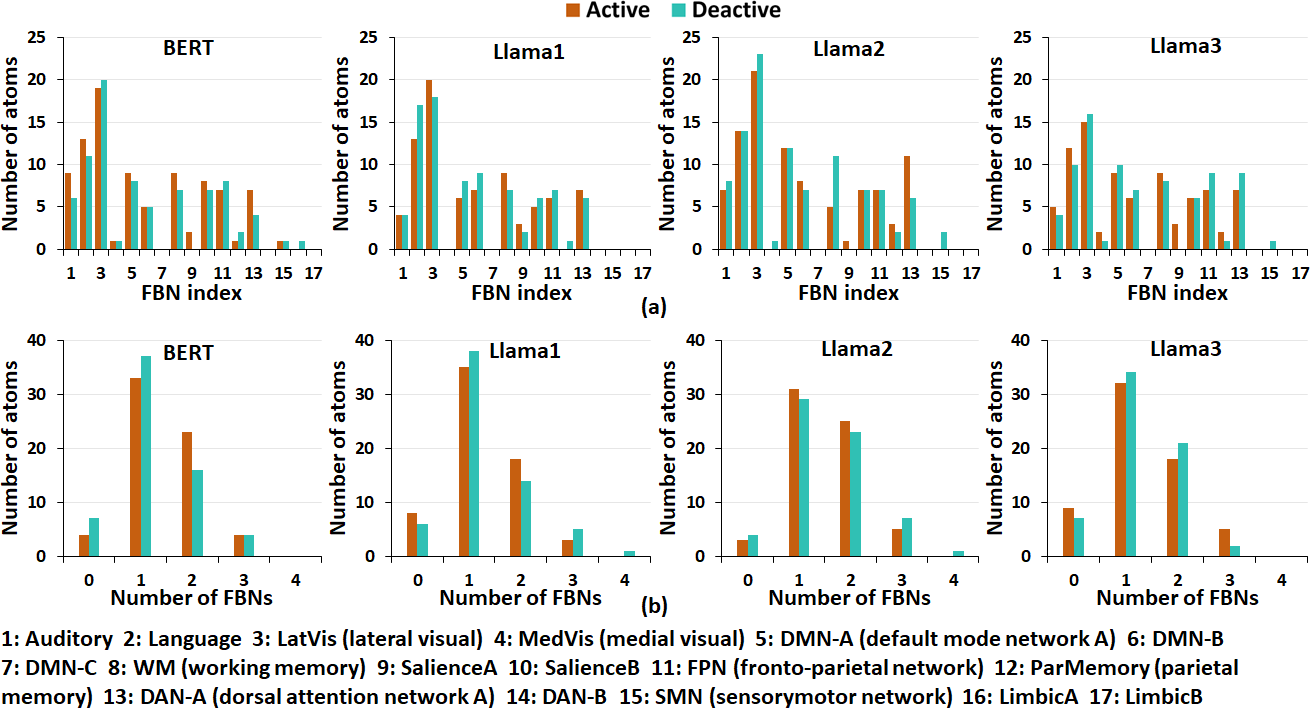
- As LLMs got more advanced, their organization looked more “brain-like.”
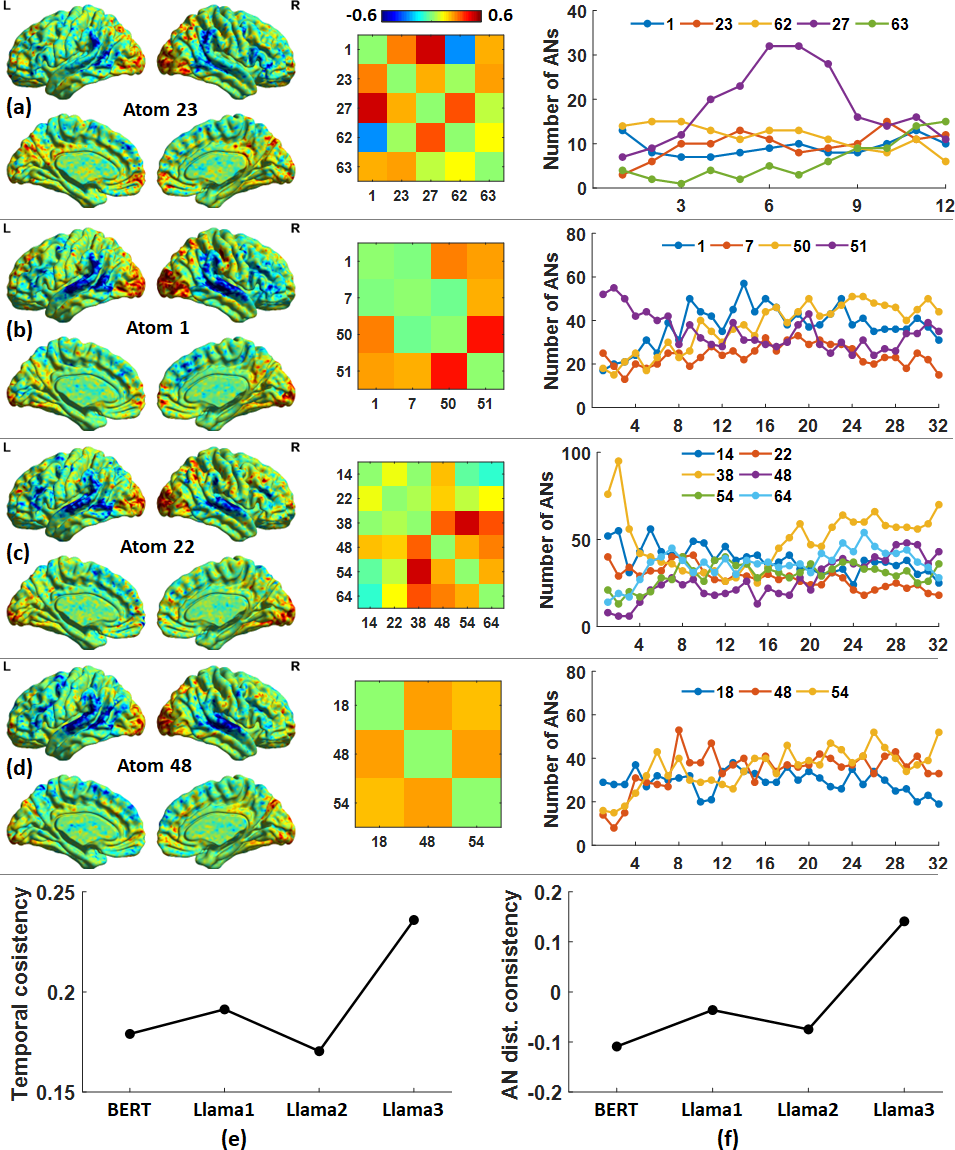
- In Llama 3, multiple patterns that were labeled with the same brain networks had more similar time-behavior, suggesting a cleaner, more consistent organization.
- Groups of artificial neurons tied to the same pattern were organized more consistently across the model’s layers and tended to appear more in deeper layers. This hints that deeper parts of the model may handle higher-level, more abstract processing—similar to how deeper brain regions handle more complex meaning.
- Overall, Llama 3 seemed to strike a better balance: it kept useful diversity (different patterns for different needs) while also showing consistent specialization (reliable patterns for particular functions).
Why this matters scientifically:
- It supports the idea that strong AI models may develop internal structures that resemble how the brain organizes functions.
- It highlights the role of both specialized (language, auditory) and general-purpose (attention, control, DMN) brain networks during story understanding—something prior neuroscience has also shown.
5. Why does this matter? (Implications and impact)
- For AI: This work suggests we can design and interpret AI using ideas from the brain. If better-performing LLMs show clearer brain-like organization, then aiming for brain-inspired structures could help us build smarter, more understandable AI.
- For understanding models: Linking LLM neuron groups to specific brain networks makes these models less “black-box.” It gives clues about which parts do what, and how different parts work together.
- For neuroscience: If LLMs mirror brain network patterns during language, they could be used as tools to explore human cognition—especially how multiple brain networks cooperate and compete during complex tasks like story understanding.
- Looking ahead: The authors note some limits—they only used one story session, and they fixed the number of patterns (64) for all models. Testing more data and tuning the number of patterns per model could reveal even clearer connections. Applying this approach to vision or audio models could show whether brain-like organization is a general property of today’s advanced AI.
In short: As LLMs get smarter, their inner workings seem to organize more like the human brain—specialized yet coordinated—offering a path toward AI that learns and thinks in more human-like ways.
Collections
Sign up for free to add this paper to one or more collections.