- The paper introduces quantum birthmarks as persistent imprints from early-time dynamics that break classical ergodicity.
- It employs statistical analysis of wavepacket recurrences and simulations in stadium billiards to quantify deviations from uniform phase space exploration.
- The results challenge conventional quantum thermalization theories and suggest novel experimental avenues in nanoscale systems.
Quantum Birthmarks: Ergodicity Breaking Beyond Scarring
Introduction to Quantum Birthmarks
The concept of quantum birthmarks introduces a novel perspective on ergodicity in quantum systems, particularly emphasizing how initial states leave enduring imprints that affect the long-time behavior of quantum systems. This contrasts sharply with classical ergodicity, where systems lose all memory of initial conditions. The notion of quantum birthmarks identifies a permanent, non-ergodic signature left by the initial state and its early-time evolution, advocating a breakdown of the classical idea of ergodicity persisting in the long-time limit of quantum dynamics.
The framework revolves around two essential components: the universal quantum birthmark (UQB) factor and the revival-enhanced quantum birthmark (RQB) factor. The UQB reflects a minimal amplification carried by the evolution based on global symmetries, while the RQB incorporates further enhancements stemming from early dynamics, notably recurrences occurring before the Heisenberg time.
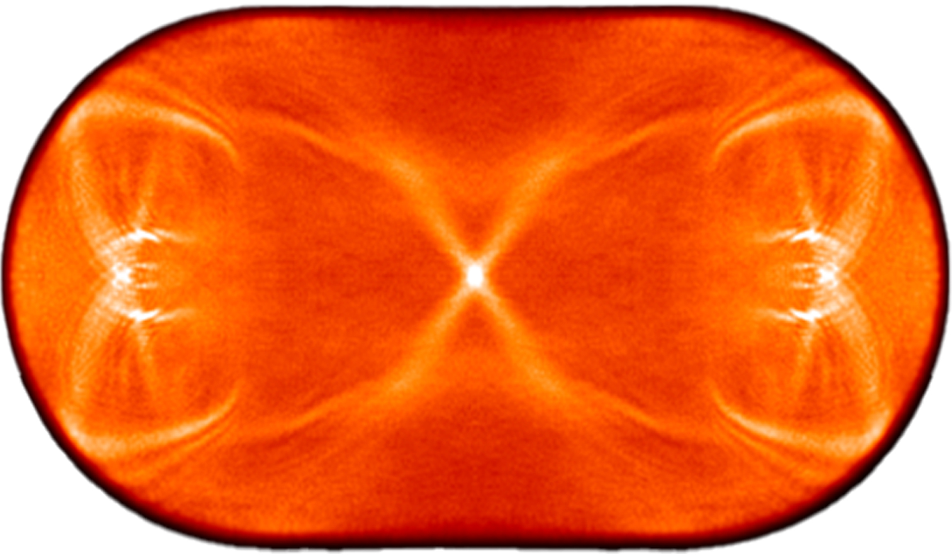
Figure 1: Quantum birthmark: Figure displays the long-time average of the probability density for a Gaussian wavepacket initialized along a "bowtie" quantum scar at the center of a stadium billiard.
Quantum Ergodicity and Birthmarks
Considering quantum ergodicity, initially localized wavepackets in systems like the stadium billiards exhibit persistent non-ergodic behavior characterized by quantum birthmarks. This behavior starkly contrasts classical expectations based on ergodic uniformity where phase space becomes uniformly covered.
The emergent quantum birthmark is evaluated using statistical measures over nonstationary states composed of pure eigenstates. Remarkably, the universal enhancement universally violates classical ergodic predictions, as illustrated by the increased probability of the system returning to its initial state compared to exploring a dynamically distinguishable state.
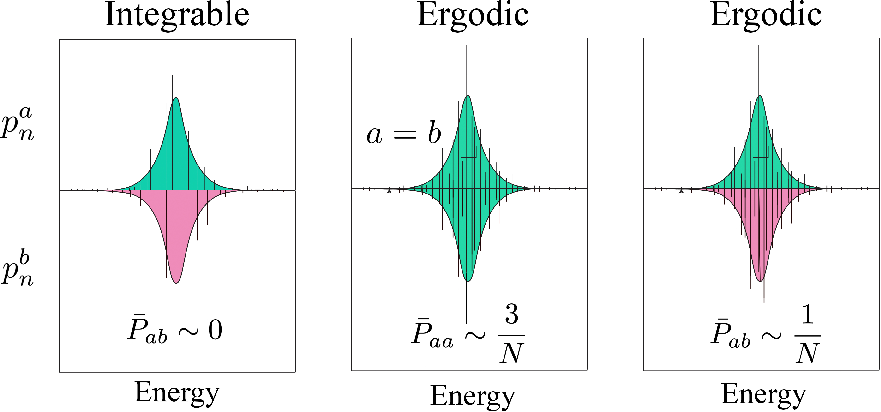
Figure 2: Spectral decomposition and overlap. In the chaotic system, spectral intensities fluctuate according to a χ2 distribution, leading to a systematic enhancement above classical ergodic expectations.
Analysis in Coordinate and Phase Space
The study undertakes simulations in a soft Bunimovich stadium to visualize quantum birthmarks and their impact on long-term averaged densities. Variations in early-time dynamics, such as focusing events and periodic orbit alignments, imprint permanent birthmarks onto these densities, preventing classical ergodic coverage.
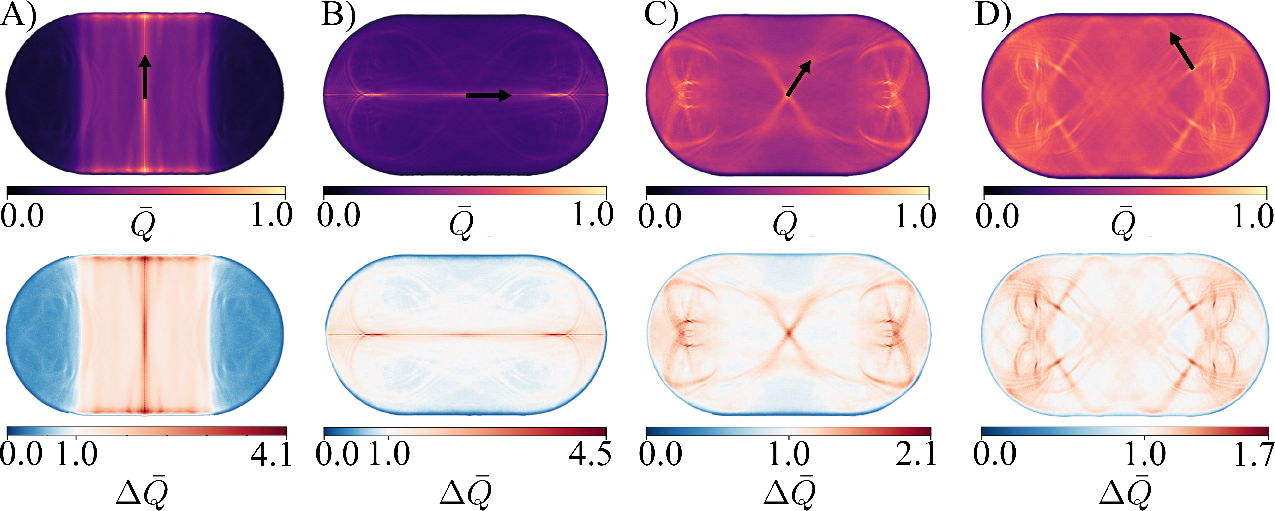
Figure 3: Birthmarks in a soft Bunimovich stadium. Normalized long-time averaged densities reveal enhancements linked to early dynamics and initial state alignment.
From a phase space perspective, quantum wavepackets exploring classically chaotic systems exhibit restricted access due to persistent birthmarks. Quantum ergodicity, constrained by the interplay of universal and revival-enhanced factors, falls short of exhaustive exploration, unveiling the maximum rate principle where recurrences impede uniform phase space exploration.
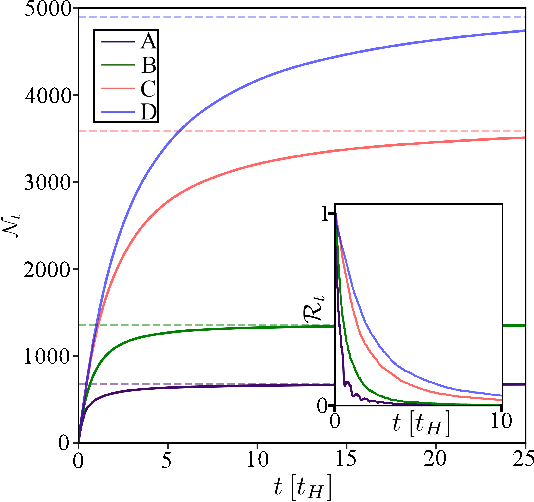
Figure 4: Phase space exploration. The time evolution of explored phase space reflects bounded exploration consistent with quantum birthmark enhancement.
Implications and Future Research Directions
Quantum birthmarks redefine foundational assumptions of quantum ergodicity and thermalization, shifting focus from stationary eigenstates to time-domain dynamics. This paradigm aligns quantum behavior closer to classical considerations while accommodating quantum-specific phenomena like interference and scarring.
Potential applications span nanoscale devices, understanding quantum thermalization processes, and robust experimental setups, warranting exploration beyond this theoretical work. Future research should address connections with quantum localization mechanisms, investigate impacts of additional symmetries, and explore birthmarks within more complex mixed phase space systems.
Conclusion
Quantum birthmarks fundamentally alter our understanding of quantum ergodicity, highlighting the persistence of memory effects and challenging classical assumptions. This study provides quantitative metrics and simulations affirming the profound impact of initial conditions on long-time dynamics, offering fertile ground for experimental validation and theoretical expansion across quantum physics domains.