- The paper introduces a generalized diffusion framework that replaces Gaussian assumptions with non-normal distributions such as Laplace and Uniform.
- The study details customized loss functions and convergence proofs, enabling flexible adaptation to various data structures.
- Experimental results on CIFAR10 and ImageNet show improved visual quality metrics, highlighting practical benefits in generative tasks.
Non-Normal Diffusion Models
Introduction
The paper "Non-Normal Diffusion Models" (2412.07935) investigates diffusion models by proposing an expanded framework which lifts the typical Gaussian assumption on the diffusion step distribution Δxk. The authors argue that while conventional approaches assume normality, various physical and biological systems demonstrate non-Gaussian incremental behavior. This study generalizes diffusion models by considering several alternative distributions, enhancing flexibility in generative modeling and density estimation tasks.
Background
Diffusion models have become prominent in generative modeling due to their ability to systematically reverse noise accumulation in data. Standard models typically rely on Gaussian assumptions for diffusion increments, making the reverse-time stochastic differential equations (SDEs) well-behaved. This underlying Gaussian process convention limits adaptability to systems where non-Gaussian noise predominates, thus prompting the exploration of alternatives such as Laplace or Uniform distributions for the diffusion step.
Generalized Framework
By introducing a novel interpretation through non-normal distributions, the paper establishes analytical conditions under which arbitrary distributions for the diffusion increment converge to a Gaussian process as the step size approaches zero. This generality permits a broader choice of loss functions during model training, depending on the structural properties of the data, illustrated by constructing structured random walks able to converge to a desired stochastic process under minimal assumptions.
Non-Normal Diffusion Models
The authors detail several specific models which substitute Gaussian increments with other distributions:
- Laplace Diffusion: Implements a Laplace distribution for diffusion steps. The model adapts the loss function to an L1-norm-based approach, fostering robustness in environments prone to outlier influences, potentially improving visual characteristics in generated content.
- Uniform Diffusion: Tests both pure and mixed uniform increments, revealing variations in density estimation efficacy and stylistic variances in sample generation. Notably, a uniform approach paired with Gaussian estimation introduces additional penalties for distributional mismatches during training.
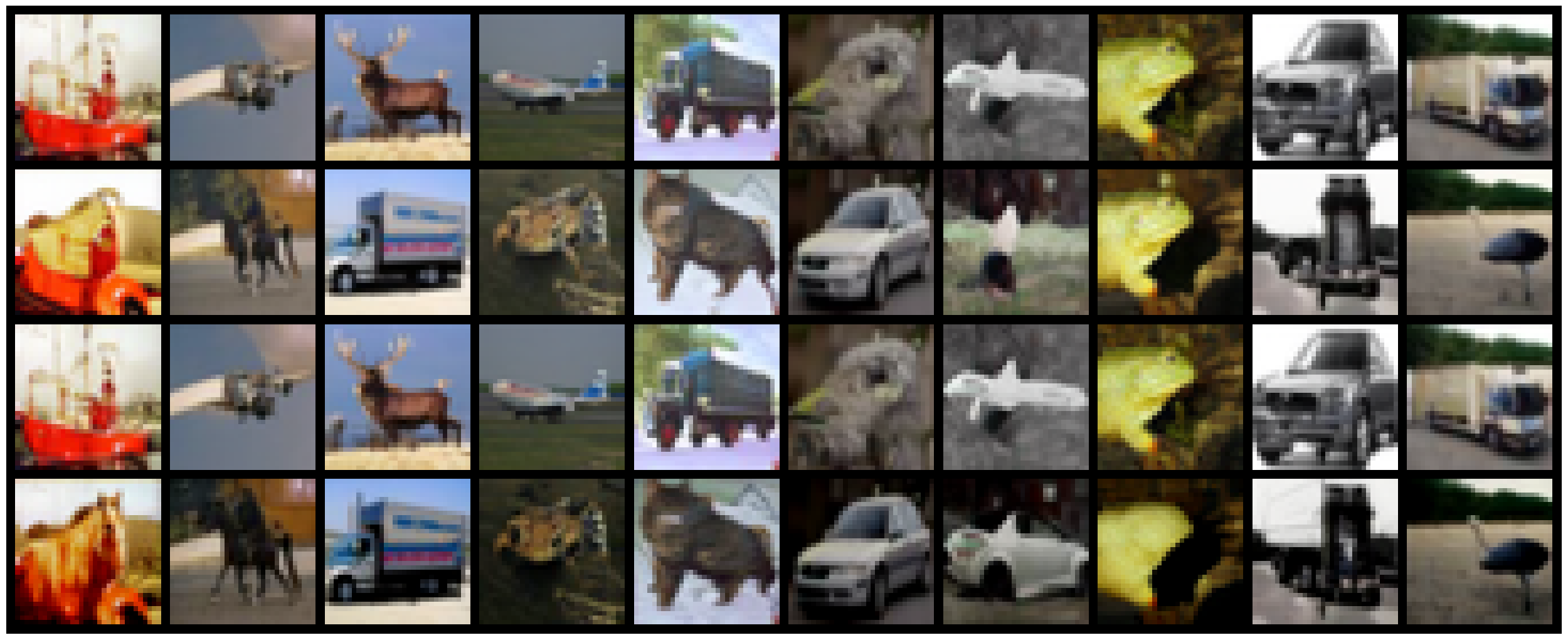
Figure 1: Images generated from the same seed via (in order from top to bottom) Gaussian-Gaussian, Laplace-Laplace, Uniform-Gaussian, and Uniform-Laplace diffusion increments. While the qualitative difference is somewhat subtle, Laplace diffusion appears to be biased towards smoother images with more saturated colors.
Convergence Analysis
The paper solidifies the convergence of structured random walks with non-Gaussian increments to diffusion processes, supported by detailed proofs of invariance principle application. The structured random walk setup ensures that model design variants remain grounded in theoretical consistency, paving the way for customizable dynamic models capable of adapting to unique data distributions.
Experimental Results
Experimentation using CIFAR10 and down-sampled ImageNet datasets reveals competitive performance from alternative diffusion models, assessed through negative log-likelihood and Frechet Inception Distance (FID). Laplace variants demonstrate particular stylistic enhancements, suggesting practical implications for visual data rendering and quality control in synthetic images.
Conclusion
This exploration into non-normal diffusion models significantly broadens the generative modeling landscape by removing reliance on Gaussian assumptions, enabling more versatile applications in contexts where non-standard noise distributions predominate. The choice of diffusion step distribution becomes a design parameter, allowing customization based on specific generative goals. Future lines of inquiry regarding the statistical properties of non-normal score matching objectives remain open, inviting further advancement in the methodology of diffusion modeling.
Overall, this research presents a valuable extension to current generative model frameworks, with implications that could influence both theoretical shaping and practical deployment in AI systems designed for nuanced environments.

