Published 12 Dec 2024 in cs.ET, cond-mat.dis-nn, cond-mat.mtrl-sci, cs.AI, physics.app-ph, and quant-ph | (2412.13212v1)
Abstract: There is a growing interest in the development of artificial neural networks that are implemented in a physical system. A major challenge in this context is that these networks are difficult to train since training here would require a change of physical parameters rather than simply of coefficients in a computer program. For this reason, reservoir computing, where one employs high-dimensional recurrent networks and trains only the final layer, is widely used in this context. In this chapter, I introduce the basic concepts of reservoir computing. Moreover, I present some important physical implementations coming from electronics, photonics, spintronics, mechanics, and biology. Finally, I provide a brief discussion of quantum reservoir computing.
The paper introduces the reservoir computing paradigm, highlighting the use of fixed recurrent reservoirs with only the output layer trained.
It demonstrates how high-dimensional projections transform time-series data into linearly separable representations for efficient processing.
Diverse implementations in electronic, photonic, spintronic, mechanical, biological, and quantum systems underscore its potential for energy-efficient neuromorphic hardware.
Overview of Reservoir Computing
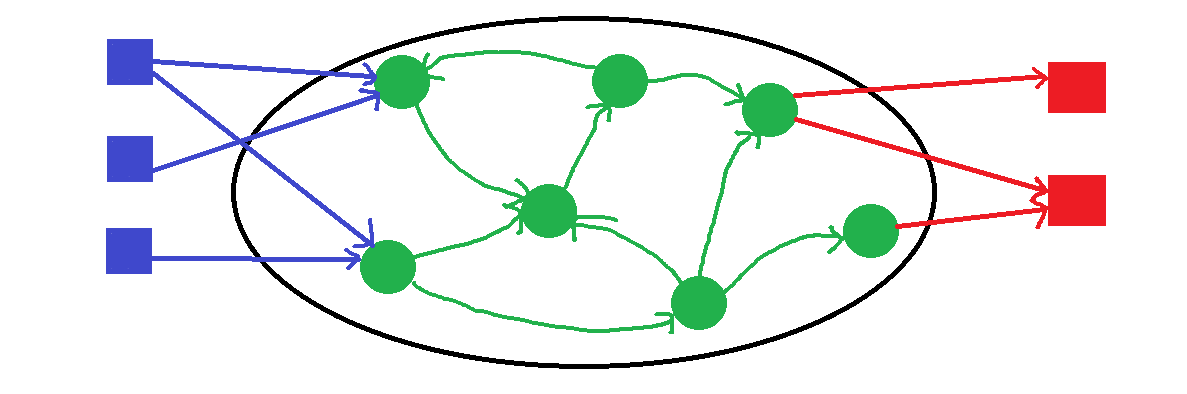
Reservoir computing (RC) leverages high-dimensional, recurrent dynamical systems as computational substrates, where only the final readout layer is trained while the internal dynamics of the reservoir remain fixed. This paradigm addresses the limitations of training physical neural network implementations, where adjusting internal parameters is often impractical or infeasible, offering a pathway to efficient AI deployments in unconventional substrates such as optical, magnetic, mechanical, biological, and quantum systems (2412.13212).
Figure 1: Basic RC framework—input signals (blue) drive a recurrent reservoir (green), followed by a trained output readout layer (red).
Fundamental Principles and Dynamics
RC operates on time-dependent, multidimensional input signals utrain(t), driving a nonlinear dynamical system (the reservoir) whose accessible states x(t) are mapped to outputs y(t) by the trained readout function F. Notably, only F is optimized, typically via linear regression. The reservoir's temporal dynamics encodes history, allowing efficient processing of sequential and time-series data. The inherent recurrent feedback yields memory, enabling RC to capture long-term dependencies without external memory modules.
RC distinguishes itself from extreme learning machines (ELMs) that employ feedforward architectures lacking temporal memory. Unlike conventional RNNs, which demand arduous, often unstable training protocols (e.g., gradient descent prone to bifurcation and vanishing gradients), RC circumvents these pitfalls by leaving the recurrent weights static and randomly initialized, providing robust, rapid convergence in training.
Mechanisms for High-Dimensional Separation
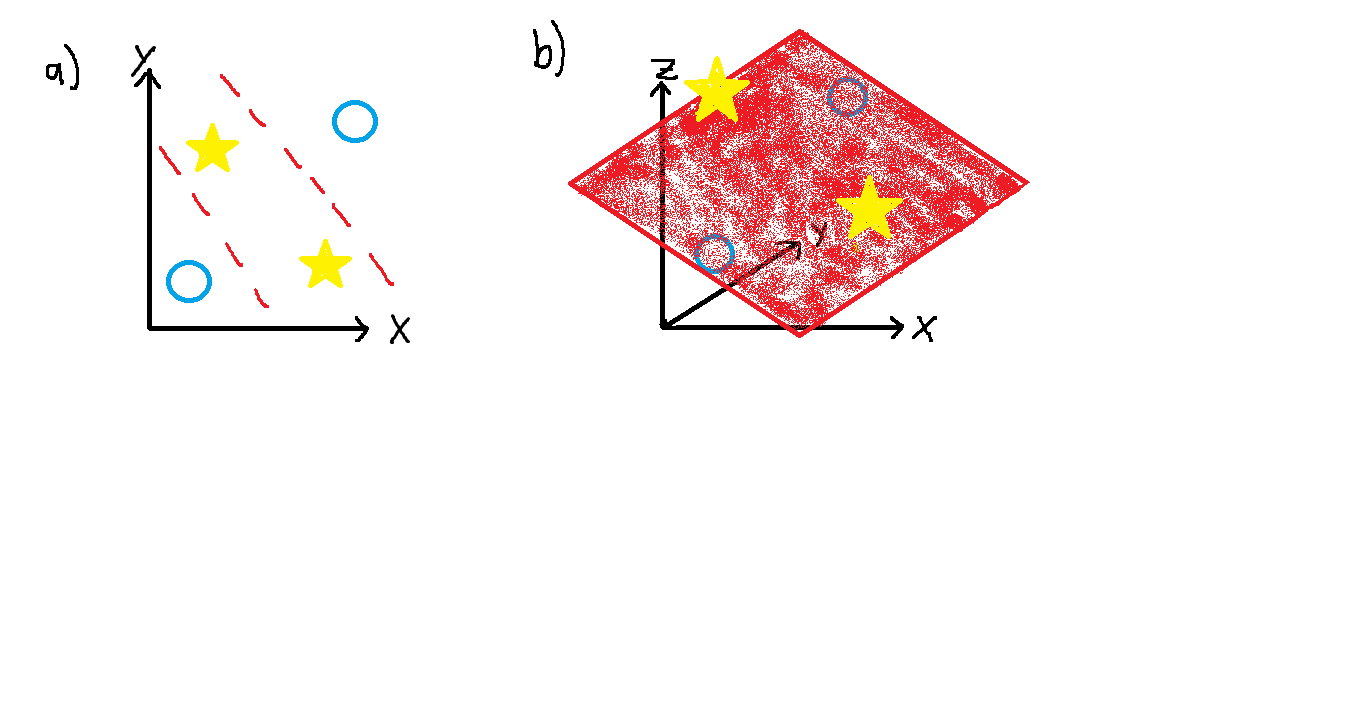
A critical insight is the role of high-dimensionality in facilitating linear separability. Input signals, initially inseparable via linear decision boundaries in low-dimensional feature spaces, undergo nonlinear projection into a high-dimensional reservoir, dramatically enhancing separability and classification accuracy. The final readout layer can resolve previously intractable distinctions.
Figure 2: High-dimensional projections transform inseparable data into linearly separable domains, simplifying output classification via a single layer.
Criteria for Reservoir Selection
Effective reservoir design necessitates several properties:
Reproducibility: Similar inputs must yield similar outputs, ensuring generalization.
Separability: Distinct inputs must produce distinguishable outputs, enabling robust classification.
Fading Memory: The system must retain temporal context but prioritize recent inputs, formalized in the echo state property—the diminishing influence of initial conditions.
Temporal Dynamics Near Instability: Operating near chaotic or critical thresholds increases computational richness, though this is context-dependent and not universally advantageous.
Systems meeting these criteria span diverse physical domains, from fluids and electronics to spintronics and biological networks. The echo state property and fading memory timescales must be aligned with domain-specific requirements for optimal performance.
Physical Implementations
Electronic RC
Memristor networks exemplify electronic RC substrates, leveraging devices with tunable resistance and inherent memory for nonlinear signal transformation. Memristor-based RC achieves neuromorphic functionality, capturing biological neuron plasticity.
Photonic RC
Photonic RC uses light as the information carrier, achieving high-speed and low-power computation. On-chip photonic RC enables large-scale integration, particularly via delay systems governed by delay differential equations, generating infinite-dimensional phase spaces from minimal physical architectures.
Spintronic RC
Spintronic RC manipulates electron spin for information processing. Magnetic skyrmion-based Brownian RC exploits stochastic dynamics for ultra-low-power computing, resembling neurotransmitter-driven information transfer. Experimental demonstrations of skyrmion RC validate its practical energy efficiency and potential for neuromorphic hardware.
Mechanical RC
Soft robotics and compliant mechanical networks serve as computational reservoirs, where complex, noisy body dynamics are harnessed for processing time series. Nonlinear mass-spring-damper arrangements and bio-inspired robotic limbs (e.g., octopus arms) provide natural substrates for RC, turning physical noise into computational assets.
Biological and Chemical RC
Biological RC draws inspiration directly from neural circuits—e.g., cerebellum modeled as liquid state machines; experiments reveal mammalian brains utilize RC principles. Bacterial (e.g., E. coli) and DNA-based RC showcase chemical implementations, leveraging intrinsic molecular dynamics for computation.
Quantum Reservoir Computing
Quantum RC employs quantum-mechanical reservoirs, using exponentially large Hilbert spaces for input encoding and temporal multiplexing. Qubits serve as computational nodes, with observables extracted as output signals. This approach exponentially scales the reservoir's dimensionality, offering considerable computational power with polynomially accessible outputs (via true and virtual nodes).
Decoherence and dissipation—traditionally detrimental in quantum computing—are harnessed to enhance or modulate reservoir dynamics, with measurement-induced state changes and dissipative effects used for RC tasks.
RC and Intelligent Matter
RC represents a foundational step toward intelligent matter, where physical substrates undertake machine learning tasks autonomously. However, several limitations remain:
The readout layer still requires manual training, preventing full autonomous intelligence.
Evolutionary dynamics may eventually yield RC systems with adaptive capabilities, integrating RC principles with self-modifying substrates. However, the requirement for high-dimensional reservoirs imposes energetic and complexity costs, potentially offsetting evolutionary advantages.
Implications and Future Directions
RC provides a scalable, efficient method for deploying AI in physical, analog, and quantum domains where conventional training is impractical. The approach promises advances in neuromorphic computing, energy-efficient AI hardware, and robust temporal processing for real-world sequences. Progress in quantum RC points toward leveraging quantum advantage for machine learning tasks, although challenges in scalability and decoherence persist.
Future research will likely focus on automated adaptation, integration with evolutionary mechanisms, and the realization of long-term memory architectures within physical RC substrates. The development of RC-based intelligent matter, capable of autonomous learning and memory retention, remains a significant theoretical and practical goal.
Conclusion
Reservoir computing stands as a versatile and efficient paradigm for leveraging high-dimensional dynamical systems in AI, with minimal training overhead and wide applicability across diverse physical and quantum substrates. Its capacity for temporal processing and integration with unconventional materials positions RC as a critical technology for the advancement of neuromorphic hardware and intelligent matter, as well as a promising candidate for future developments in quantum and evolutionary machine learning systems.