- The paper presents a novel ensemble deep learning model, GeoCME, to predict geoeffective CMEs using SOHO images.
- It leverages transfer learning with ResNet152 and InceptionResNetV2, achieving high MCC, TSS, and an 8.7% false positive rate.
- The study underscores GeoCME's operational potential for advancing space weather forecasting and protecting infrastructure.
Prediction of Geoeffective CMEs Using SOHO Images and Deep Learning
Introduction
The paper examines the prediction of geoeffective coronal mass ejections (CMEs) using solar images and a deep learning framework known as GeoCME. This model addresses the challenge of determining whether a CME, upon arrival at Earth, will cause a geomagnetic storm characterized by a Dst index less than -50 nT. The GeoCME framework is built on observations from the Solar and Heliospheric Observatory (SOHO) instruments, including LASCO C2, EIT, and MDI, utilizing ensemble and transfer learning methodologies to enhance prediction capabilities.
Data Collection
The study focuses on halo and partial halo CMEs from Solar Cycle 23. Key data sources include 136 CME events selected from the SOHO/LASCO CME catalog and supported by Dst index values from the RC list maintained by Richardson and Cane. This data selection is crucial for understanding the distribution and intensity of geomagnetic storms resulting from CME events.
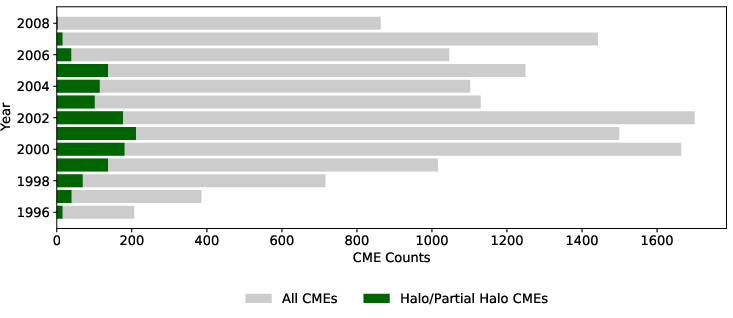
Figure 1: Chart showing the total counts of halo/partial halo CMEs among all CMEs during Solar Cycle 23 (1996-2008) according to the SOHO/LASCO CME catalog.
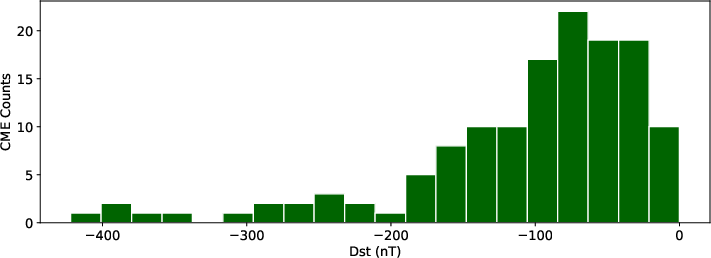
Figure 2: Distribution of the Dst index values caused by the 136 halo/partial halo CME events in our dataset.
Methodology
Transfer Learning
The paper leverages transfer learning due to the limited dataset size, adapting pre-trained models such as ResNet152 and InceptionResNetV2 for geoeffective CME prediction. These models, originally trained on ImageNet, are repurposed to identify relevant solar features in CME images. Key elements include residual blocks in ResNet which facilitate gradient flow, enhancing network depth capabilities.
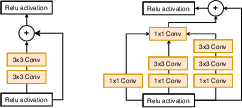
Figure 3: Illustration of a residual block (left) and an InceptionResNet module (right), demonstrating improved training efficiency and feature capturing at multiple scales.
Ensemble Model
GeoCME integrates ResNet152 and InceptionResNetV2 to extract features from SOHO images. The ensemble approach improves overall model performance by combining output through concatenation layers, convolutional blocks, and ensemble layers. This architecture design allows for precise feature extraction and decision making based on multi-source data from LASCO C2, EIT, and MDI.
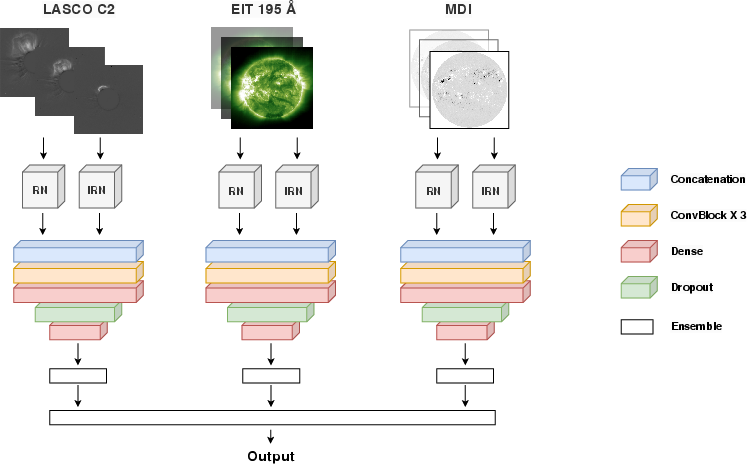
Figure 4: Illustration of the GeoCME architecture showcasing the ensemble of pipelines dedicated to each SOHO instrument, culminating in an aggregated prediction output.
Results
GeoCME is tested with deterministic and probabilistic prediction models. For deterministic predictions, GeoCME achieved high MCC and TSS metrics, reinforcing the model's efficacy. The model demonstrated an acceptance that approximately 82% of CME events are geoeffective, with an 8.7% false positive rate, suggesting a sensitive model that does not miss geomagnetic storms.
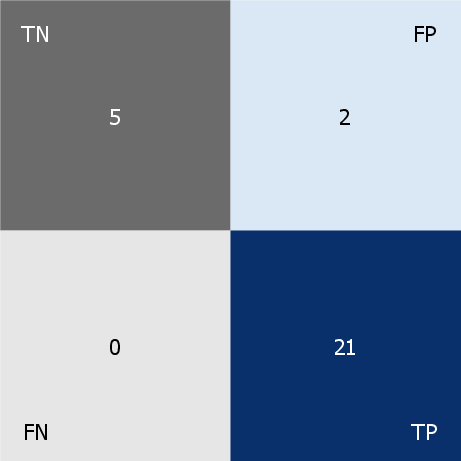
Figure 5: The confusion matrix obtained by GeoCME used as a deterministic prediction model on the test set.
In probabilistic forecasting, metrics such as the Brier score and Brier skill score validate GeoCME, proving the model's relative advantage in capturing complex solar-terrestrial interactions.
Discussion and Conclusion
The paper concludes that the GeoCME framework successfully bridges machine learning techniques and solar imagery to predict geoeffective CMEs, offering both deterministic and probabilistic forecasting based on sophisticated model architectures. It highlights the importance of using ensemble learning and transfer learning to optimize predictions.
GeoCME's potential for operational usage is noted as significant due to its ability to use direct observations for prediction, avoiding complicated parameter calculations. Its real-world application could improve space weather forecasting, thereby safeguarding technological infrastructure against geomagnetic storm impacts. Future enhancements may expand dataset sizes or integrate additional data sources to further refine prediction accuracy and model robustness.