What is Positive Geometry?
Abstract: This article serves as an introduction to the special volume on Positive Geometry in the journal Le Matematiche. We attempt to answer the question in the title by describing the origins and objects of positive geometry at this early stage of its development. We discuss the problems addressed in the volume and report on the progress. We also list some open challenges.
Summary
- The paper introduces a formal framework for positive geometries, defining them as tuples involving complex algebraic varieties, semi-algebraic subsets, and canonical forms.
- It details key examples like amplituhedra and cosmological polytopes, illustrating their use in encoding scattering amplitudes and correlators through combinatorial and geometric methods.
- The study outlines open problems and future directions, highlighting challenges in fully characterizing positive geometries and their implications in particle physics and cosmology.
Positive Geometry: Concepts, Objects, and Open Problems
Introduction and Foundational Framework
Positive geometry is an interdisciplinary research area crystallized through efforts at the intersection of mathematics and fundamental physics. The field emerged in response to insights from particle physics and cosmology, recognizing that physical observables such as scattering amplitudes and cosmological correlators can be encoded as periods of canonical differential forms associated with semi-algebraic regions of complex algebraic varieties. Notable geometric incarnations arising in this context include the amplituhedron and cosmological polytope, which respectively capture scattering amplitudes and cosmological correlators via canonical forms [arkani2014amplituhedron, arkani2017cosmological].
A positive geometry is formally a tuple (X,X≥0,Ω(X≥0)), where X is a complex algebraic variety, X≥0 is a semi-algebraic subset of the real points of X, and Ω(X≥0) is a recursively defined canonical (meromorphic) top-form. The structure of positive geometries is tightly linked to recursive decompositions, and their study necessitates machinery from algebraic geometry, combinatorics, tropical geometry, analysis, and numerical methods.
The concept is broader than its name suggests, as it involves not only real positivity but also complex and tropical frameworks. For instance, the positive Grassmannian GrR(k,n)≥0 sits naturally alongside the complex Grassmannian and its tropicalization, with each viewpoint contributing distinct combinatorial or analytic structure. This trichotomy is exemplified in the study of moduli spaces and their applications to quantum field theory, statistical models, and optimization.
Prototypical Examples: Polytopes, Amplituhedra, and Canonical Forms
Consider a convex polytope P in Rn. The canonical form Ω(P), as introduced in [arkani2017positive], is a meromorphic form on Pn whose poles align with the facet hyperplanes of P and whose zeros lie on the adjoint hypersurface. For cosmological polytopes, period integrals of this form produce cosmological correlators, with analytic and combinatorial properties governed by holonomic D-modules.
In the context of particle physics, one replaces the ambient space with the complex Grassmannian and studies the amplituhedron A, a semi-algebraic subset of GrC(k,n). The canonical form on A yields scattering amplitudes in planar N=4 super Yang–Mills theory. The combinatorial aspects in both cases manifest through intricate connections to polytopal triangulations and arrangements of (Schubert) divisors.
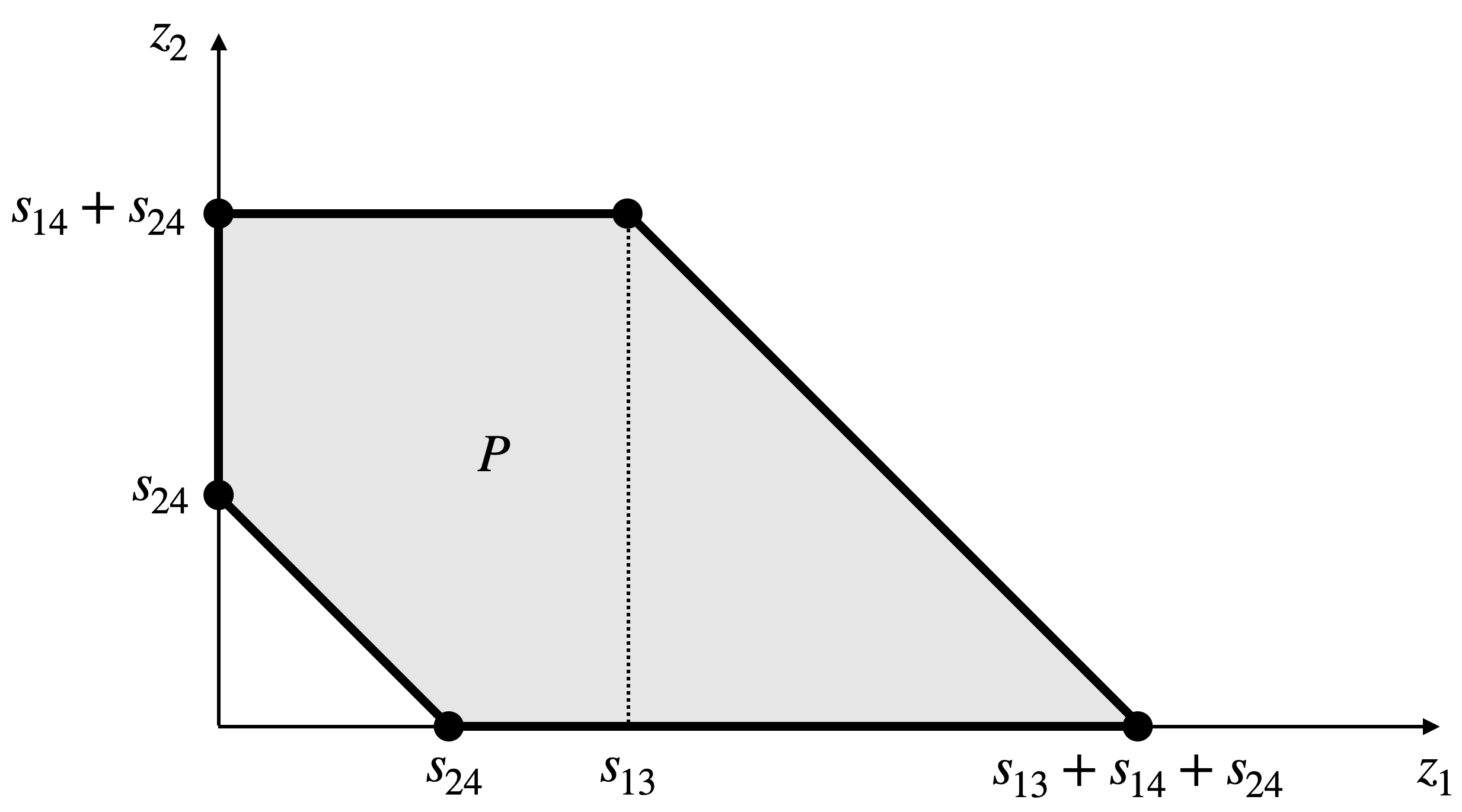
Figure 1: The amplitude A5 is the dual volume of an associahedron, elucidating the geometric encoding of bi-adjoint ϕ3 scattering amplitudes in terms of polytopal geometry.
This duality between physical amplitudes and polytopal or Grassmannian geometry is further formalized via canonical forms constructed through mixed Hodge theory [brown2025positive]. Specifically, mixed Hodge modules provide a functorial mechanism for associating logarithmic differential forms with relative homology classes, thus grounding the physically motivated canonical forms in rigorous algebro-geometric foundations.
Combinatorial Structures: Scattering Equations and Tropical Geometry
The Cachazo–He–Yuan (CHY) formalism computes scattering amplitudes as sums over critical points of logarithmic potentials on moduli spaces, with underlying kinematic data encoded as Mandelstam variables. For example, the n=5 bi-adjoint ϕ3 amplitude A5 can be represented as a rational function whose terms correspond to triangulations of the pentagon, or equivalently to maximal cones in the positive tropical Grassmannian Trop+Gr(2,5). The scattering equations capture the critical points determining the sum, linking analysis, combinatorics, and algebraic geometry.
Expanding further, binary geometries arising from pellytopes and their tropicalizations relate to cluster algebras and moduli of trees, relevant both mathematically and physically, as in the context of tree-level amplitudes and CEGM theory [cachazo2019scattering]. The duality between arrangements in real, complex, and tropical settings is visually captured in diagrams (see Figure 2 in the original paper, not reproduced here).
Positive Geometries in Grassmannians and Amplituhedra
A profound development in positive geometry is the study of amplitude polytopes (amplituhedra) as semi-algebraic images of positive Grassmannians under linear projections defined by totally positive matrices. The structure of these subsets in Gr(k,k+m) is intimately linked to the combinatorics of cyclic polytopes and their boundary arrangements.
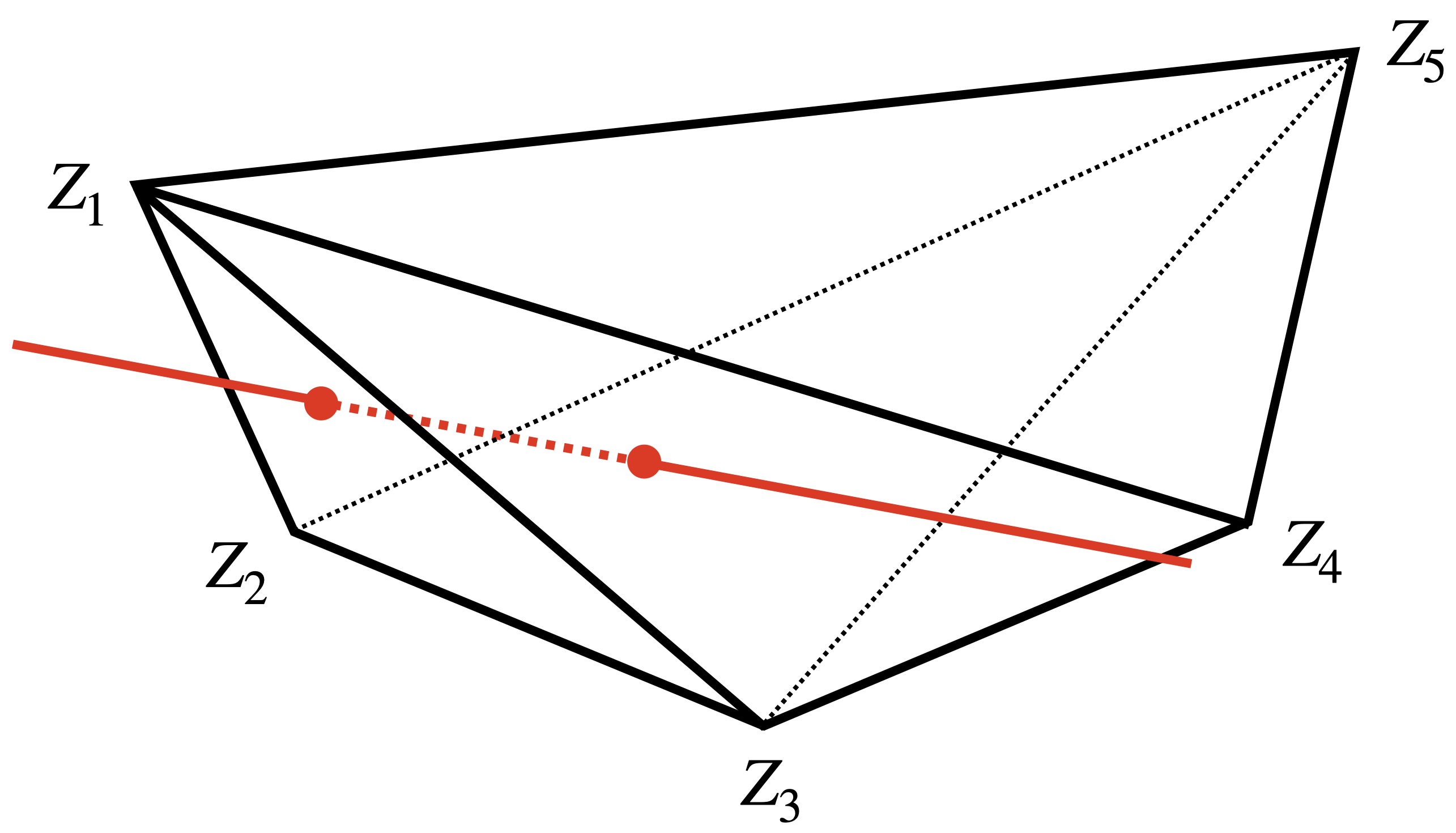
Figure 3: A cyclic polytope in RP3 with a stabbing line; illustrating the connection between combinatorial, real, and semi-algebraic structure and its role in defining positive geometries within Grassmannians.
Explicit equations for the amplituhedron and its adjoint hypersurface, presented in the paper for various cases, demonstrate the algebraic complexity of boundary stratifications and the canonical forms' numerator structures [Ranestad_Sinn_Telen_2024]. The exact characterization of amplituhedra as positive geometries remains only partially resolved and is an area of intense current research.
Beyond the classical Grassmannian, other subvarieties such as orthogonal Grassmannians and ABCT varieties arise in related physical theories, leading to further generalizations. The cell decomposition, sign flip alternations, and stabbing set interpretations provide a rich combinatorial apparatus for the investigation of these canonical regions.
Periods, Differential Systems, and Canonical Integrals
Most physical observables captured by positive geometry are period integrals of canonical forms over suitable cycles. The analytic representation of these objects is governed by holonomic D-modules (e.g., GKZ systems), with toric and Euler differential operators encoding the functional relations among amplitudes and correlators. In many cases, the boundary arrangement or constraints on the coefficients induce subtle reductions in system dimensionality and complexity [Fevola, Pfister].
The specific instance of the CHY amplitude is both expressible as a sum over critical points and as a limit of a string amplitude involving the Koba–Nielsen potential. The equivalence between these formulations is a manifestation of the rich analytic–combinatorial duality at the heart of positive geometry.
Iterated integrals, signatures of piecewise-linear paths on cyclic polytopes [Lotter], and exponential integrals for graphical enumeration [Borinsky] represent further extensions of the analytic toolkit, with implications in number theory, algebraic geometry, and quantum field theory.
Open Problems and Future Directions
The field is replete with deep and unresolved questions. Current challenges include characterizing the image of the positive Grassmannian under various embeddings, determining the full combinatorial and algebraic structure of scattering equations, resolving conjectures regarding the amplituhedron as a positive geometry, extending bivariate exponential integrals to higher graphs, and understanding the structure of logarithmic discriminants in moduli spaces.
These open problems reflect both the youth of the field and the inherent depth in reconciling combinatorial, geometric, analytic, and physical perspectives. Success in these areas will potentially impact not only the mathematical understanding of positive geometry but also its physical applications, notably in quantum field theory and beyond.
Conclusion
Positive geometry is a rapidly developing area at the interface of combinatorics, algebraic geometry, and physics. Its central objects—amplituhedra, cosmological polytopes, and their canonical forms—encode intricate analytic and combinatorial structures directly linked to physical observables. Progress in formalizing the theory, constructing canonical forms via Hodge-theoretic and algebro-geometric methods, and generalizing the analytic framework to iterated and constrained integrals, demonstrates the field’s dynamism. However, foundational questions, especially concerning the complete characterization of general positive geometries and their boundaries, remain open and invite further investigation. The integration of geometric, tropical, analytic, and combinatorial methods will continue to shape the trajectory and scope of positive geometry in both mathematics and physics.
Paper to Video (Beta)
No one has generated a video about this paper yet.
Whiteboard
No one has generated a whiteboard explanation for this paper yet.
Paper Prompts
Sign up for free to create and run prompts on this paper using GPT-5.
Top Community Prompts
Open Problems
- Positivity of tree-level amplituhedra for general parameters
- Positive geometry inside the ABCT variety
- Chirotropical Dressian versus chirotropical Grassmannian
- Scheme structure in weak CHY formulation via reciprocal varieties
- Partial fraction decomposition for flat-space cosmological wavefunctions
- Irreducibility and degree of the logarithmic discriminant of M_{0,n}
- Unique representation of n-point MHV gravity amplitudes
- Ring of volume invariants from iterated integral signatures
- Chow–Lam recovery for Grassmannian subvarieties
- Kinematic variety for spinor brackets and multilinear rank
- Sign-vector determination of k-face Schubert arrangement cells
Continue Learning
- How does the paper formalize the concept of positive geometry within a rigorous algebro-geometric framework?
- What is the significance of canonical forms in linking physical observables to geometric structures like amplituhedra?
- How are combinatorial structures, such as triangulations and scattering equations, utilized in the study of positive geometries?
- What analytical challenges are involved in extending positive geometry methods to complex and tropical settings?
- Find recent papers about scattering amplitudes in positive geometries.
Related Papers
- Scattering Forms and the Positive Geometry of Kinematics, Color and the Worldsheet (2017)
- Nonperturbative Negative Geometries: Amplitudes at Strong Coupling and the Amplituhedron (2021)
- Positive Geometries and Canonical Forms (2017)
- The positive Grassmannian, the amplituhedron, and cluster algebras (2021)
- Scattering Amplitudes and the Positive Grassmannian (2012)
- Positive Geometries for Scattering Amplitudes in Momentum Space (2023)
- Triangulations and Canonical Forms of Amplituhedra: a fiber-based approach beyond polytopes (2020)
- Taking the amplituhedron to the limit (2025)
- Algebraic and Positive Geometry of the Universe: from Particles to Galaxies (2025)
- Positive Genus Pairs from Amplituhedra (2026)
Authors (3)
Collections
Sign up for free to add this paper to one or more collections.
Tweets
Sign up for free to view the 4 tweets with 66 likes about this paper.