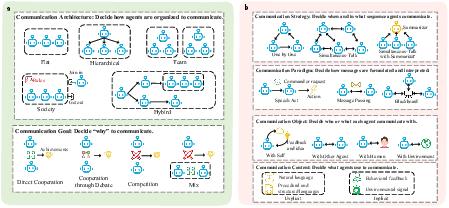
- The paper establishes a framework for dissecting system-level and internal communication, categorizing architectures and strategies in LLM-MAS.
- It details various architectures—from flat to hybrid—and communication paradigms like message passing, speech act, and blackboard models.
- It highlights challenges and opportunities including secure communication, game theory integration, and multimodal interactions for effective collaboration.
Beyond Self-Talk: A Communication-Centric Survey of LLM-Based Multi-Agent Systems
Introduction
This paper undertakes a comprehensive survey of LLM-based Multi-Agent Systems (LLM-MAS) from a communication perspective, focusing on system-level and internal communication mechanisms. LLMs have demonstrated exceptional capabilities in reasoning, planning, and decision-making. By integrating LLMs into MAS, agents can collaborate or compete to accomplish complex tasks beyond the scope of single-agent configurations. The research provides an in-depth examination of LLM-MAS, elucidating the architecture design, communication strategies, paradigms, objects, and content that enable collective intelligence and collaboration.
System-Level Communication
The paper establishes a framework to dissect communication in LLM-MAS into two distinct levels: system-level and internal communication.
System-Level Communication
System-level communication focuses on the architecture and overarching goals of the MAS. The study categorizes system architectures into several types, each suiting different application requirements and collaboration dynamics:
Communication goals are characterized as cooperation, competition, or a mixture of both, guiding agent interactions and decision-making processes.
System Internal Communication
The paper explores internal communication mechanisms within LLM-MAS, focusing on strategies, paradigms, objects, and content.
Communication Strategies
- One-by-One: Agents communicate sequentially, maintaining context but potentially increasing time complexity.
- Simultaneous-Talk: All agents communicate simultaneously, fostering brainstorming but requiring careful synchronization.
- Simultaneous-Talk-with-Summarizer: Introduces a summarizer to re-align global contexts, balancing parallelism with coherence.
Communication Paradigms
- Message Passing: Direct communication suitable for rapid information dissemination.
- Speech Act: Emphasizes language as a tool for performing actions, crucial in negotiations and dynamic adjustments.
- Blackboard: Offers a centralized repository for information sharing, enhancing coordination in complex tasks.
Communication Objects
Characterizes the entities interacted with during communication, including self, other agents, the environment, and humans, each influencing system dynamics.
Communication Content
Differentiates between explicit (natural language, code) and implicit communication (behavioral feedback, environmental signals), dictating how information is shared and actions are coordinated.
Challenges and Opportunities
The research identifies several challenges and prospects in optimizing LLM-MAS:
- Optimizing System Design: Developing hybrid architectures and scalable communication paradigms that balance resource allocation and communication efficiency.
- Advancing Agent Competition Research: Integrating game theory to balance competition and cooperation, fostering strategic innovation.
- Multimodal Content Communication: Incorporating multimodal data to enhance the versatility of interactions.
- Communication Security: Ensuring secure interactions to protect against malicious activities in diverse applications.
- Benchmarks and Evaluation: Developing comprehensive evaluation benchmarks to assess collaborative and interactive capabilities across multiple domains.
Conclusion
The survey proposes a nuanced framework for understanding and advancing LLM-MAS through a communication-centric lens. By dissecting system-level and internal communication constructs, the research broadens the conceptualization of LLM-MAS, identifies pivotal challenges, and motivates future exploration in enhancing scalability, security, and robustness in multi-agent settings.