Papers
Topics
Authors
Recent
Search
2000 character limit reached

Dynamic Parallel Tree Search for Efficient LLM Reasoning

Published 22 Feb 2025 in cs.AI | (2502.16235v2)

Abstract: Tree of Thoughts (ToT) enhances LLM reasoning by structuring problem-solving as a spanning tree. However, recent methods focus on search accuracy while overlooking computational efficiency. The challenges of accelerating the ToT lie in the frequent switching of reasoning focus, and the redundant exploration of suboptimal solutions. To alleviate this dilemma, we propose Dynamic Parallel Tree Search (DPTS), a novel parallelism framework that aims to dynamically optimize the reasoning path in inference. It includes the Parallelism Streamline in the generation phase to build up a flexible and adaptive parallelism with arbitrary paths by fine-grained cache management and alignment. Meanwhile, the Search and Transition Mechanism filters potential candidates to dynamically maintain the reasoning focus on more possible solutions and have less redundancy. Experiments on Qwen-2.5 and Llama-3 with Math500 and GSM8K datasets show that DPTS significantly improves efficiency by 2-4x on average while maintaining or even surpassing existing reasoning algorithms in accuracy, making ToT-based reasoning more scalable and computationally efficient.

Summary

  • The paper introduces the Dynamic Parallel Tree Search (DPTS) framework that improves LLM reasoning by dynamically managing parallel inference paths.
  • It optimizes node processing with adaptive KV cache handling and parallel generation, reducing inference time by 2-4 times compared to traditional methods.
  • Experimental evaluations on datasets like Math500 and GSM8K demonstrate that DPTS maintains or surpasses existing accuracy while lowering computational costs.

Dynamic Parallel Tree Search for Efficient LLM Reasoning

The paper "Dynamic Parallel Tree Search for Efficient LLM Reasoning" presents the Dynamic Parallel Tree Search (DPTS) framework, addressing computational inefficiencies in Tree of Thoughts (ToT)-based LLM reasoning. By leveraging dynamic parallelism and strategic path optimizations, the framework improves both computational efficiency and reasoning accuracy. Below, I provide a detailed, technical summary of the paper's contributions and implications.

Parallelism Challenges in Tree-Based Reasoning

Tree of Thoughts (ToT) elevates LLM reasoning by structuring it as a tree search, exploiting algorithms such as Monte Carlo Tree Search (MCTS) to explore multiple reasoning pathways. The main challenges lie in the frequent focus shifts and redundant exploration inherent to tree structures, particularly in parallel computing environments. Figure 1
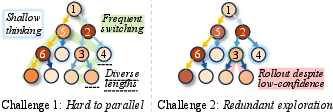
Figure 1

Figure 1: Challenges of implementing parallelism in reasoning tasks.

Irregular computational trajectories and frequent context switching complicate parallel execution, leading to inefficient memory usage and shallow exploration. This impedes the ability of traditional methods to effectively utilize parallel processing capabilities in GPUs.

The DPTS Framework

The DPTS framework introduces innovations in the reasoning phase to dynamically manage and optimize reasoning paths during inference. This framework includes two primary components: Parallelism Streamline and the Search and Transition Mechanism.

Parallelism Streamline

The Parallelism Streamline focuses on efficient node parallelization, achieving fine-grained inference through adaptive parallelization.

  • Tree Structure Building: Utilizes node-specific Key-Value (KV) caches and token sequences, optimizing memory by retaining only necessary data for each node.
  • KV Cache Handling: Manages varying path lengths via padding, ensuring consistent sequence lengths for batch processing.
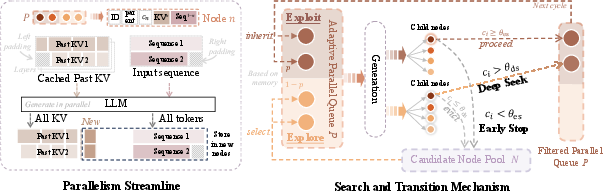
  • Adaptive Parallel Generation: Dynamically adjusts the number of parallel paths based on GPU memory availability, optimizing resource allocation. Figure 2

    Figure 2: Overview of the proposed DPTS framework. The right part demonstrates the Parallelism Streamline, while the left and middle illustrate the proposed Search and Transition Mechanism.

Search and Transition Mechanism

The mechanism effectively balances exploration and exploitation via dynamic node management and bidirectional transitions.

  • Exploitation and Exploration Nodes: Distinguishes between nodes that deepen high-confidence paths (exploitation) and those that explore new areas (exploration).
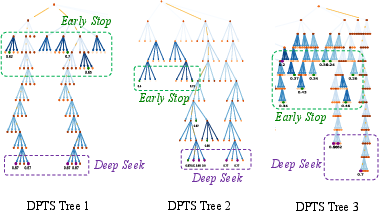
  • Early Stop and Deep Seek: Employs transitional strategies to halt expansions on low-confidence paths while promoting promising nodes to deeper exploration. Figure 3

    Figure 3: Visualization of DPTS Tree. The green boxes are early stopped nodes based on their prior confidence using our Early Stop mechanism, and the purple boxes are the terminated nodes with posterior reward scores.

Experimental Evaluation

DPTS demonstrates significant improvements over existing methods when tested across various LLMs (like Qwen-2.5 and Llama-3) on reasoning datasets (Math500 and GSM8K).

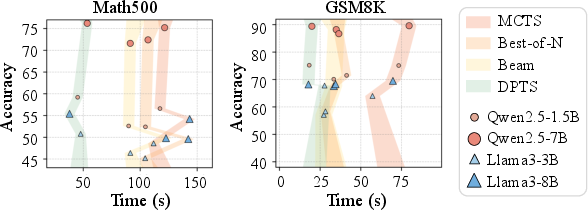
  • Efficiency: DPTS reduces inference time by 2-4 times on average compared to traditional methods like MCTS, Best-of-N, and Beam Search.
  • Accuracy: By maintaining or surpassing previous models' accuracy under reduced computational costs, DPTS shows robustness in solving complex reasoning tasks. Figure 4

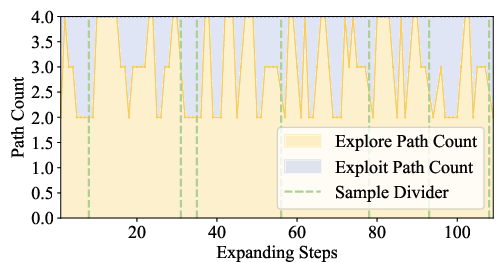
    Figure 4: Proportions of exploit and explore nodes throughout the search process.

Implications and Future Developments

The DPTS framework addresses core computational challenges of LLM reasoning by leveraging parallel computing architectures more effectively. Its approach offers significant implications for both practical applications, such as real-time decision making in complex problem-solving tasks, and theoretical advancements by enhancing the scalability of reasoning models. Future work can expand DPTS applications across different domains like coding and scientific problem solving, and further integrate hardware-level optimizations for even greater efficiency gains.
Whiteboard

No one has generated a whiteboard explanation for this paper yet.

Open Problems

We haven't generated a list of open problems mentioned in this paper yet.

Collections

Sign up for free to add this paper to one or more collections.