Volume estimates for unions of convex sets, and the Kakeya set conjecture in three dimensions
Abstract: We study sets of $δ$ tubes in $\mathbb{R}3$, with the property that not too many tubes can be contained inside a common convex set $V$. We show that the union of tubes from such a set must have almost maximal volume. As a consequence, we prove that every Kakeya set in $\mathbb{R}3$ has Minkowski and Hausdorff dimension 3.
Summary
- The paper proves that every Kakeya set in ℝ³ has Minkowski and Hausdorff dimensions equal to 3 by establishing sharp volumetric lower bounds for δ-tubes under explicit non-clustering conditions.
- It employs a multi-scale decomposition and induction-on-scales strategy, leveraging the Katz-Tao convex Wolff axioms to rigorously control tube intersections and arrangements.
- The approach introduces a self-improvement mechanism that unifies geometric measure theory techniques, thereby also resolving related conjectures such as tube doubling and line extension.
Volume Estimates for Unions of Convex Sets and the Kakeya Set Conjecture in Three Dimensions
Introduction and Main Results
This work addresses the long-standing Kakeya set conjecture in R3 by establishing sharp volumetric lower bounds for unions of δ-tubes under explicit non-concentration (convex non-clustering) conditions. The authors prove that every Kakeya set in R3—that is, any set containing a unit segment in every direction—has both Minkowski and Hausdorff dimension exactly 3, thus resolving the conjecture in three dimensions.
The foundational volume lower bound is as follows: If T is a collection of δ-tubes in the unit ball, and each a×b×2 rectangular prism contains at most Cabδ−2 tubes, then for any measurable shading Y(T)⊂T with relative density λ, one has
T∈T⋃Y(T)≳δαλKT∈T∑∣T∣
for some α,K>0, provided δ is sufficiently small.
The conclusion is that the union of such tubes is volumetrically near-maximal, invalidating the construction of low-dimensional Kakeya sets in three dimensions and forcing their measure-theoretic dimension to be full ($3$).
Non-Clustering Hypotheses and Convex Wolff Axioms
The central technical condition is a quantitative form of tube non-concentration relative to intersections with arbitrary convex sets (the Katz-Tao convex Wolff axiom): #{T∈T:T⊂W}≤C∣W∣∣T∣−1 for every convex W⊂R3, where ∣T∣∼δ2. Analogous Frostman-type slab Wolff axioms control tube count inside thickened hyperplanes, enforcing a secondary form of non-concentration.
Such hypotheses encapsulate the canonical tube arrangements arising from Kakeya sets, but also allow for a robust multi-scale analysis.
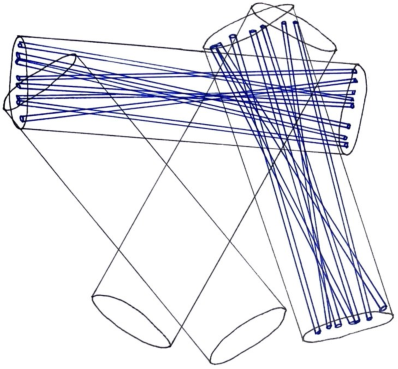
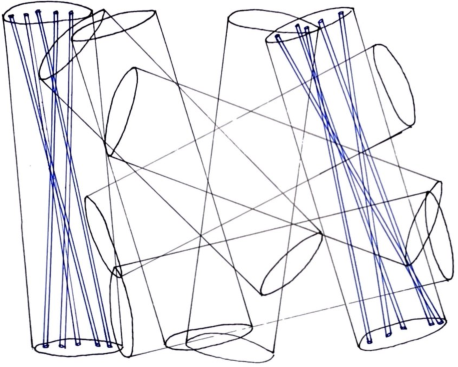
Figure 1: The tubes at scale ρ (black) satisfy the non-concentration hypothesis at both scales ρ and δ, corresponding to the sticky case; in contrast, the right-hand image illustrates the "well-separated" case, where there is high intersection multiplicity at the coarse scale and sparsity at the fine scale.
Multi-Scale Decomposition and Induction on Scales
To analyze arbitrary tube configurations, the authors leverage a flexible family of volume estimates, E(σ,ω), parameterized by exponents σ,ω≥0. These estimates guarantee union bounds of the form: ∣T∈T⋃Y(T)∣≳δω(#T)∣T∣[(#T)∣T∣1/2]−σ whenever the convex non-concentration axioms hold with small error. For σ≈0, this lower bound is nearly optimal.
The analytic core involves a sophisticated induction-on-scales strategy. Arrangements not "sticky" (i.e., those where tubes do not align at intermediate scales) display a multi-scale self-similar structure: at various scales ρ, the collection T decomposes into families Tρ of ρ-tubes which themselves satisfy analogous non-clustering constraints.
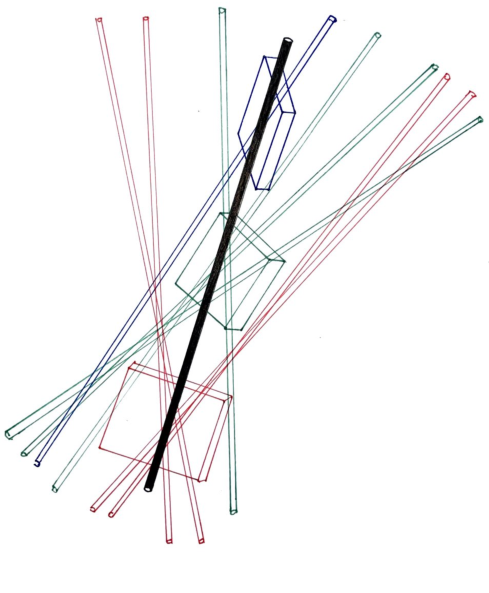
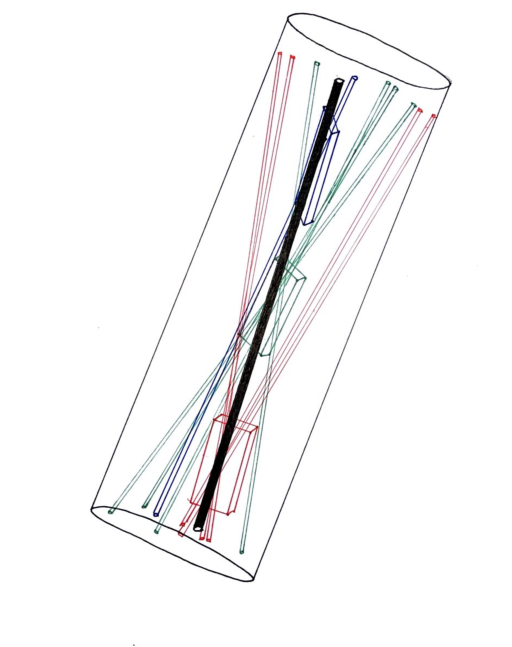
Figure 2: At a fixed intermediate scale ρ, the set of tubes is partitioned into subfamilies covered by sparse ρ-tubes; each blue collection is internally nearly disjoint and non-clustered.
However, if at some scale, the arrangement is highly "plany" (i.e., the grains are flat), the union occupies larger than expected volume, and the induction closes by exploiting this geometric structure.
Factoring and Structure Theorems for Convex Set Arrangements
A notable technical innovation is the systematic factoring of arrangements of convex sets (either tubes or more general prisms). Proposition~\ref{factoringConvexSetsProp} establishes that any set of congruent convex bodies can be decomposed into smaller subcollections, each contained in a convex envelope, such that the non-clustering (Katz-Tao and Frostman) axioms are inherited at controlled cost. This enables the arguments to descend, at each stage, to the finest relevant scale at which the "worst-case" (i.e., smallest) union volume can still occur.
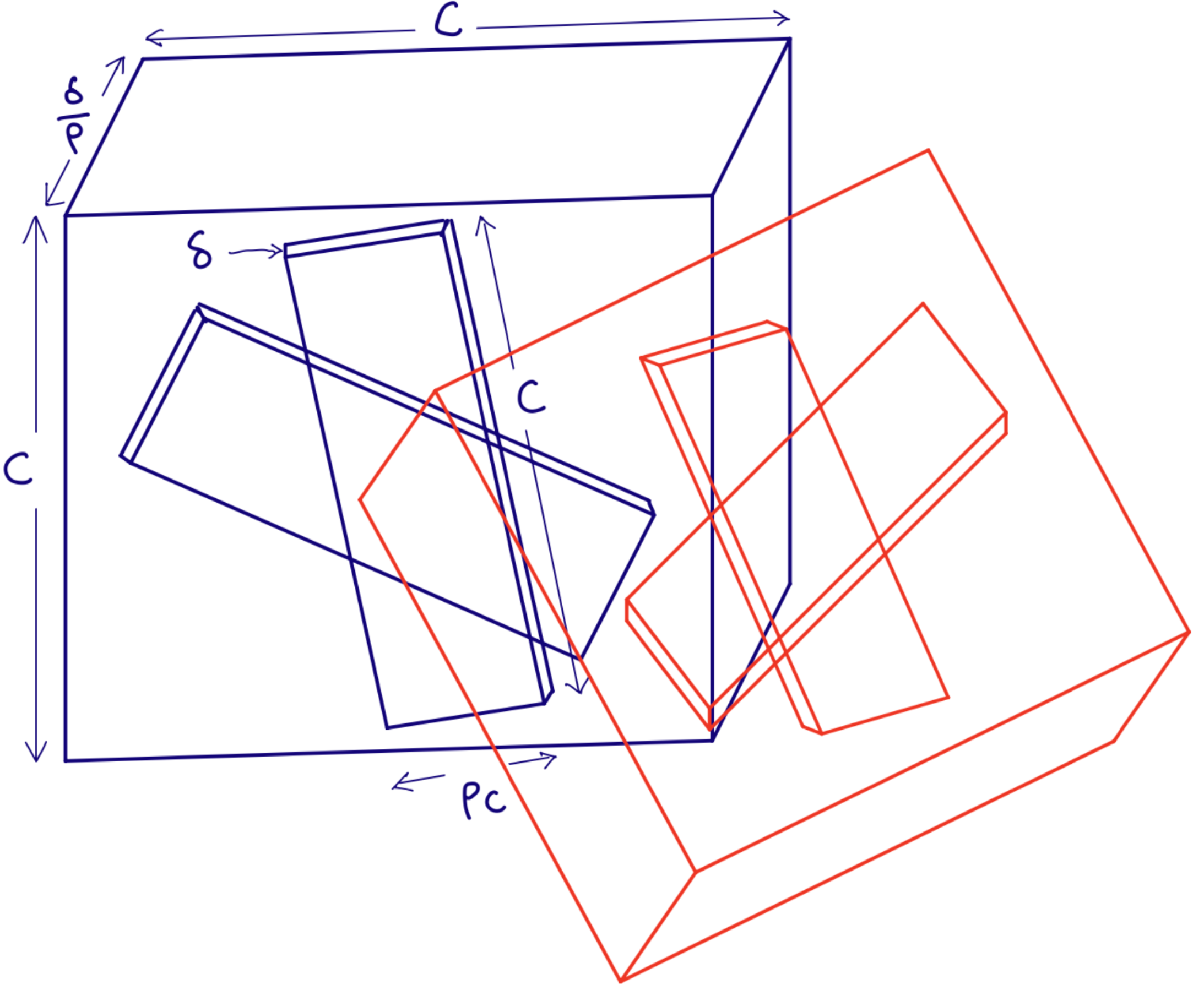
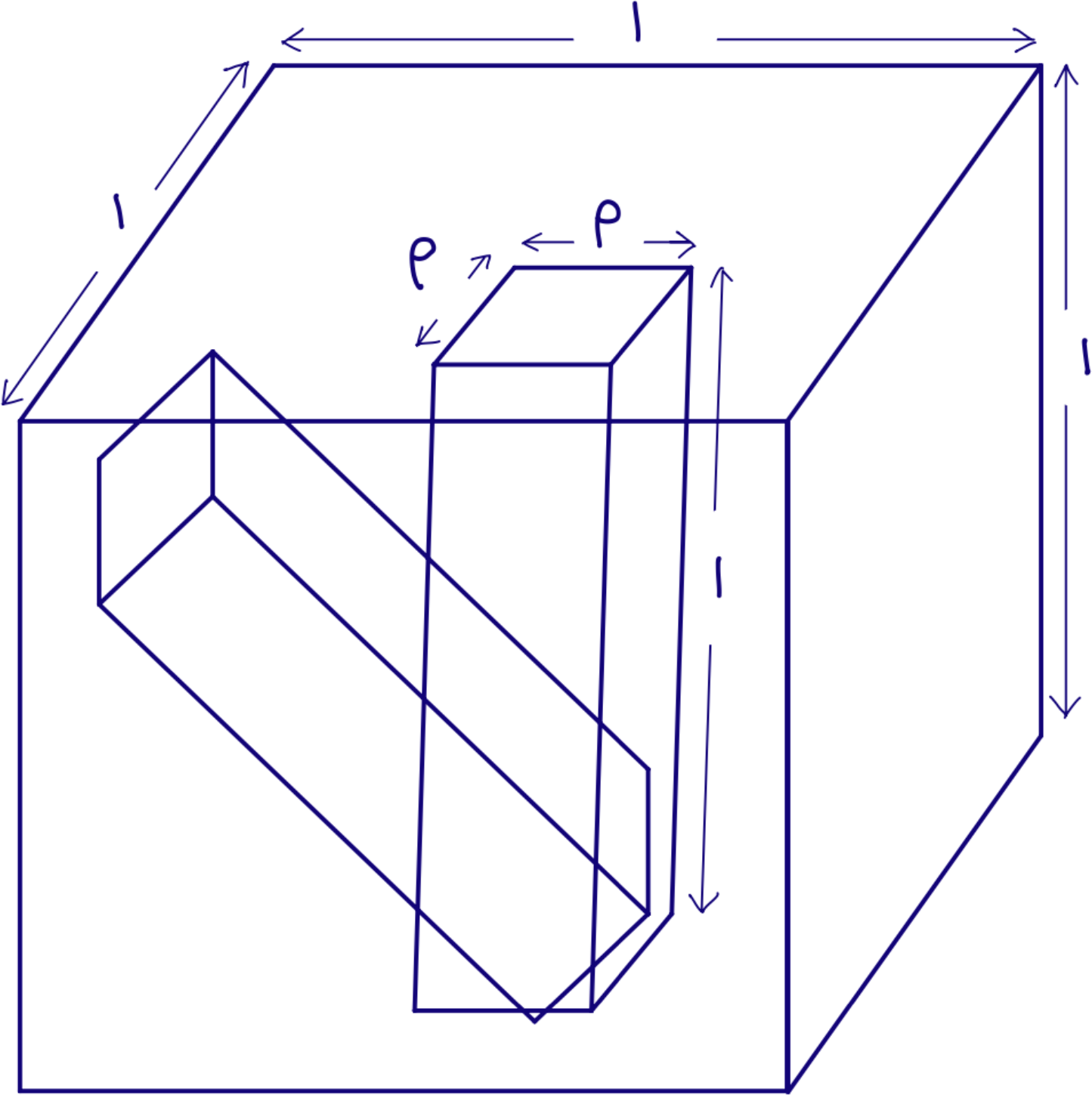
Figure 3: At an intermediate step, grains at scale c are clustered in flat or square arrangements—the partitioning convex boxes factor the convex set arrangement from above and below.
Through this approach, one can locate either a scale and arrangement where the union's volume is strictly better than predicted by potential counterexamples, or else show that sticky (multiscale self-similar) structure persists throughout, reducing ultimately to the setting solved in [WZ22, WZ23].
The Self-Improvement Mechanism and Completion of the Induction
A principal innovation is the quantitative self-improvement property: If a dimension estimate with (σ,ω) is available, then through induction on scales plus the geometric structure analysis, a stronger estimate with smaller σ and/or ω can be established. The iterative closure mechanism then forces (σ,ω)=(0,0) as the only sharp possibility.
This is facilitated by a refined two-scale "grain decomposition" (Guth-Grains, cf. [Gut14]), in which the arrangement at scale δ is covered by flat prisms at scale c, with a controlling parameter c related to intersection multiplicities and tube counts at coarser scales.
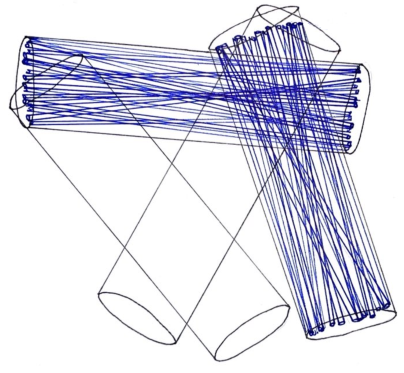
Figure 4: Local anisotropic rescaling at boxed grains: black ρ-tubes are sparse, blue δ-tubes densely pack particular regions. The mapped structure passes through convexity-based Wolff axioms, ensuring persistence of non-clustering at multiple scales.
The analysis branches naturally: if convex grains become too flat, a geometric Cordoba-style L2 argument shows that the union must fill out a large slab, again contradicting possible counterexamples.
Implications and Corollaries
Kakeya Set Conjecture in R3
The main theorem confirms that
dimMinkowski(K)=dimHausdorff(K)=3
for every Kakeya set K⊂R3.
Tube Doubling and Line Extension Conjectures
As a corollary, the authors resolve long-standing questions on volumetric expansion under tube dilation: T∈T⋃2T≤δ−ϵT∈T⋃T for any ϵ>0, for any δ sufficiently small.
Consequently, Keleti's Line Segment Extension Conjecture holds in R3: the Hausdorff dimension is invariant under replacing finite line segments by their containing lines in union constructions.
Theoretical and Practical Implications
The argument achieves a unification of the Katz-Tao framework for the Kakeya problem, confirming the heuristic that non-concentration at all convex scales precludes the construction of "fractal" low-dimensional Kakeya sets in R3. The approach relies on recursively quantifying non-clustering at every (potentially unfavorable) scale, an advance over prior analyses that had handled specific sticky or grainy configurations.
On the practical side, these results settle all three-dimensional instances of the core conjectures governing geometric measure theory's intersection with harmonic analysis and arithmetic combinatorics (including endpoint restriction and maximal function behaviors).
Outlook and Future Directions
The methods introduced, notably the multiscale convex factoring scheme and closure under self-improvement, provide a flexible blueprint potentially adaptable to higher-dimensional cases or to related geometric maximal incidence problems (e.g., finite field analogues, Nikodym sets, or multilinear analogues in Rn for n>3). The central role of convexity suggests possible connections to convex-geometric measure phenomena and their discretizations.
Moreover, the explicit verified computations of tube union volume lower bounds under convex non-clustering may, in the future, inform algorithmic or probabilistic constructions in both theoretical and computational geometry.
Conclusion
This work decisively resolves the three-dimensional Kakeya set conjecture and associated tube-union volumetric problems by a sophisticated recursive analysis of non-clustering at all convex scales. The technical infrastructure—factoring convex sets, multi-scale grain decompositions, and induction via self-improvement—may inform further progress in closely related classical problems in geometric measure theory and harmonic analysis.
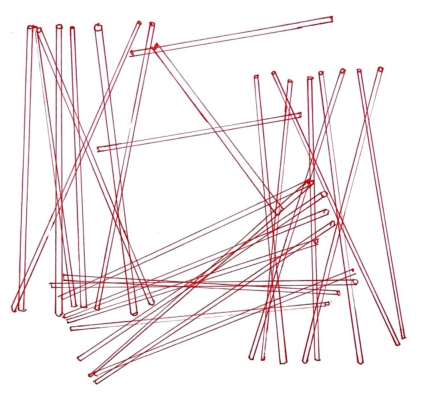
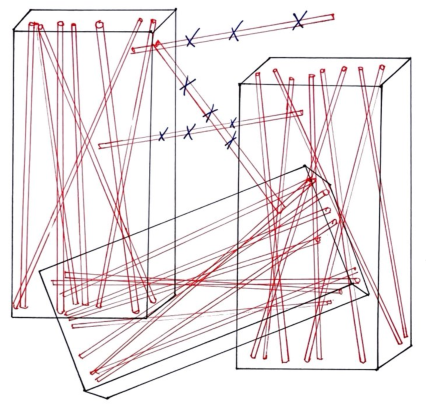
Figure 5: Visualization of the process wherein union volumes are controlled by tracking the arrangements of tubes and convex grains; transversality and tangency are handled by partitioning into slabs or boxes, enforcing lower bounds or triggering self-improving arguments.
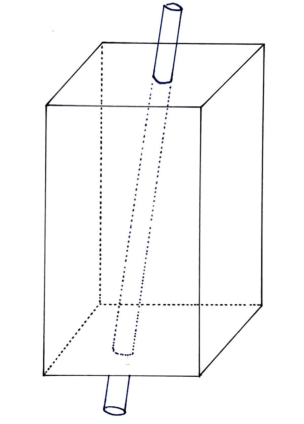
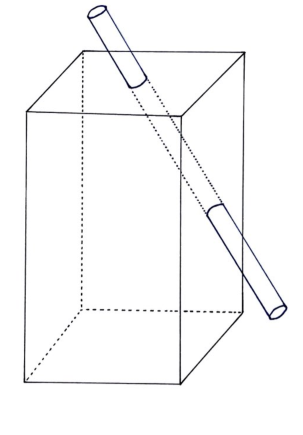
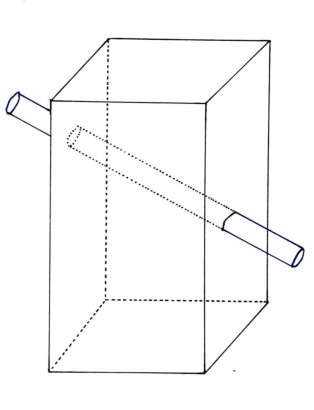
Figure 6: A tube exits a grain through the long ends (left), satisfying the well-separated criterion; middle/right, failure to do so—in such cases, volume lower bounds for unions improve by geometric arguments, excluding these as minimal-volume configurations.
Paper to Video (Beta)
No one has generated a video about this paper yet.
Whiteboard
No one has generated a whiteboard explanation for this paper yet.
Paper Prompts
Sign up for free to create and run prompts on this paper using GPT-5.
Top Community Prompts
Continue Learning
- How do the convex non-clustering hypotheses specifically impact the volumetric estimates in the proof?
- What are the key steps in the multi-scale decomposition and how do they contribute to resolving the Kakeya conjecture?
- In what ways do the Katz-Tao convex Wolff axioms facilitate control over tube density and clustering?
- Can the self-improvement mechanism used in this paper be adapted to tackle higher-dimensional Kakeya set problems?
- Find recent papers about advances in Kakeya set problems.
Related Papers
- The Assouad dimension of Kakeya sets in $\mathbb{R}^3$ (2024)
- An $L^{4/3}$ $SL_2$ Kakeya maximal inequality (2023)
- Equivalences between different forms of the Kakeya conjecture and duality of Hausdorff and packing dimensions for additive complements (2022)
- Improved bounds for the Kakeya maximal conjecture in higher dimensions (2019)
- An improved bound on the Hausdorff dimension of Besicovitch sets in $\mathbb{R}^3$ (2017)
- Dimension estimates for Kakeya sets defined in an axiomatic setting (2017)
- Polynomial Wolff axioms and Kakeya-type estimates in $\mathbb{R}^4$ (2017)
- Degree reduction and graininess for Kakeya-type sets in $\mathbb{R}^3$ (2014)
- Discrete analogues of Kakeya problems (2013)
- A Survey of the Kakeya conjecture, 2000-2025 (2025)
Authors (2)
Collections
Sign up for free to add this paper to one or more collections.
Tweets
Sign up for free to view the 22 tweets with 872 likes about this paper.
YouTube
HackerNews
- Volume estimates for unions of convex sets, and the Kakeya set conjecture in d=3 (2 points, 1 comment)
- A Solution of the Kakeya Conjecture (2 points, 0 comments)