- The paper introduces electrically tunable magnonic bound states in the continuum using non-Hermitian physics to achieve dissipationless modes.
- It employs a coupled waveguide system with spin-orbit torque and current-induced modulation to precisely control interlayer coupling and anisotropy.
- Experimental insights indicate that precise current control in antiferromagnetic systems can significantly enhance signal fidelity in spintronic circuits.
Electrically Tunable Magnonic Bound States in the Continuum
Introduction
The research focuses on reducing magnonic dissipation in spintronic systems using magnonic bound states in the continuum (BIC), a novel approach that leverages non-Hermitian physics to create dissipationless magnon states. This method is explored using antiferromagnetically coupled magnonic waveguides with one waveguide attached to a current-carrying metallic layer.
Magnonic Systems and Non-Hermitian Physics
Magnons, the quanta of spin waves in magnetically ordered systems, are pivotal for information processing due to their low energy consumption and high-speed propagation. Traditional methods to enhance magnon transport involve reducing intrinsic damping through material engineering or using spin torques. This research proposes an alternative by forming magnonic BIC in non-Hermitian systems, enabling modes that are immune to radiation losses. The study harnesses exceptional points (EPs), non-Hermitian degeneracies where coupled magnon gain and loss result in phenomena like non-reciprocal transmission, to achieve magnonic BIC.
The setup involves two antiferromagnetically coupled waveguides on a metallic layer (e.g., platinum), offering spin-orbit torque (SOT) to amplify magnonic signals. The resultant system displays coupled loss and additional loss characteristics, facilitating BIC formation. Key to this process is the manipulation of electric current density, influencing interlayer coupling and anisotropy constants to control the emergence of BICs (Figure 1).
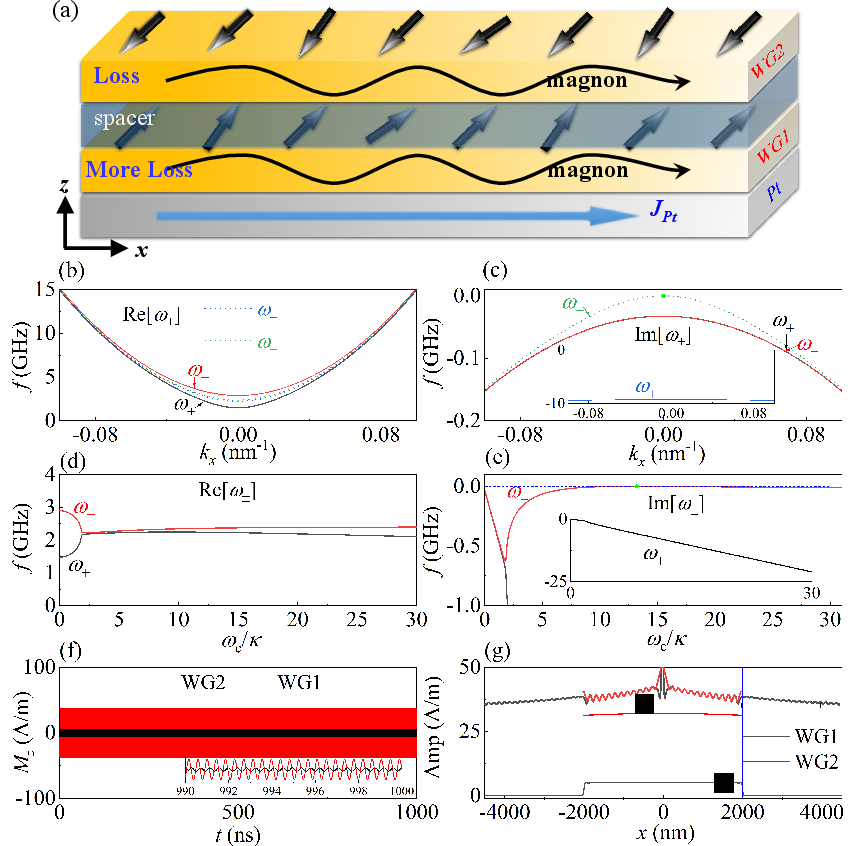
Figure 1: The schematic illustrates two antiferromagnetically coupled magnon waveguides, detailing the effect of injected charge current on magnon damping and subsequent BIC support.
For a Hamiltonian H^ derived via the Landau-Lifshitz-Gilbert equation, EP arises from charge current modulation, leading to identical magnon mode frequencies at specific current values. Beyond the EP, the separation in the imaginary parts of modes grows, resulting in a dissipationless BIC at a determined ωc value (Figure 2).
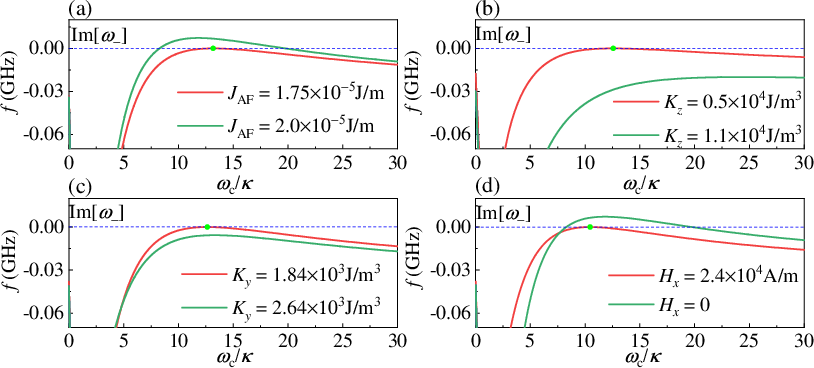
Figure 2: Variations in imaginary parts of magnon modes with changes in interlayer coupling and anisotropy depict conditions for BIC emergence.
Experimental Considerations
Empirical validation of magnonic BICs includes assessing parameters like anisotropy constants, interlayer coupling strength, and external magnetic fields (Figure 3). These factors decisively impact the stability of antiferromagnetic coupling and the manifestation of BICs. Importantly, controlling the system through electric currents ensures robustness against parameter fluctuation.
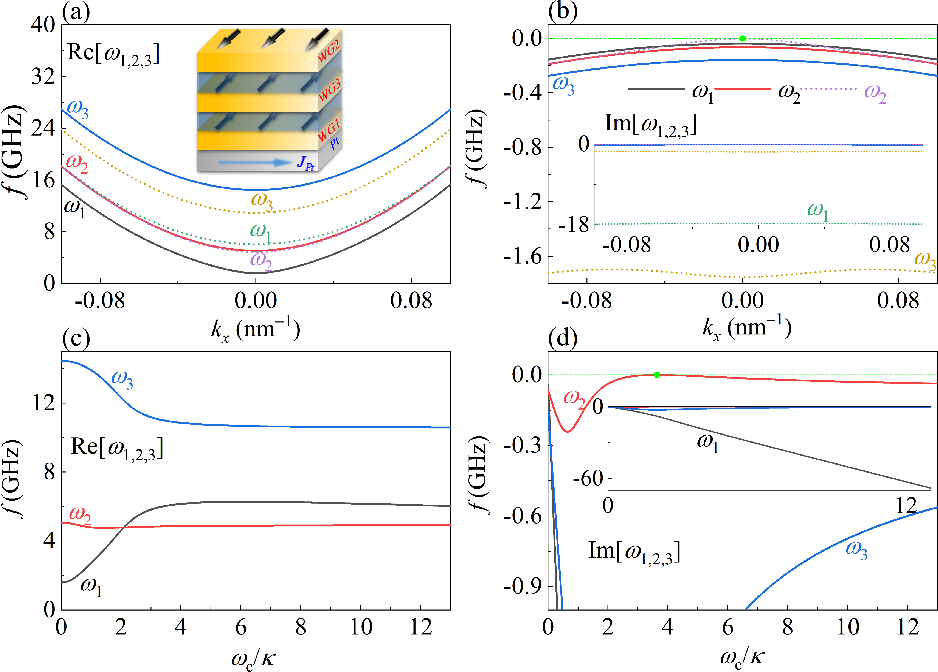
Figure 3: Magnonic BIC responses to parameter changes highlight experimental controllability.
Applications and Implications
The creation of magnonic BICs is a pivotal advancement for designing magnon delay lines. By incorporating precise current modulation, high-fidelity magnon signal control can be achieved. This innovation holds significant promise for developing next-generation magnonic circuits, offering enhancements in logic devices and transmission capabilities (Figure 4).
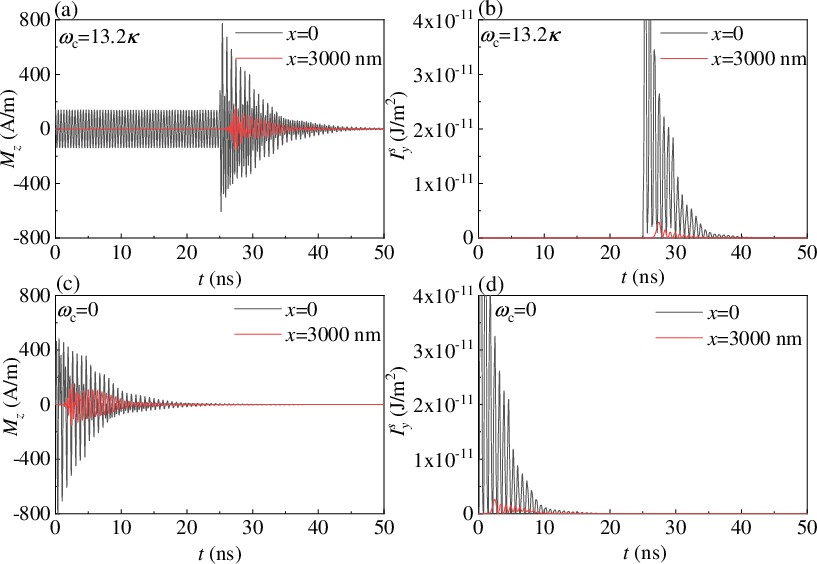
Figure 4: Temporal profiles demonstrate how controlled current environments enable the formation and sustenance of BICs in magnonic systems.
Conclusion
This research introduces a paradigm shift in reducing magnon dissipation through electrically tunable magnonic BICs. Impacts are extensive, including potential applications in information processing and logical operations in spintronics. Future work may explore broader material systems and further stabilize these non-Hermitian magnonic systems, potentially integrating them into commercial spintronic devices.