Papers
Topics
Authors
Recent
Search
2000 character limit reached

On the determinant of the walk matrix of the rooted product with a path

Published 15 Mar 2025 in math.CO | (2503.12130v1)

Abstract: For an $n$-vertex graph $G$, the walk matrix of $G$, denoted by $W(G)$, is the matrix $[e,A(G)e,\ldots,(A(G)){n-1}e]$, where $A(G)$ is the adjacency matrix of $G$ and $e$ is the all-ones vector. For two integers $m$ and $\ell$ with $1\le \ell\le (m+1)/2$, let $G\circ P_m{(\ell)}$ be the rooted product of $G$ and the path $P_m$ taking the $\ell$-th vertex of $P_m$ as the root, i.e., $G\circ P_m{(\ell)}$ is a graph obtained from $G$ and $n$ copies of the path $P_m$ by identifying the $i$-th vertex of $G$ with the $\ell$-th vertex (the root vertex) of the $i$-th copy of $P_m$ for each $i$. We prove that, $\det W(G\circ P_m{(\ell)})$ equals $\pm (\det A(G)){\lfloor\frac{m}{2}\rfloor}(\det W(G))m$ if $\gcd(\ell,m+1)=1$, and equals 0 otherwise. This extends a recent result established in [Wang et al. Linear Multilinear Algebra 72 (2024): 828--840] which corresponds to the special case $\ell=1$. As a direct application, we prove that if $G$ satisfies $\det A(G)=\pm 1$ and $\det W(G)=\pm 2{\lfloor n/2\rfloor}$, then for any sequence of integer pairs $(m_i,\ell_i)$ with $\gcd(\ell_i,m_i+1)=1$ for each $i$, all the graphs in the family \begin{equation*} G\circ P_{m_1}{(\ell_1)}, (G\circ P_{m_1}{(\ell_1)})\circ P_{m_2}{(\ell_2)}, ((G\circ P_{m_1}{(\ell_1)})\circ P_{m_2}{(\ell_2)})\circ P_{m_3}{(\ell_3)},\ldots \end{equation*} are determined by their generalized spectrum.
Summary

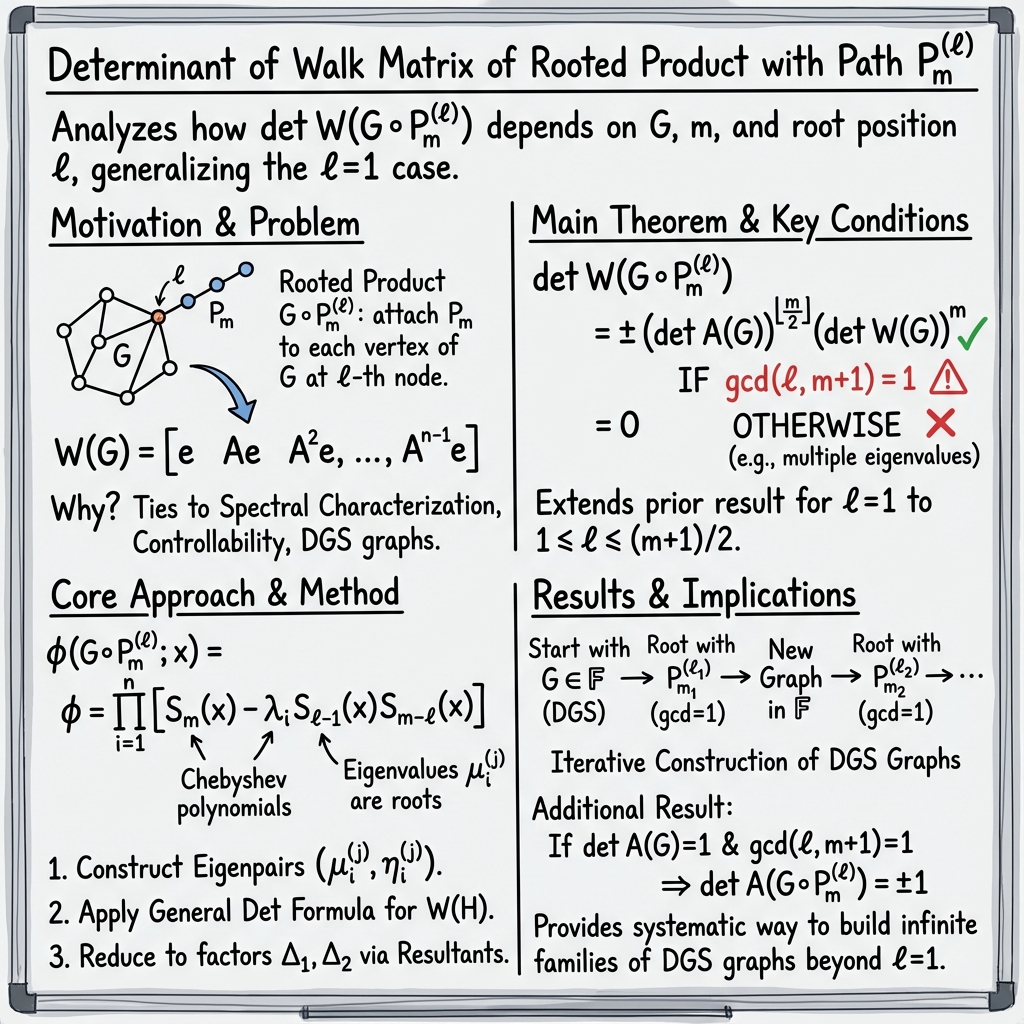
  • The paper presents a closed-form determinant formula for the walk matrix of rooted product graphs with paths, using a coprimality condition to ensure nondegeneracy.
  • It employs spectral analysis with Chebyshev polynomials and Kronecker product representations to express the graph's eigenvalues in relation to those of its components.
  • The results facilitate the construction of DGS graph families by detailing when the walk matrix is non-singular based on root-position constraints.

Determinant of the Walk Matrix of Rooted Products with Paths

Introduction and Context

The paper investigates the determinant of the walk matrix for graphs constructed as rooted products with paths, notably generalizing previous results from the case where the root is the first vertex of the path to arbitrary roots. This extension is significant in advancing spectral graph theory, with direct implications for understanding generalized spectral characterizations and controllability of composite graphs.

Let GG be an nn-vertex simple graph with adjacency matrix A(G)A(G) and walk matrix W(G)=[e,Ae,,An1e]W(G) = [e, Ae, \ldots, A^{n-1}e], where ee is the all-ones vector. The central focus is the graph GPm()G\circ P_m^{(\ell)}, the rooted product of GG and the path PmP_m, where each vertex of GG is identified with the \ell-th vertex of its copy of PmP_m. The determinant of the walk matrix of such constructed graphs, especially its closed form and its zero-pattern, is analyzed completely.

Main Theorem and Its Analysis

The main result is the exact evaluation of detW(GPm())\det W(G\circ P_m^{(\ell)}):

detW(GPm())={±(detA(G))m2(detW(G))mif gcd(,m+1)=1, 0otherwise.\det W(G\circ P_m^{(\ell)}) = \begin{cases} \pm (\det A(G))^{\lfloor\frac{m}{2}\rfloor}(\det W(G))^m & \text{if } \gcd(\ell, m+1) = 1,\ 0 & \text{otherwise.} \end{cases}

This formula characterizes, for any nn-vertex graph GG, any m2m \geq 2, and any root position 1(m+1)/21\leq\ell\leq (m+1)/2, exactly when the determinant is nonzero and how it relates multiplicatively to the original graph GG. The result resolves the impact of root position—specifically, the coprimality constraint gcd(,m+1)=1\gcd(\ell,m+1)=1 is necessary and sufficient for non-degeneracy. When this condition fails, the walk matrix becomes singular.

Structural and Spectral Properties

The authors harness the algebraic structure of GPm()G\circ P_m^{(\ell)} through the Kronecker product representation of its adjacency matrix and employ the Chebyshev polynomials to succinctly capture characteristic polynomials of both the path and the product graph. In particular,

A(GPm())=A(Pm)In+DA(G),A(G\circ P_m^{(\ell)})=A(P_m)\otimes I_n+D_\ell\otimes A(G),

where DD_\ell is an indicator for the root attachment. The spectral analysis reveals that the eigenvalues of the rooted product admit explicit expressions in terms of those of GG, parameterized by the spectrum of PmP_m and Chebyshev polynomials, leading to the determinant formula.

A crucial intermediary is the fact that GPm()G\circ P_m^{(\ell)} has only simple eigenvalues if and only if gcd(,m+1)=1\gcd(\ell, m+1) = 1 and GG has simple eigenvalues. This interplay underpins both the non-vanishing and the precise algebraic form of the determinant.

Methodological Advances

Through deft use of resultants and combinatorial identities for Chebyshev polynomials, the determinant computation is reduced to evaluating certain products over roots of polynomial systems. The paper develops a framework in which the determinant of the walk matrix of a highly composite graph can be recursively or inductively expressed in terms of determinants from its constituent graphs. Figure 1

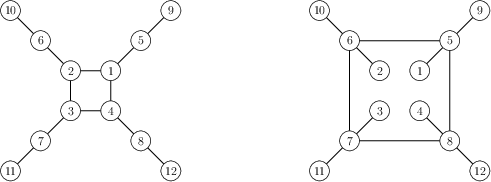
Figure 1: Explicit depiction of C4P3(1)C_4\circ P_3^{(1)} and C4P3(2)C_4\circ P_3^{(2)}, illustrating the distinct graph topologies induced by different root positions.

Implications: Generalized Spectra and DGS Constructions

A notable application is the construction of large families of graphs determined by their generalized spectrum (DGS graphs). For any GG in the family Fn\mathcal{F}_n (defined by detA(G)=±1\det A(G)=\pm 1 and detW(G)=±2n/2\det W(G)=\pm 2^{\lfloor n/2\rfloor}), and any sequence of admissible rooted products (with the coprimality constraint on each pair), all iterated rooted products remain DGS. This demonstrates that the DGS property is robust under iterated rooted products with paths at suitable roots and provides a generative method for constructing infinite DGS-graph families.

This is formalized as follows: for any sequence {(mi,i)}\{(m_i, \ell_i)\} with gcd(i,mi+1)=1\gcd(\ell_i, m_i+1)=1, the family

GPm1(1),(GPm1(1))Pm2(2),((GPm1(1))Pm2(2))Pm3(3),G\circ P_{m_1}^{(\ell_1)}, (G\circ P_{m_1}^{(\ell_1)})\circ P_{m_2}^{(\ell_2)}, ((G\circ P_{m_1}^{(\ell_1)})\circ P_{m_2}^{(\ell_2)})\circ P_{m_3}^{(\ell_3)},\ldots

consists exclusively of DGS graphs whenever GFnG\in \mathcal{F}_n. This result extends prior work which handled only the case =1\ell=1.

Technical Subtleties: Vanishing, Simplicity, and Combinatorics

A striking claim is the dichotomy in the determinant vanishing: if gcd(,m+1)>1\gcd(\ell, m+1)>1 or if GG has repeated eigenvalues, then detW(GPm())=0\det W(G\circ P_m^{(\ell)})=0 automatically. This follows from the effect of root placement on the multiplicity and location of eigenvalues. The paper also identifies connections to Wronskian vertices and the properties of totally unimodular matrices in combinatorial matrix theory.

Moreover, the proof strategy blends spectral graph theory, properties of walk matrices, symmetric functions over eigenvalues, and determinant identities. This multi-pronged approach enables the reduction of an intricate combinatorial-analytic object to a manageable algebraic form.

Conclusion

The paper delivers a comprehensive analysis and closed formula for the determinant of the walk matrix of rooted products of graphs with paths at general root locations, unified via the coprimality condition on the root parameter. The results provide new algebraic and spectral tools for constructing and classifying DGS graphs, cementing the bridge between adjacency matrix invariants, walk matrices, and spectral characterization theory. The explicit formulas and reduction machinery introduced open avenues for future research into walk-based invariants and further generalizations to rooted products with other graphs or under more relaxed spectral constraints.

Whiteboard

Explain it Like I'm 14

A simple explanation of “On the determinant of the walk matrix of the rooted product with a path”

What is this paper about?

This paper studies how a certain “fingerprint number” of a graph changes when you attach a chain of mm vertices (a path) to every vertex of the graph in a specific way. That fingerprint number is the determinant of the walk matrix. The authors find a clean formula for this number and show how it helps build big graphs that are uniquely identified by their spectra (their lists of special numbers called eigenvalues).

Key ideas you need to know first

  • A graph is a set of points (vertices) with lines (edges) connecting some pairs.
  • The adjacency matrix A(G)A(G) records which vertices are connected: Aij=1A_{ij}=1 if ii and jj are connected, otherwise $0$.
  • The walk matrix W(G)W(G) is built from how many ways you can walk from each vertex in 1 step, 2 steps, and so on:
    • W(G)=[e,Ae,A2e,,An1e]W(G) = [e,\, A e,\, A^2 e,\, \dots,\, A^{n-1} e], where ee is the all-ones column vector and nn is the number of vertices.
    • Think of the columns as “how many walks of length k start at each vertex.”
  • The determinant of a matrix is a single number that, among other things, says if the matrix is invertible (nonzero determinant) or not (zero determinant). It often behaves like a strong “summary” feature of the matrix.
  • A path PmP_m is just a chain of mm vertices in a line.
  • The rooted product GPm()G \circ P_m^{(\ell)} means you attach a copy of the chain PmP_m to every vertex of GG, gluing it at the \ell-th vertex of the chain. If =1\ell=1, you glue at an end; if \ell is bigger, you glue somewhere in the middle.
  • The greatest common divisor gcd(a,b)\gcd(a,b) is the largest number that divides both aa and bb.

What is the main goal?

The paper answers: if we take a graph GG and attach a path of mm vertices at position \ell to every vertex (forming GPm()G \circ P_m^{(\ell)}), what is the determinant of the walk matrix of this new big graph, in terms of the original GG?

They also ask: when does this process create graphs that are uniquely determined by their generalized spectrum (the spectra of the graph and its complement)? Such graphs are called DGS (Determined by their Generalized Spectrum).

How do the authors approach the problem?

  • They express the adjacency matrix of the rooted product neatly using the Kronecker product (a way of combining matrices like tiling a pattern).
  • They analyze eigenvalues and eigenvectors (the special directions and scaling factors of the matrix action) of the new graph using known properties of paths. Here, Chebyshev polynomials of the second kind (special polynomials that describe paths) play a central role.
  • They prove a key condition: the eigenvalues of the big graph are all simple (no repeats) if and only if gcd(,m+1)=1\gcd(\ell, m+1)=1. This matters because repeated eigenvalues often force the determinant of the walk matrix to be zero.
  • They compute the big determinant by:
    • Relating it to products of differences between roots (Vandermonde-type products),
    • Using resultants (a tool that multiplies differences between roots of two polynomials),
    • And carefully simplifying with identities from Chebyshev polynomials.

In short, they translate the graph problem into a polynomial problem, solve it with algebra, then translate back.

What are the main results?

The core formula is:

detW(GPm())  =  {±(detA(G))m/2(detW(G))mif gcd(,m+1)=1, 0otherwise.\det W\big(G \circ P_m^{(\ell)}\big) \;=\; \begin{cases} \pm \big(\det A(G)\big)^{\lfloor m/2 \rfloor} \, \big(\det W(G)\big)^m & \text{if } \gcd(\ell, m+1)=1, \ 0 & \text{otherwise.} \end{cases}

What this means in plain language:

  • If the glue position \ell and m+1m+1 share no common factor other than 1, then the determinant of the walk matrix of the big graph is just a simple power of the original numbers detA(G)\det A(G) and detW(G)\det W(G). That’s a remarkably clean rule.
  • If they do share a factor, the determinant is zero. Intuitively, that means the new graph’s walk matrix loses information (it’s not invertible), often because of hidden symmetries or repeated eigenvalues.

This result generalizes a recent earlier result that only covered the case =1\ell=1 (gluing at the end of the path). Now it works for any glue position \ell in the first half of the path.

A key application:

  • If GG has detA(G)=±1\det A(G)=\pm 1 and detW(G)=±2n/2\det W(G)=\pm 2^{\lfloor n/2\rfloor} (this is a special, but important class of graphs), then by repeatedly attaching paths at positions i\ell_i with gcd(i,mi+1)=1\gcd(\ell_i, m_i+1)=1, every graph you build this way is DGS. That means each is uniquely pinned down by its generalized spectrum—no other non-isomorphic graph shares the same spectral data. This gives a method to build many new, large, uniquely identifiable graphs from a small seed.

Why is this important?

  • It gives a precise, easy-to-use formula for a complicated graph construction. That makes it possible to predict the behavior of large networks built in a structured way.
  • It extends our toolbox for constructing DGS graphs. DGS graphs are valuable in areas like network science and chemistry, where you want to be sure a structure is uniquely determined by spectral measurements.
  • The gcd condition gcd(,m+1)=1\gcd(\ell, m+1)=1 is simple to check but has powerful consequences: it’s the switch between a clean, nonzero determinant and zero.

Big-picture impact

  • The paper provides a scalable recipe: start with a “good” graph GG (with detA(G)=±1\det A(G)=\pm 1 and detW(G)=±2n/2\det W(G)=\pm 2^{\lfloor n/2\rfloor}), and keep attaching paths at allowed positions (those with gcd(,m+1)=1\gcd(\ell, m+1)=1). Every step preserves the property of being uniquely identifiable by spectrum. This is like growing a family tree of graphs that remain distinguishable even as they get large and complex.
  • The techniques combine graph theory with algebra and special polynomials, showing how different areas of math fit together to solve structural problems about networks.

A small sanity check example

  • Suppose m=3m=3 and you glue at =2\ell=2. Then m+1=4m+1=4, and gcd(2,4)=21\gcd(2,4)=2\ne 1. The theorem says detW(GP3(2))=0\det W(G \circ P_3^{(2)})=0. In other words, gluing in the middle of a path of length 3 forces the walk matrix to lose invertibility.
  • If you instead glue at =1\ell=1 for any mm, and GG is nice, you get the clean nonzero formula and can keep building DGS graphs.

Overall, the paper deepens our understanding of how graph “fingerprints” behave under a common graph-building operation and gives a practical way to construct many uniquely identifiable graphs.

Open Problems

We haven't generated a list of open problems mentioned in this paper yet.

Authors (2)

Collections

Sign up for free to add this paper to one or more collections.