- The paper identifies six distinctive curiosity profiles by quantifying factors like novelty, uncertainty, and social influence from Telegram chat data.
- It employs information-theoretic metrics and clustering analyses on 6 million messages from over 29,000 users to reveal context-driven participation patterns.
- Regression and network analyses show uncertainty as a positive engagement driver and highlight non-uniform curiosity effects across different topical groups.
Curiosity-Driven Active Engagement in Telegram Groups: Mechanisms, Profiles, and Influence
Introduction
The study "Join the Chat: How Curiosity Sparks Participation in Telegram Groups" (2503.13635) delivers a quantitative and multi-dimensional analysis of the role of curiosity in stimulating user engagement, specifically content production, within Telegram group chats. By leveraging a large-scale dataset encompassing 6 million messages across 29,196 users in 409 groups covering diverse topical domains, the authors systematically operationalize psychological constructs of curiosity—such as social influence, novelty, uncertainty, complexity, and conflict—using information-theoretic and statistical metrics. This approach enables the granular characterization of message- and user-level curiosity stimulation, the clustering of behavioral profiles, and the elucidation of dynamics linking curiosity, participation, and social influence.
Dataset and Methodology
The dataset, visualized in (Figure 1), comprehensively represents user activity across an expansive Telegram group ecosystem, supporting the robustness and external validity of the analyses.
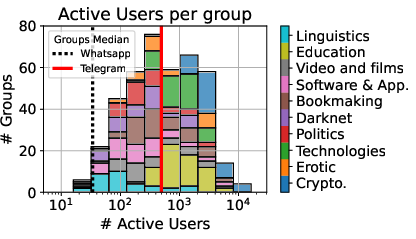
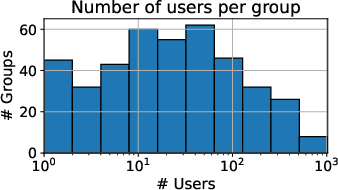
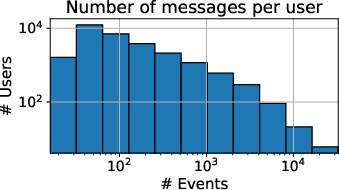
Figure 1: Distribution of the number of users (900k) who sent at least one message in the period under consideration among the 409 analysed groups.
Curiosity stimulation variables are operationalized via context-agnostic metrics computed on 30-minute sliding interaction windows, foregoing message text to prioritize media and participation patterns, thereby facilitating comparison across multilingual and multi-topic settings. Metric design captures both message-level and environmental properties, and includes category-conditioned novelty, entropy-based uncertainty, category/user diversity (conflict/complexity), and direct/indirect social influence quantified via Pointwise Mutual Information and Mutual Information statistics.
The metrics are confirmed to be statistically complementary, with low redundancy except between direct and indirect social influence components (Figure 2). This ensures that downstream clustering and explainability analyses reflect genuine multidimensionality in curiosity drivers.
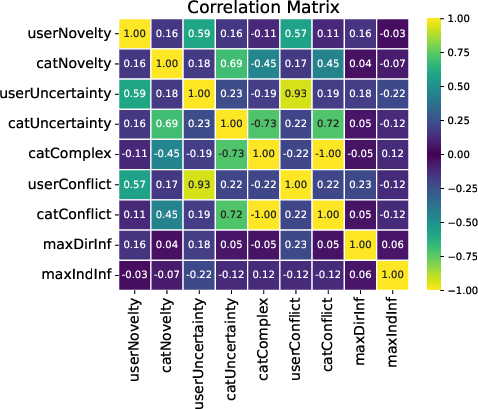
Figure 2: Correlation among curiosity metrics for all messages.
Curiosity Stimulation Profiles: Clustering and Topical Dependence
Clustering analysis identifies six principal curiosity stimulation profiles among active Telegram group messages. Two are predominately shaped by social influence (direct and indirect), two by traditional collative variables (novelty, uncertainty), one exhibits mixed influences, and one exhibits no dominant stimulation pattern (independent). The identified clusters are not equally prevalent—contrary to earlier findings on WhatsApp political groups, where social influence dominated, here only 28% of messages are best explained by direct/indirect influence, and the “independent” profile is comparatively suppressed.
Topic-wise analysis (Figure 3) reveals significant heterogeneity: political groups exhibit a marked enrichment for uncertainty-driven engagement, whereas bookmaking, cryptocurrencies, and linguistics groups display higher fractions of social influence-driven behaviors.
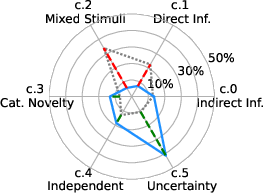
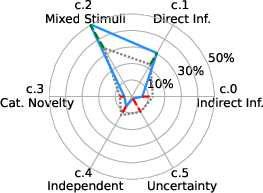
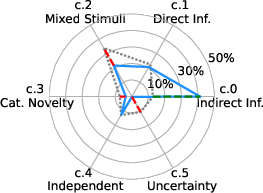
Figure 3: Average fraction of messages in each curiosity stimulus profile for users in political groups; uncertainty-driven participation predominates.
This empirical result contradicts the assumption that social curiosity is uniformly dominant in online group communication. The semantic and structural characteristics of the group topic substantially modulate which curiosity stimuli activate participation.
Stability, Transitions, and Individual Consistency
Longitudinal tracking demonstrates that user curiosity profiles are stable: for 76.6% of users, over 50% of their messages fall within a single curiosity profile. However, as inter-message intervals increase, users demonstrate increased likelihood to shift curiosity profiles, reflecting adaptability to evolving group environments.
Curiosity, Engagement, and Social Positioning
Regression analysis (OLS) models user engagement as a function of average curiosity metrics and group structure. Direct social influence and novelty-seeking are negatively correlated with message production, while uncertainty is a positive predictor (Figure 4). High overall group activity and number of active users further amplify individual participation.
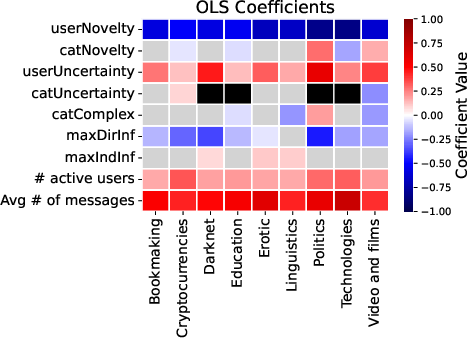
Figure 4: OLS coefficients modeling user engagement based on curiosity metrics, group size, and group activity.
Graph-theoretic analysis constructs “Influenced-by” networks, assigning user centrality scores (PageRank) as a function of stimulation profiles. Users whose engagement is driven by direct influence or uncertainty occupy peripheral positions in the influence network; those with dominant “independent” or indirect-influence profiles are central and potentially act as conversation initiators.
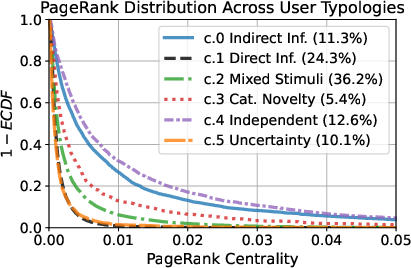
Figure 5: Distribution of node PageRank in the Influenced-by network, partitioned by dominant curiosity-stimulus cluster.
Novel Insights and Implications
Key numerical findings include the identification of six robust curiosity clusters, the quantification that only 28% of participatory acts are directly accounted for by social influence, and the demonstration that uncertainty acts as the primary engagement driver in political contexts.
Pragmatically, these insights challenge the design of engagement and recommendation algorithms on social and messaging platforms. Effective intervention demands the integration of context- and topic-aware models that account for the non-universality of curiosity drivers. For the spread of information—whether benign or adversarial—targeting uncertainty and complex engagement structures, rather than simply exploiting influence hubs or novelty, may yield better predictions of activity surges. Theoretically, the empirical refutation of curiosity profile uniformity across platforms and topics substantiates recent cognitive and computational models advocating multidimensional curiosity constructs.
Conclusion
This study advances the formal decomposition and large-scale quantification of curiosity-driven participation in Telegram groups. By bridging psychological theory and computational social science, it reveals the nuanced, stimulus- and context-dependent patterns of active engagement, as well as the nontrivial mapping between profile, participation, and social network centrality. Future research trajectories include integration of content-based triggers, longer-term participation evolution, cross-platform generalization, and downstream applications to information diffusion modeling and automated intervention design.