- The paper demonstrates that Krylov spread complexity detects phase transitions by revealing non-analytic shifts in the spectral regime.
- It utilizes a non-Hermitian SSH model with an imaginary potential to distinguish between PT-symmetric and broken phases.
- The research confirms that divergence in complexity derivatives signals new dynamical quantum transitions.
Phase Transitions in a Non-Hermitian Su-Schrieffer-Heeger Model
This essay provides an in-depth analysis of the study conducted on phase transitions in a non-Hermitian Su-Schrieffer-Heeger (SSH) model using Krylov spread complexity and Krylov fidelity. The research focuses on identifying transitions in the spectrum from real to complex (and vice versa) and from complex to purely imaginary, leveraging the behavior of Krylov complexity as a diagnostic tool for these transitions.
Non-Hermitian SSH Model and Spectrum Analysis
The non-Hermitian SSH model with an imaginary chemical potential is represented by a Hamiltonian that exhibits parity and time-reversal (PT) symmetry. The model's spectrum is investigated, revealing key insights into the PT-symmetric and broken phases. The presence of these phases is characterized by whether the spectrum is purely real, complex, or imaginary.
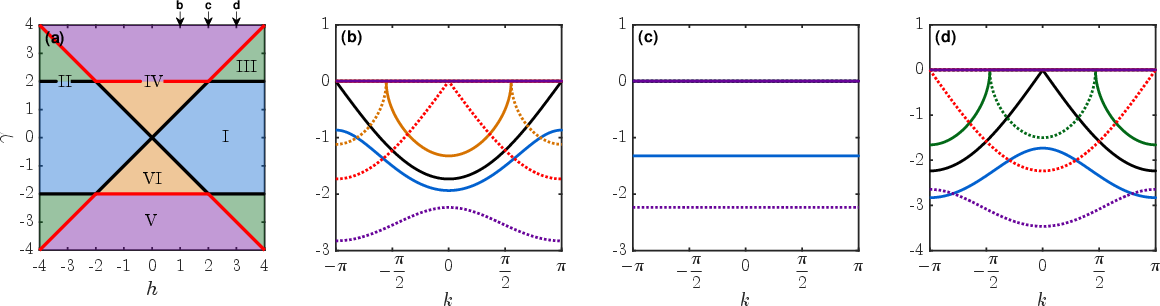
Figure 1: Negative part of the spectrum \eqref{eq:7} and its behavior under different parameter regimes.
The spectrum of the model is analyzed to identify critical points where transitions occur, specifically where the spectrum shifts from being purely real to complex and further to purely imaginary in the PT-broken phase.
Krylov Spread Complexity
Krylov spread complexity is employed to measure the distribution of an evolved state over a natural basis, providing a quantitative metric for detecting phase transitions. The paper identifies that the Krylov spread complexity transitions exhibit non-analytic behaviors across regions indicating phase transitions, evidenced by the divergence of second derivatives of the complexity measure with respect to the model parameters.
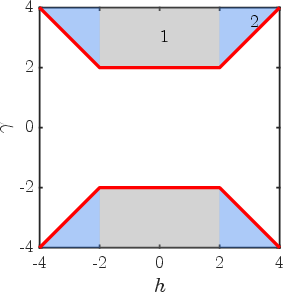
Figure 2: Schematic phase diagram defined via the Krylov fidelity \eqref{eq:b5.1}, showing the spread complexity differences across phase boundaries.
Unitary Dynamics and Spread
Through unitary evolution via a Hermitian Hamiltonian, the non-Hermitian vacuum of the SSH model is reached. The work demonstrates that Krylov complexity is a reliable measure to detect not only conventional PT symmetry breaking but also transitions between complex and purely imaginary spectra.
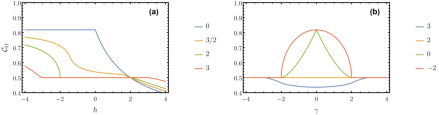
Figure 3: Transverse sections of the spread Eq.~\eqref{eq:15.1}, showcasing different parameter dependencies affecting the spread.
Time-Dependent Krylov Spread and Dynamical Phases
The time-dependent behavior of the Krylov spread complexity offers insights into how a state evolves into its non-Hermitian vacuum. Within the PT-broken regime, this evolution leads to a stationary state characterized by a specific complexity value. The research utilizes Krylov fidelity to determine how the complexity reaches its stationary state value, thus identifying new dynamical phase transitions based on characteristic times derived from the asymptotic behavior of the complexity measure.
Conclusion
The study provides compelling evidence that Krylov spread complexity, supported by Krylov fidelity, serves as an effective diagnostic tool for uncovering phase transitions in non-Hermitian systems. It highlights the capacity of this method to identify previously undetected dynamical phases and offers a robust framework for understanding complex quantum behaviors associated with non-Hermitian Hamiltonians. Through careful analysis and practical application of Krylov methods, this research significantly enhances the comprehension of phase transitions beyond what's traditionally accessible through conventional methodologies.

