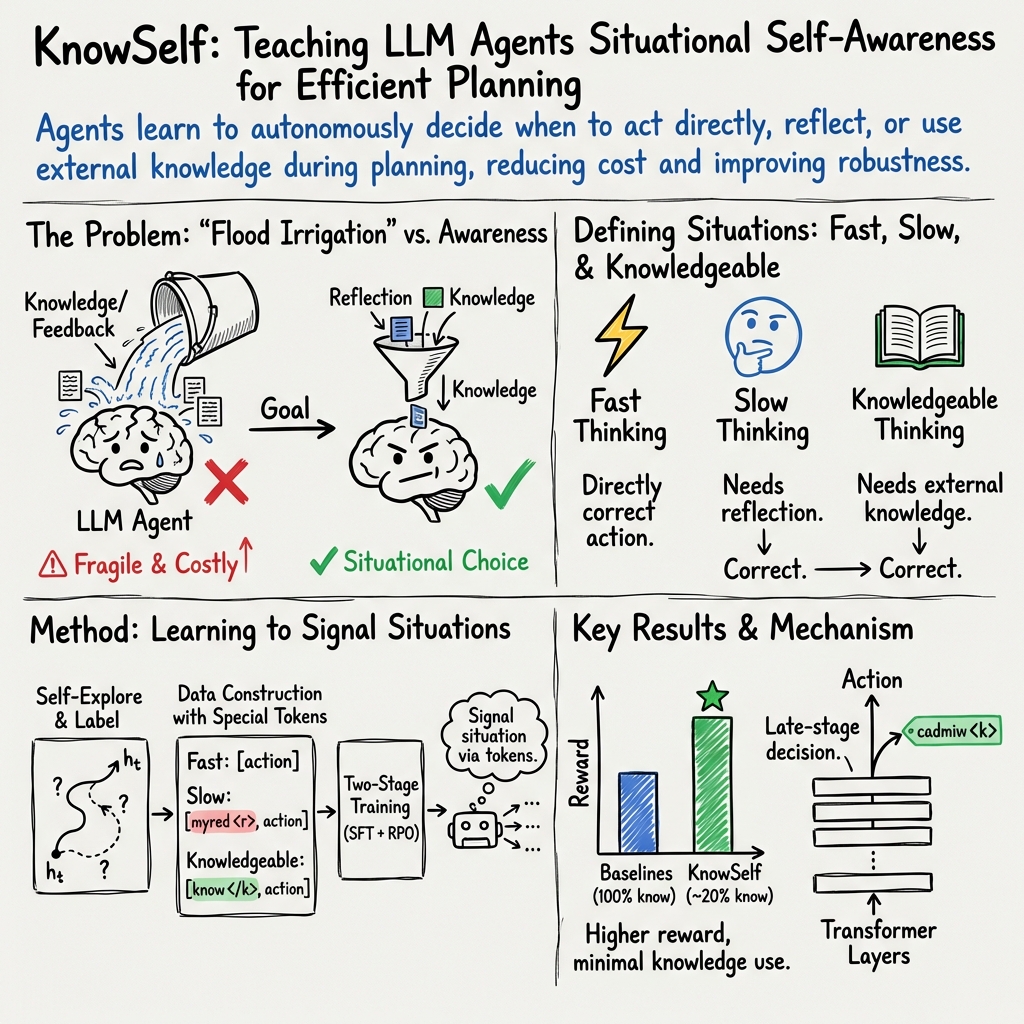
- The paper introduces Agentic Knowledgeable Self-awareness and the KnowSelf framework to enhance LLM agent planning by enabling agents to dynamically regulate knowledge use based on situational demands.
- KnowSelf employs a two-stage training process teaching agents to classify interactions into fast, slow, or knowledgeable thinking situations using special tokens for adaptive decision-making.
- Experiments demonstrate KnowSelf improves planning accuracy while significantly reducing reliance on external knowledge, suggesting potential for lower inference costs and more autonomous AI systems.
Agentic Knowledgeable Self-awareness
The paper entitled "Agentic Knowledgeable Self-awareness" introduces a novel approach aimed at enhancing the planning capabilities of LLM-based agents. The primary focus is on developing agentic knowledgeable self-awareness, enabling these agents to autonomously regulate their knowledge utilization during decision-making tasks, similar to human cognitive processes.
Problem Statement and Approach
In traditional agent planning methodologies, LLMs are supplied with fixed trajectories, external feedback, and domain knowledge indiscriminately, which may lead to inefficient planning due to the lack of situational self-awareness. The authors propose a dynamic approach where agents can assess situational demands and strategically deploy resources. This approach contrasts with the "flood irrigation" of knowledge injection that does not consider the contextual requirements during decision-making processes.
The authors introduce KnowSelf, a data-centric strategy that mimics human-like knowledgeable self-awareness in LLM-based agents. The method employs a heuristic criterion to classify agent interactions into three situations: fast thinking, slow thinking, and knowledgeable thinking. These situations determine whether the agent can immediately decide, needs reflective reasoning, or requires external knowledge, respectively. Special tokens are assigned to classify these situations during the agent's trajectory exploration process.
Methodology
KnowSelf operates through a two-stage training process:
- Stage One: The model is subjected to supervised fine-tuning to establish initial self-awareness planning patterns, teaching the agent how to mark different situations with special tokens.
- Stage Two: An additional RPO (Iterative Reasoning Preference Optimization) loss is implemented to further enhance the model's self-awareness capabilities, allowing it to refine its agent planning abilities.
During inference, the agent uses these special tokens to adaptively determine whether to reflect on its previous actions or consult external knowledge sources, facilitating optimal decision-making with minimal resource use.
Experimental Findings
The KnowSelf framework was tested on two simulated agent planning datasets, ALFWorld and WebShop, using different scales of LLMs. The experiments consistently showed that KnowSelf outperformed various baselines in terms of planning accuracy, using significantly less external knowledge. For instance, on the ALFWorld dataset, KnowSelf achieved superior performance with only 15.01% of actions requiring knowledge assistance, highlighting its efficiency in utilizing knowledge selectively.
Theoretical and Practical Implications
The introduction of agentic knowledgeable self-awareness in LLM-based agents represents an important step towards developing more autonomous and contextually aware AI systems. The theoretical implications suggest that agents with self-awareness capabilities can better handle unexpected signals, reduce planning pattern overfitting, and potentially exhibit improved generalization across tasks.
Practically, KnowSelf could significantly lower inference costs by reducing unnecessary knowledge retrieval and reflection, making it highly applicable for real-world scenarios where computational resources are constrained. Furthermore, the research opens pathways for future studies to explore the scaling laws of agentic self-awareness and the potential integration of these methods in multi-modal environments.
Conclusion
This paper provides a robust framework for advancing the practical efficiency of LLM-based agents through conscientious knowledge use and situational adaptability. By enhancing the self-awareness capabilities of AI systems, the paper sets a foundation for more sophisticated and responsive agent-based planning applications, contributing valuable insights into the evolving field of artificial intelligence. Future research could explore extending these concepts to multi-task or multi-modal scenarios, further broadening the scope and utility of self-aware AI agents.