- The paper introduces a novel framework that embeds watermarks into the behavior-level decisions of intelligent agents.
- The framework employs a multi-round simulation with probabilistic biases and memory updates to integrate watermark-guided behavior selection.
- Experimental validation using z-statistics confirms robust watermark detection with low false-positive rates across diverse digital interactions.
Agent Behavioral Watermarking Framework: Agent Guide
Introduction
The paper "Agent Guide: A Simple Agent Behavioral Watermarking Framework" introduces an innovative framework designed for embedding watermarks in the high-level decisions of intelligent agents, particularly within digital ecosystems. Existing watermarking methodologies tailored for LLM outputs are challenged by their focus on token-level manipulations, which fail to address the intricacies of agent behaviors. This research proposes Agent Guide, which effectively infuses watermarks at the behavior level, preserving the natural execution of actions.
Framework Design
Agent Guide operates within a multi-round simulated environment, embedding watermarks into the decision-making processes of agents. This process is showcased in a structured framework (Figure 1), which includes a Memory Module for storage and retrieval of agent personas and behavior lists, a module for generating behavior probabilities via LLMs, and an Agent Guide Module that applies watermark-guided biases. The resulting actions are selectively executed, updating reflective memory to simulate ongoing interactions.
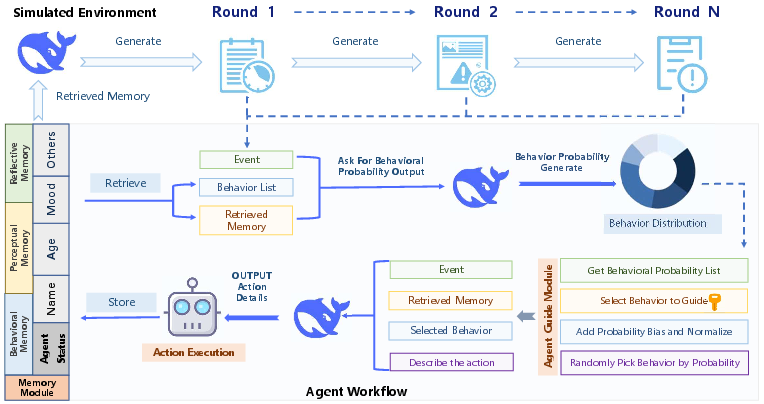
Figure 1: The workflow of Agent Guide, highlighting the multi-round watermark embedding process through behavior guidance.
Event Generation and Probability Output: For each interaction cycle, an event is generated, prompting behavior probability distributions over potential actions. Probabilities are calculated using LLM outputs, ensuring contextual relevance based on prior interactions and a predefined behavior set.
Watermark-Guided Behavior Selection: The heart of the framework lies in its ability to guide behavior selection through probabilistic biases. This selection is conducted via algorithmic processes that modulate behavior probabilities, embedding an indicator for each action choice. The adjustments maintain statistical integrity while achieving behavior watermarking.
1
2
3
4
5
6
7
8
|
def watermark_guided_behavior(P_r, behavior_list, key, round_num):
    gamma = max(gamma, gamma_min)
    n = max(n, n_min)
    guided_behaviors = select_behaviors(behavior_list, key, round_num, n)
    for b in guided_behaviors:
        P_r[b] += gamma * P_r[b]
    normalize(P_r)
return random_selection(behavior_list, P_r) |
Action Execution and Memory Update: The executed actions—derived from the guided behavior decisions—are retained within the memory module, updating contextual data for the next interaction cycle. The sequential nature of memory updating assures coherent agent behavior across operations.
Watermark Detection and Analysis
For verification, statistical analysis grounded in z-statistics is employed to detect watermarks. By contrasting observed behavior against expectations from non-watermarked agents, the framework reliably determines watermark presence. Detection is predicated on a careful examination of behavior pattern alignment over a series of interactions.
Experimental Validation
Experiments simulated in social media environments underscore the framework’s robustness in identifying watermarked agents while minimizing false positives. Diverse profiles reflecting variations in user activity and mood were tested, demonstrating consistent z-statistic performance well above detection thresholds. Watermark detection showed adaptability against varying levels of agent engagement.
Conclusion
The Agent Guide framework shows considerable promise in embedding detectable watermarks within agent behavior, offering a robust mechanism for agent traceability and accountability in digital ecosystems. It addresses existing gaps in watermarking techniques by catering specifically to agent behaviors rather than purely content outputs. Future directions of research include expanding applicability to other domains such as finance or healthcare and addressing adversarial challenges to further optimize watermark resilience.