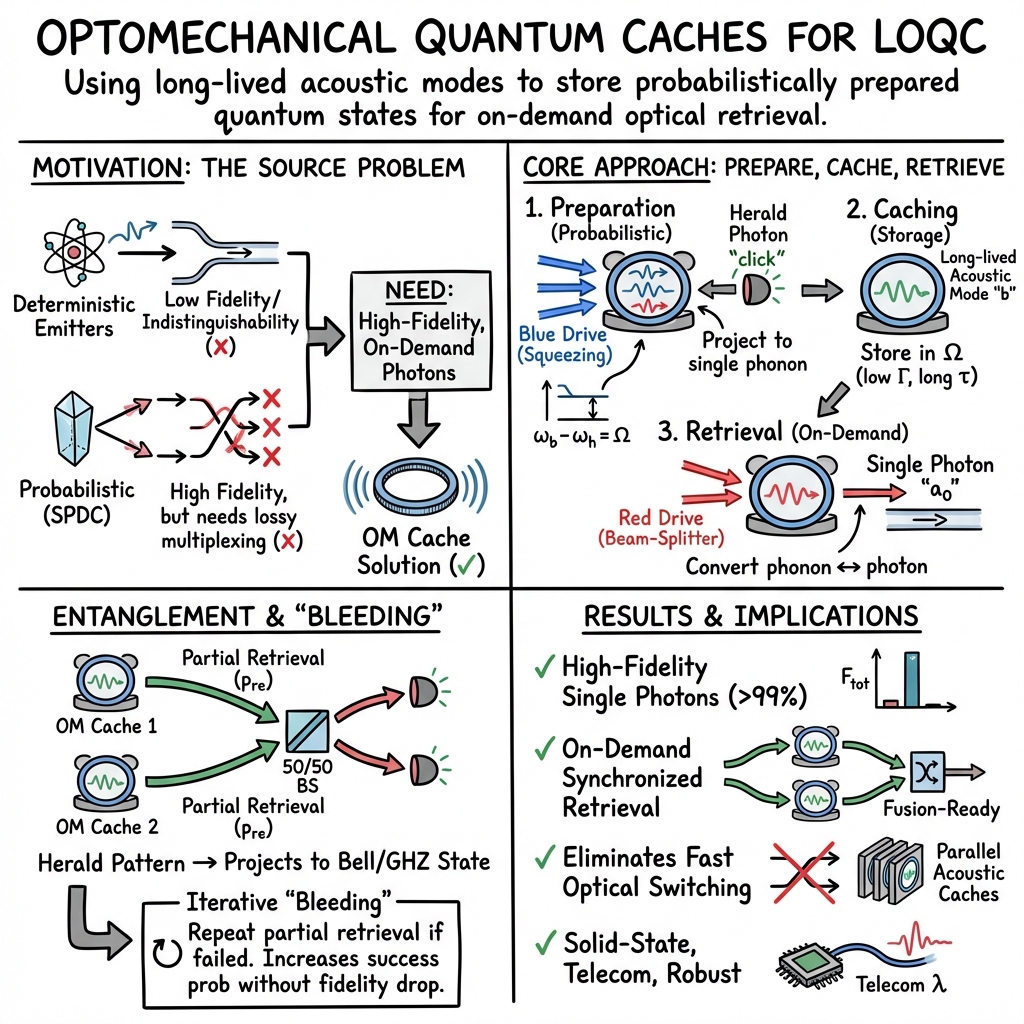
- The paper demonstrates how optomechanical systems use acoustic modes to enable deterministic photon read-out and high-fidelity single photon generation while mitigating electromagnetic noise.
- It details a triply-resonant interaction framework with heralding techniques that balance preparation fidelity and enable scalable parallel photon generation.
- The study outlines an adaptive bleeding strategy for enhanced entangled state creation, providing a robust resource for fault-tolerant linear optical quantum computing.
Optomechanical Resource for Fault-Tolerant Quantum Computing
Introduction
The paper "Optomechanical resource for fault-tolerant quantum computing" (2505.00768) explores the use of optomechanics as a means to facilitate fault-tolerant quantum computing with linear optics. Traditional approaches often require complex networks for rerouting and retiming due to the inherent probabilistic nature of single photon and entangled state generation. This work proposes using acoustic modes within optomechanical (OM) systems to cache quantum resources and provide deterministic read-out capabilities, offering advantages such as longer lifetimes and insensitivity to electromagnetic noise.
Theory of Optomechanical Setup
The proposed OM setup involves a Hamiltonian where acoustic modes (b^) interact with optical modes through radiation pressure and the photo-elastic effect. The system is comprised of a triply-resonant interaction where two optical pairs {a^b,a^h} and {a^0,a^r} engage with the acoustic mode. The optical coupling rates and vacuum coupling constants define the dynamics, allowing tailored interactions for photon-phonon entanglement and deterministic single photon output from phonon states.
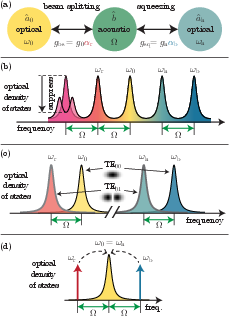
Figure 1: Proposed optomechanical system. (a) Coupled mode diagram. The output optical mode, a^0 (yellow circle), and herald optical mode, a^h (teal circle) independently couple to quantum acoustic mode b^ (green circle), with strongly-driven classical mode amplitudes αr and αb controlling the effective coupling strengths.
Single Photon Source Preparation
The methodology for creating a single photon source involves initializing the OM resonator, preparing a single phonon state, and reading it out as a photon. High-fidelity single-phonon preparation relies on effective heralding techniques, with optical and acoustic modes maintained close to ground state through laser cooling (Sec.~\ref{sec:init}). The probability of single phonon generation is calibrated to balance the trade-off between heralding fidelity and idling fidelity, ensuring efficient parallel preparation of N single photons (Sec.~\ref{sec:parallelization}).
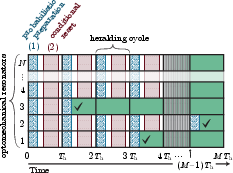
Figure 2: Parallel preparation of N single phonons divided into heralding cycles. Each heralding cycle consists of two steps: (1) (blue hatch) attempt to prepare a single phonon in every OM resonator not already prepared, and (2) (red dots) re-initialize modes to the ground state where preparation does not herald success.
Entanglement Resource for Quantum Computing
The paper extends the OM system's utility to preparing small entangled states, essential for LOQC. By manipulating phononic dual-rail qubit states, the system can probabilistically prepare entangled states like GHZ states in acoustic modes. The entangled states can be heralded based on single-photon detections, and their preparation probability can be enhanced using a bleeding strategy that iterates the entanglement protocol, capitalizing on stationary acoustic modes for repeated interactions (Sec.~\ref{sec:bleeding}).
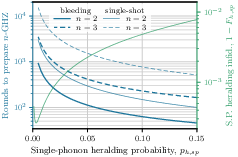
Figure 3: Adaptive bleeding compared to single-shot strategy for preparing entangled states. The expected number of rounds to prepare an n-GHZ state is minimized with the bleeding strategy, using optimal retrieval probabilities at each step.
Conclusion
This paper articulates a comprehensive framework for leveraging optomechanics to generate precise quantum resources necessary for fault-tolerant LOQC. By circumventing the requisite optical multiplexing with acoustic caching, this approach shows potential for high-fidelity photon and entangled state generation. The proposed method is particularly well-suited to environments where robust, delay-free operation is crucial. Future directions include addressing experimental challenges such as optical losses and device uniformity, as well as designing error-correcting codes adaptable to inevitable quantum resource imperfections.