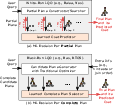
- The paper introduces a Conformal Prediction method for runtime verification of Learned Query Optimizers with formal latency guarantees.
- It details a CP-guided plan search strategy that enhances query plan quality and reduces planning time, improving performance by up to 9.84x.
- The framework adapts to distribution shifts in dynamic workloads, detecting violations early and integrating fallback mechanisms when needed.
The paper "Conformal Prediction for Verifiable Learned Query Optimization" introduces an innovative approach for verifying Learned Query Optimizers (LQOs) using Conformal Prediction (CP), addressing a significant challenge in database query optimization. The work focuses on enhancing the reliability and performance of learning-based query optimization techniques, which have shown promise but face practical barriers due to unpredictability and stability issues.
Introduction to Learned Query Optimization and Its Challenges
Query optimization remains a pivotal yet challenging component of database management systems, translating user queries into efficient execution plans. Traditional query optimizers are predominantly heuristic-based, relying on fixed optimization rules. However, Learned Query Optimizers (LQOs) are increasingly preferred for their adaptability and superior performance in complex query scenarios. Despite their advantages, LQOs face critical challenges, notably the potential for generating suboptimal execution plans during early trainings, susceptibility to catastrophic performance in sparse data scenarios, and performance degradation under workload distribution shifts [neo].
The paper redefines LQO verification as a Conformal Prediction (CP) problem, presenting a robust statistical framework for runtime verification of LQOs with formal guarantees.
CP-Guided Plan Search Strategy
In addition to verification capabilities, the paper proposes a CP-guided plan search strategy. Unlike traditional LQOs that depend on predicted costs, this method utilizes CP-derived latency upper bounds to make more informed optimization decisions during query plan generation. This new approach enhances plan quality and reduces planning time, which is particularly beneficial for large and complex queries.
The verification and enhancement frameworks were integrated into three LQOs—Balsa, Lero, and RTOS—and tested across standard workloads, such as the JOB and TPC-H benchmarks. The experiments demonstrated several crucial outcomes:
- Accuracy and Efficiency: The CP-based verification methods reliably detected and managed constraint violations, with adaptive CP maintaining high confidence levels amidst distribution shifts.
- Improved Query Plan Quality: The CP-guided plan search improved query plans by up to 9.84x in certain scenarios, with significant reductions in planning latency (up to 74.4% for individual queries and 9.96% overall).
- Reduction in Execution Latency: Handling long-latency queries via the proposed methodology substantially decreased execution times, highlighting its practical efficacy.
Implications and Future Developments
The proposed CP-based frameworks hold tremendous potential for enhancing the robustness and reliability of LQOs in real-world applications. The adaptive CP approach, in particular, presents a scalable solution to the challenges posed by dynamic environments and distribution shifts. As database systems continue to evolve, integrating runtime verification and CP-guided strategies could become integral to future query optimization frameworks, potentially extending beyond LQOs to other learned components in data management systems.
Conclusion
This work represents a significant step forward in addressing the verification challenges of LQOs using Conformal Prediction. By providing a mechanism for runtime verification and latency-bound guidance in query plan generation, the paper paves the way for more trustworthy and efficient database optimization systems, capable of adapting to dynamic and complex workloads while maintaining performance stability and reliability.