- The paper highlights advancements in multi-agent embodied AI, integrating control strategies, learning methods, and generative models to enhance dynamic interactions.
- The paper demonstrates the scalability and coordination challenges in decentralized multi-agent environments, focusing on robust planning and adaptability.
- The paper proposes future directions centered on hierarchical coordination, data-efficient learning, and improved agent communication for real-world applications.
Multi-agent Embodied AI: Advances and Future Directions
The paper "Multi-agent Embodied AI: Advances and Future Directions" (2505.05108) explores the evolving landscape of embodied AI, specifically focusing on multi-agent systems. By integrating artificial intelligence with physical bodies, embodied AI systems are capable of interacting with the environment in a more dynamic and context-aware manner. The paper identifies current advancements, challenges, and future directions in multi-agent embodied AI, emphasizing the need for sophisticated mechanisms to manage complex scenarios involving multiple agents.
Introduction to Embodied AI
Embodied AI combines AI, robotics, and cognitive science, equipping agents with the ability to perceive, act, and interact with their environments (Figure 1). Unlike traditional AI paradigms that rely on abstract reasoning or passive data learning, embodied AI emphasizes real-world interaction through the perception-cognition-action cycle. Agents equipped with multimodal sensors and actuators can dynamically adapt their behavior and improve intelligence incrementally through interacting with their surroundings.
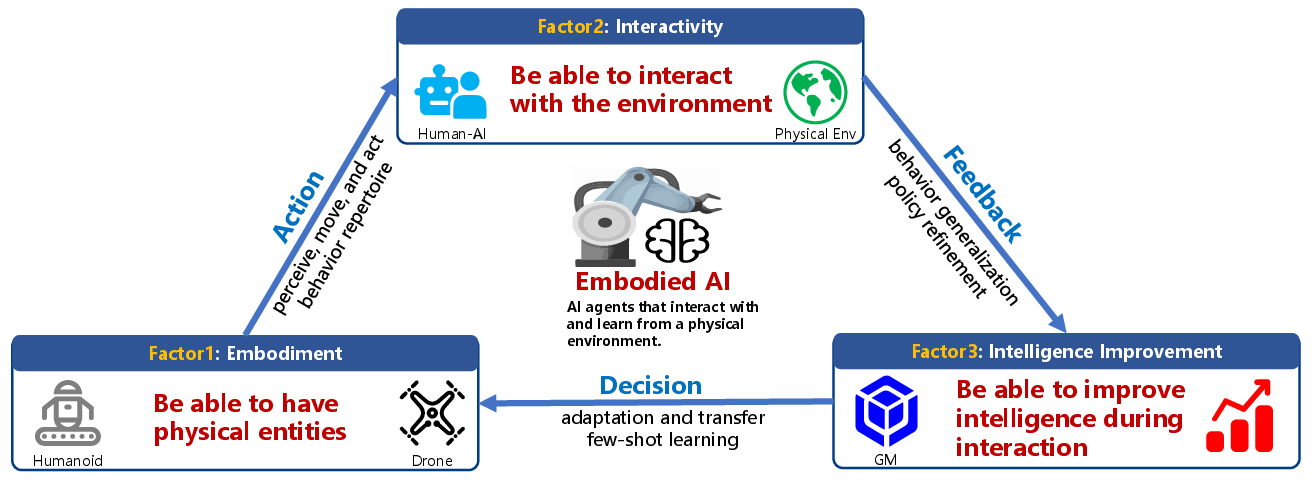
Figure 1: An illustration of embodied AI.
Multi-Agent Systems (MAS)
Multi-agent systems (MAS) involve multiple autonomous agents, each making independent decisions and interacting with their surroundings and other agents (Figure 2). A key advantage of MAS is their ability to distribute tasks among agents, enhancing scalability and adaptability, even in non-stationary environments. Despite the potential, MAS research remains relatively nascent, especially for embodied systems, requiring solutions for effective collaboration, coordination, and communication among diverse agents.
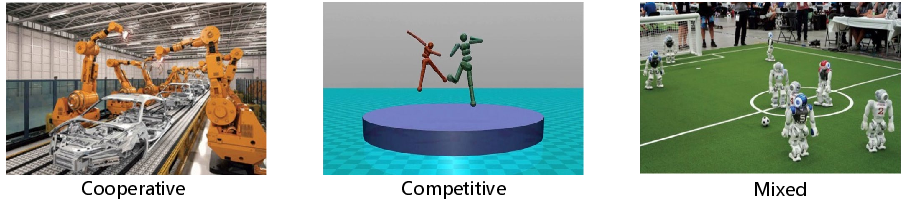
Figure 2: Three common settings of MAS.
Current Methodologies in MAS
The current methodologies in MAS focus on classic control and planning, learning-based approaches, and integration with generative models.
Control and Planning
Classic methods often use centralized planning strategies that suit well-structured environments. However, these approaches can become inefficient as systems scale or when adaptability to dynamic environments is required. Distributed control and planning have arisen to address these issues by decentralizing decision-making, allowing for greater flexibility and robustness in dynamic scenarios.
Learning-Based Methods
Learning-based methods, such as multi-agent reinforcement learning (MARL), provide a robust framework for managing complex, dynamic interactions. These methods enable agents to learn optimal strategies from interactions and adapt to new environments or tasks. However, challenges such as the "curse of dimensionality" and sample inefficiency persist, especially in environments requiring intricate collaboration among agents.
Generative Model Integration
The integration of large-scale generative models, particularly LLMs, offers new insights into MAS by facilitating natural language understanding, enhancing perception, and enabling more intuitive interaction and communication among agents. These models can help resolve complex tasks by leveraging prior knowledge encoded in large datasets.
Challenges and Future Directions
Despite advancements, several challenges in multi-agent embodied AI need addressing. These include developing robust algorithms that handle non-stationarity and scalability, integrating hierarchical coordination frameworks, and ensuring data-efficient learning. Additionally, the theoretical foundations for MAS need further development, particularly concerning stability, generalization, and interpretability of the models.
The future of MAS involves creating general frameworks that facilitate seamless interaction among agents and between agents and humans. This goal requires robust methodologies for multi-agent coordination in open environments, sophisticated benchmarking, and adaptive learning algorithms.
Conclusion
This paper provides a comprehensive overview of the advancements and future directions in multi-agent embodied AI. It underscores the potential of integrating sophisticated AI models with physical embodiments to create systems capable of navigating complex real-world scenarios. As the field progresses, addressing current challenges will be crucial in harnessing the full potential of multi-agent systems across various domains including robotics, transportation, and interactive simulations.