- The paper offers an exhaustive taxonomy of six LLM-CAD application domains, mapping from code generation to evaluation.
- It details methodologies like automated CAD code and parametric data generation using multimodal LLM processing.
- The paper quantifies industrial benefits and outlines future research directions for enhanced CAD design automation.
LLMs for Computer-Aided Design: An Expert Survey
Overview and Taxonomy
This survey offers an exhaustive analysis of the integration of LLMs within Computer-Aided Design (CAD) ecosystems. The authors delineate the industrial relevance of CAD, systematically review foundational LLM architectures, and classify state-of-the-art LLM families (closed-source and open models). The core contribution is a taxonomy of six primary application areas where LLMs intersect with CAD, shaping both current practice and future directions.
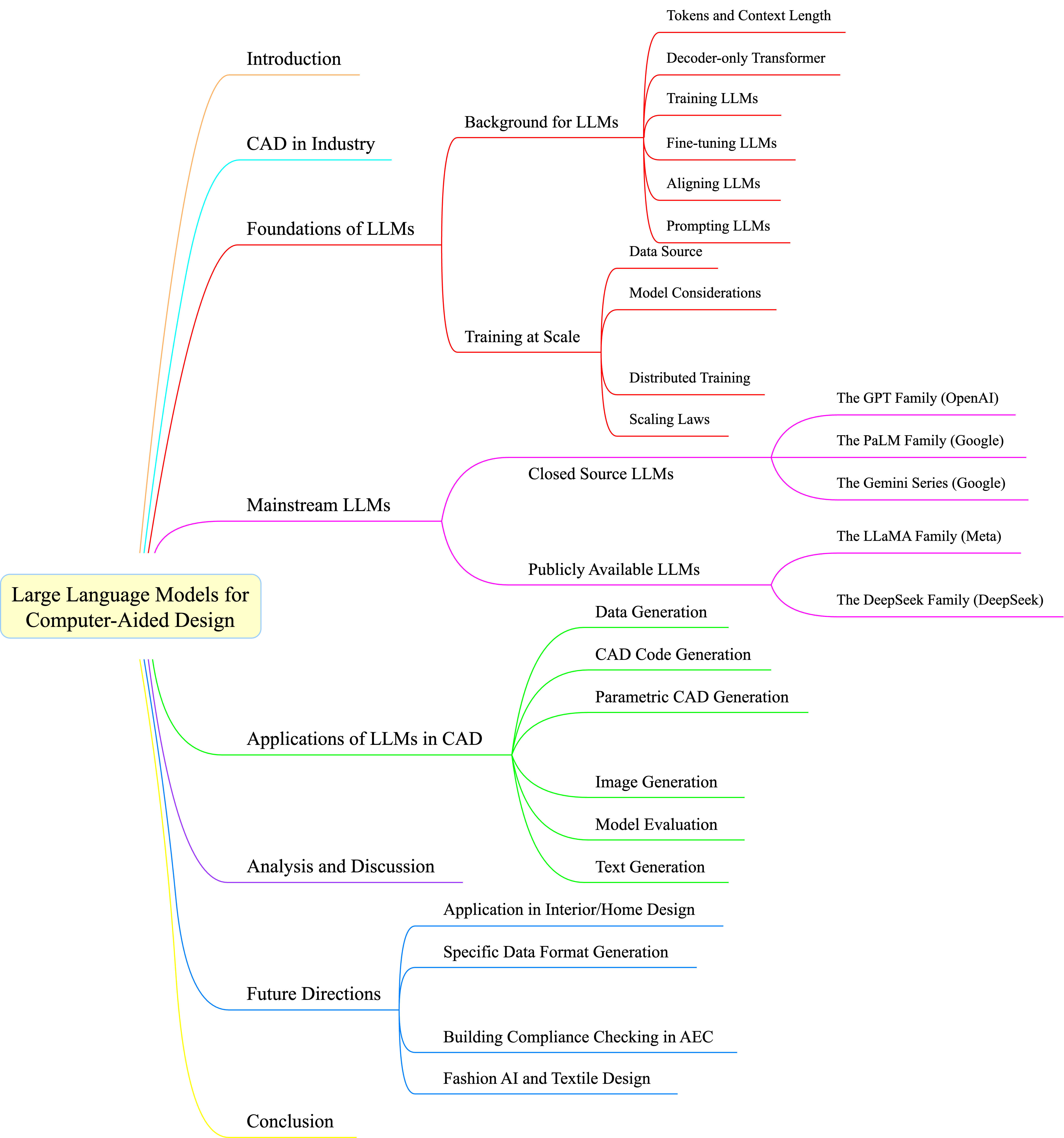
Figure 1: Taxonomy of the review, enumerating six major thematic areas in LLM–CAD integration.
Industrial Significance of CAD
CAD is established as an indispensable infrastructure across sectors such as manufacturing, architecture, aerospace, electronics, and biomedical engineering. The migration from manual to digital design tools facilitates a reduction in design cycle time by 30–50% and enables programmatic, accurate design workflows. The annual global market for 3D CAD software is forecast to more than double, attributed to the adoption of increasingly complex modeling and automation methods.
Foundations and Scaling of LLMs
LLMs are presented as high-capacity, transformer-based neural architectures with billions to trillions of parameters. The survey carefully discusses core concepts pertinent to CAD researchers: tokenization, context window, pretraining, fine-tuning (especially instruction-based and RLHF), alignment, and advanced prompting paradigms (e.g., Chain-of-Thought, in-context learning).
Scaling up LLMs invokes stringent prerequisites in data quality, diversity, privacy, and bias mitigation. The survey underscores that >90% of web-scraped content may be discarded during curation for optimal model performance, and that scaling laws drive the empirical improvement of LLMs as a function of compute and training data. Distributed training is identified as a critical engineering challenge, with recent models (e.g., LLaMA-3, DeepSeek-V3) utilizing tens of thousands of GPUs and sophisticated mixture-of-experts architectures.
Classification of Mainstream LLMs for CAD
The authors systematically group key LLMs into closed and open-source families:
- Closed-source: GPT (various generations up to GPT-4.5o), PaLM and derivatives (PaLM-E, Flan-PaLM, Med-PaLM), Gemini series, Claude 3, Grok, BloombergGPT.
- Open models: LLaMA (LLaMA, LLaMA-2, LLaMA-3/3.1/4 and many fine-tuned derivatives), DeepSeek family, Code LLaMA, Mistral, Vicuna, Alpaca, Qwen, Koala, Orca, WizardLM, MiniGPT-4, Stable Beluga, Gemma, FLM, Pythia, Baichuan2.
The proliferation of instruction-following, multimodal, mixture-of-experts, and domain-specialized models is established as a hallmark of recent progress.
Applications of LLMs in the CAD Domain
The survey's central contribution is a rigorous mapping of LLM capabilities to CAD applications, grouped into six classes:
1. Data Generation
LLMs are leveraged for synthetic dataset creation, especially textual instruction hierarchies and multimodal object descriptions. Prompts, multi-view images, and parameter sequences are paired to produce large, structured corpora. State-of-the-art works primarily utilize LLMs for textual annotation, and there is no evidence yet of direct generation of CAD images or point clouds using LLMs in this application category.
2. CAD Code Generation
LLMs pretrained on code corpora (notably Codex, GPT-4, and GPT-4V) are used for automatic generation of executable CAD scripts. Multimodal LLMs parse inputs ranging from text, sketches, and images to produce modeling macros in Python, SQL, or CAD-specific languages. Iterative refinement processes—debugging, error feedback, and program verification—are widely adopted to improve execution success and semantic fidelity.
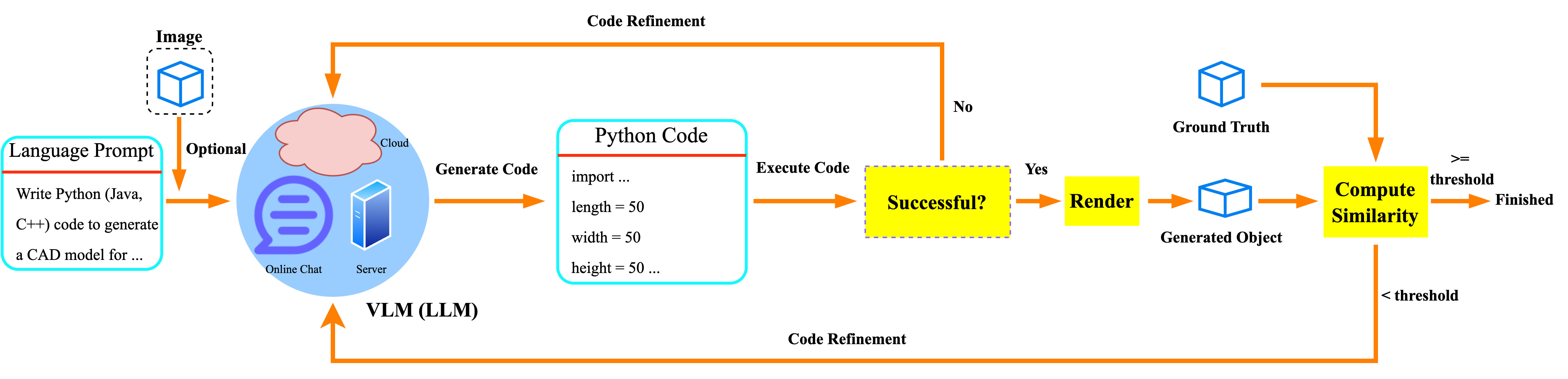
Figure 2: Canonical CAD code generation workflow with feedback-driven code refinement and visual similarity evaluation.
3. Parametric CAD Generation
LLMs generate parametric sequences (typically JSON or XML formats) that encode CAD construction histories. Models process multimodal inputs (text, images, point clouds) to propose symbolic or continuous parameter tuples, enabling flexible downstream parsing and controllable CAD model synthesis.
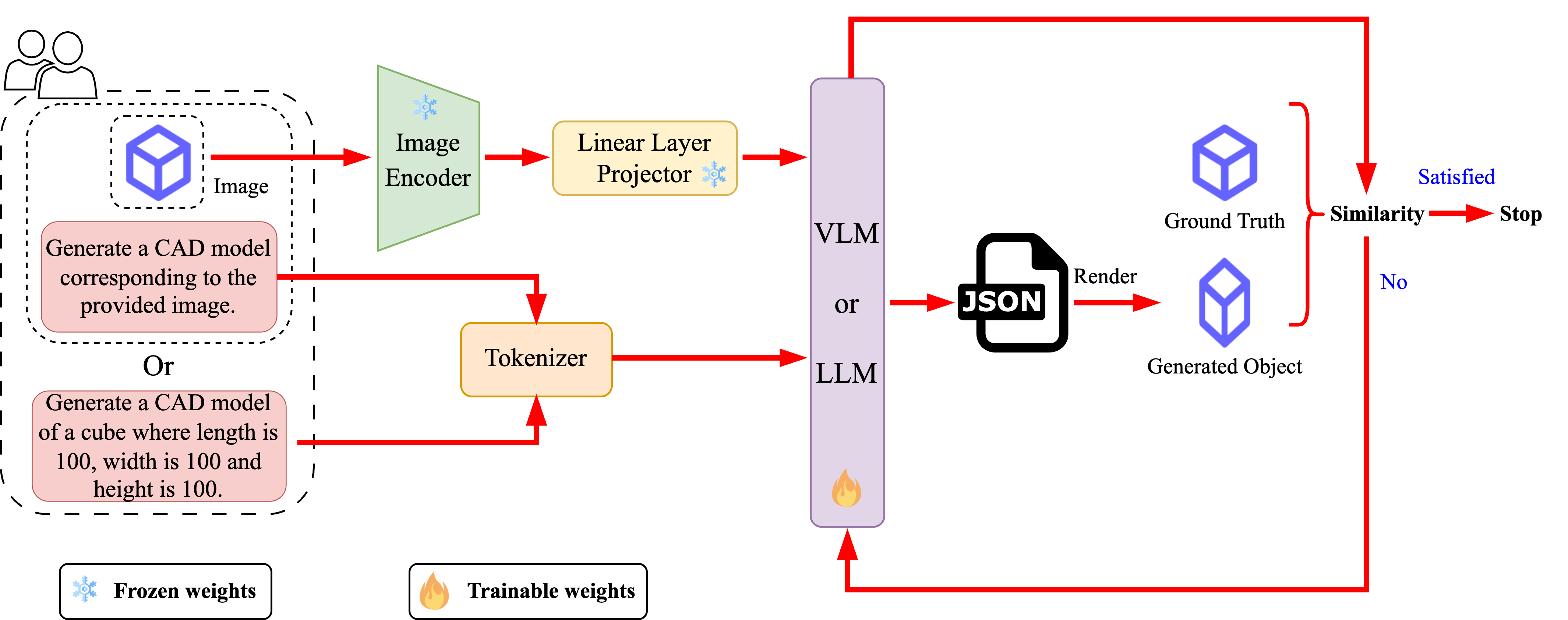
Figure 3: Parametric CAD generation pipeline, mapping prompt and optional image features via VLM/LLM to structured parametric outputs for 3D model synthesis.
4. Image Generation
Application of LLMs for end-to-end CAD image synthesis remains nascent. One notable instance is ChatCAD—a multi-agent LLM framework for zero-shot digital drawing restoration, utilizing domain-specific Retrieval-Augmented Generation.
5. Model Evaluation
LLMs and VLMs are increasingly adopted to assess generated CAD models both visually and semantically. Evaluation tasks encompass automated scoring of visual fidelity, attributes (size, color, material), and textual description similarity—enabling scalable, human-in-the-loop and auto-feedback loops.
6. Text Generation
Text generation encompasses automatic creation of design descriptions, semantic code block comments, plan generation, and question answering. Recent research demonstrates LLMs decompose complex CAD programs into labeled semantic parts, generate photorealistic prompts, and assist in manufacturing feature recognition from multi-view images.
Observed Trends, Contradictory Findings, and Institutional Mapping
The survey numerically quantifies that the most frequent application of LLMs in CAD is code generation, with GPT-4o dominating tool selection despite closed-access limitations—indicative of its superior performance on CAD-centric tasks.
A crucial observation is that almost all workflows are mediated via intermediate formats (code, parametric data) rather than direct-to-model synthesis. Multimodality is pervasive, but text and image are the most exploited channels. The manufacturing sector is by far the most active domain, while sectors such as shipbuilding and textiles are underrepresented in current efforts. The authors assert there is no current evidence of direct LLM-based synthetic point cloud or image dataset generation for CAD.
Future Directions
The paper identifies several promising avenues for further research:
- Interior and home design: LLM-driven interior design solutions exist but lack open-source 3D CAD support, motivating future work on semantically conditioned scene graph and parametric model generation.
- Multi-format data generation: Projection towards LLMs that generate not only text and code but point clouds and full 3D models for direct use in CAD environments.
- Automatic compliance checking: Deployment of LLMs for regulatory adherence verification in AEC workflows, with notable progress in BIM interpretation but a gap for direct 3D CAD analysis.
- Fashion and textile CAD modeling: CAD-enabled fashion workflow automation via LLM-driven parametric design remains underexplored and is highlighted as a high-impact area for computational creativity.
Theoretical and Practical Implications
The survey consolidates the position of LLMs as universal mediators between humans and CAD systems, capable of both semantic understanding and programmatic generation. Practically, the emergence of multimodal prompt-conditioned code and parametric model generation is altering design automation, iterative optimization, and cross-domain interoperability. Theoretically, the failure to directly synthesize 3D model outputs via LLMs marks a significant research challenge, likely requiring deeper architectural and representation advances. The authors further speculate that advances in alignment and vision-language fusion (e.g., VLMs with robust spatial reasoning) will be required for fully automated CAD workflows.
Conclusion
This survey systematically analyzes the current intersection of LLMs and CAD, detailing foundational architectures, application taxonomies, observed trends, and future prospects. The most prominent contributions of LLMs to CAD are in text-centric dataset construction, code and parametric data generation informed by multimodal inputs, and automated evaluation. The survey highlights both technical challenges and untapped sectors, mapping a clear trajectory for innovation and theoretical progress in the automated design domain (2505.08137).