- The paper models vortex formation and fractional quantum Hall effects in a rotating anisotropic Bose gas, identifying phase transitions via ED and DMRG.
- It employs a lowest Landau level projection with a two-parameter model to link interaction strength and trap anisotropy with emergent quantum phases.
- The findings reveal transitions from superfluid condensates to vortex lattices and strongly correlated FQH states, offering experimental pathways in ultracold atoms.
Vortex and Fractional Quantum Hall Phases in a Rotating Anisotropic Bose Gas
Introduction
This paper develops a theoretical model to investigate the phases of a rapidly rotating anisotropic Bose gas and the emergence of fractional quantum Hall (FQH) states within it. The study is motivated by recent experimental advances in manipulating ultracold atomic systems, where trap anisotropies and rapid rotation are employed to recreate conditions similar to those found in electronic systems in strong magnetic fields. The central aim is to analyze how various phases emerge as functions of interaction strength, rotation rate, and system anisotropy.
The authors project the full Hamiltonian onto the lowest Landau level (LLL) to derive a two-parameter model. This framework captures the influence of interaction strength (characterized by g) and trap anisotropy (expressed by γ) on the rotating Bose gas. The system is analyzed in a cylindrical geometry with periodic boundaries facilitated by trap anisotropy and high rotation rates, allowing the exploration of edge phenomena and topologically ordered phases.
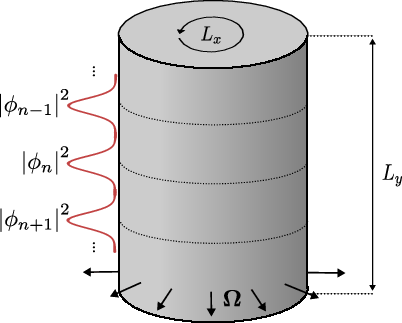
Figure 1: Geometry of the 2D rotating atomic Bose gas in the Landau gauge and schematic representation of the eigenfunctions of the noninteracting Hamiltonian.
The effective model resembles a one-dimensional quantum chain with all-to-all long-range interactions, challenging previous conceptions about the stability and competition between phases such as Bose-Einstein condensates, vortex lattices, and strongly correlated FQH states. Exact diagonalization (ED) and density matrix renormalization group (DMRG) methods provide insights into phase transitions and edge phenomena characteristic of different interaction regimes.
Results and Analysis
The phase diagram developed through this study reveals intricate transitions between distinct physical states based on the rotation and anisotropy parameters. Several diagnostics, including entanglement entropy, particle-hole energy gap, and overlaps with Laughlin wavefunctions, are employed to identify phase boundaries and characterize emergent phenomena.
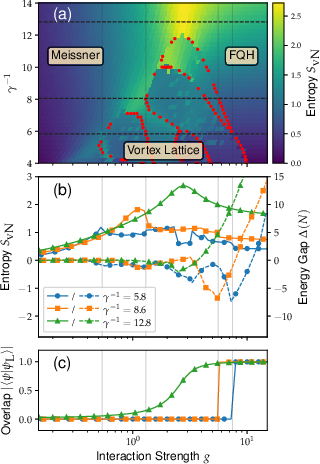
Figure 2: (a) The phase diagram of a rapidly rotating anisotropic Bose gas described by the Hamiltonian.
In weak interaction regimes, the system exhibits conventional superfluid properties analogous to Meissner states. As interactions strengthen, vortex lattice configurations arise, characterized by broken translational symmetry. These vortex phases are marked by nonzero ground state momentum in ED analyses and show complex transitions dependent on trap-induced anisotropies.
Beyond critical interaction strengths, strongly correlated phases resembling FQH states emerge. These are identified by large excitation gaps and uniform density in contrast to crystalline vortex patterns. The system's behavior in the wide-cylinder limit presents a systemic transformation into effectively one-dimensional dynamics dominated by edge properties, indicating potential Luttinger liquid behavior.
Implications and Future Directions
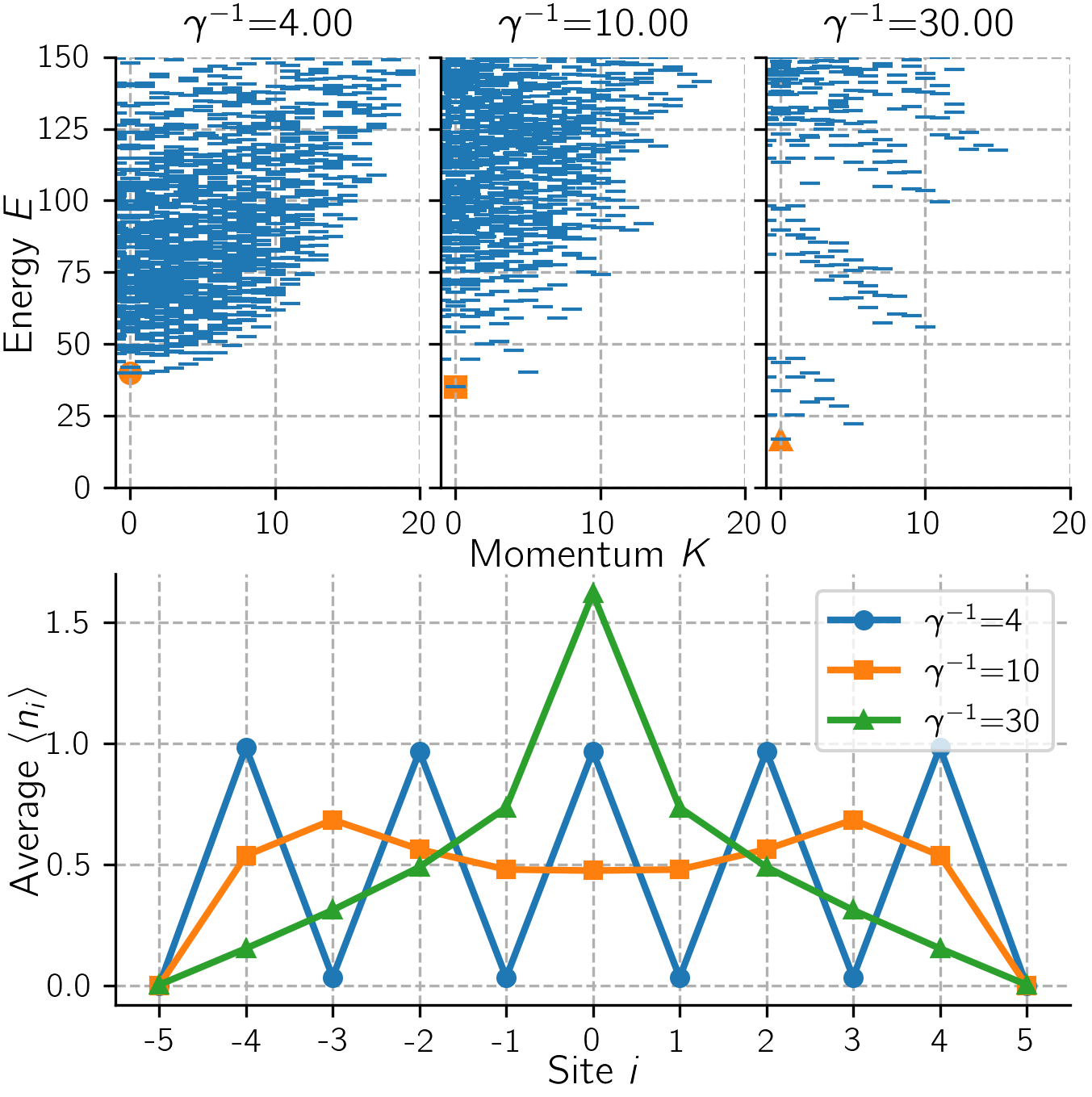
Figure 3: Energy spectrum of the Hamiltonian showcasing transitions from Tao-Thouless states to Laughlin states.
The results offer a comprehensive framework for understanding anisotropic quantum fluids, suggesting pathways for experimental realization of mesoscopic FQH states in ultracold atomic systems. The insights gained illustrate potential for further experimental and theoretical exploration, particularly in regimes dominated by edge effects or anisotropic interactions.
Future work may focus on extending the model to include higher Landau levels or investigating rapidly rotating dipolar gases. Additionally, clarifying specific vortex lattice structures in the thermodynamic limit and their impact on quantum phase transitions offers valuable research opportunities.
Conclusion
This paper establishes a unified and robust model for understanding transitions between superfluid condensates, vortex structures, and topologically ordered phases in rotating Bose gases. By relating experimental parameters such as rotation and trap anisotropy to these transitions, it provides a foundational framework for future studies aiming to explore and harness the unique physical properties of these systems. The work notably advances our understanding of rapidly rotating quantum systems in strong anisotropic traps, contributing significantly to both theoretical and experimental paths forward in the study of quantum phase transitions in cold atomic gases.