- The paper introduces path signatures as a novel framework that decodes ODE solutions by linking iterated integrals with algebraic structures.
- It establishes necessary and sufficient algebraic conditions for characterizing holonomic paths and Legendrian knots within contact distributions.
- The study highlights applications in differential geometry and mathematical physics with potential extensions to analytic manifolds and stochastic systems.
Path Signatures of ODE Solutions
Introduction
The paper "Path signatures of ODE solutions" (2505.13234) investigates the utilization of path signatures to decode solutions of ordinary differential equations (ODEs). The study leverages geometric theories to establish algebraic conditions on path signatures that satisfy a given system of ODEs. This research explores the intricacies of path signatures and their applicability in characterizing integral paths in vector fields, focusing on both linear and Hamiltonian cases. Additionally, it discusses the implications of these findings and potential applications in differential geometry and mathematical physics.
Path Signatures and Algebraic Varieties
The concept of path signatures introduces a sequence of tensors that presents a unique depiction of a path. This sequence can reconstruct the path by encoding the essential information through iterated integrals. The paper describes how path signatures have wide applications, including in topological data analysis and quantum field theory. It extends the characterizations to paths that lie on algebraic varieties, providing necessary and sufficient conditions on signature tensors for paths to satisfy certain geometric constraints.
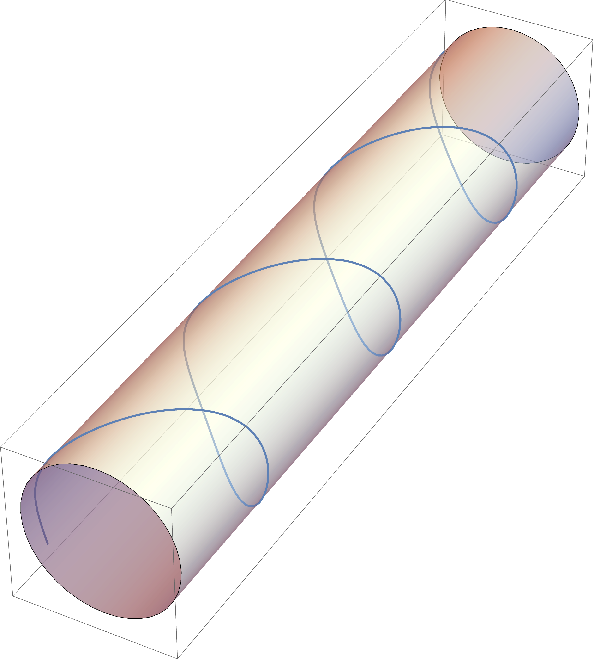
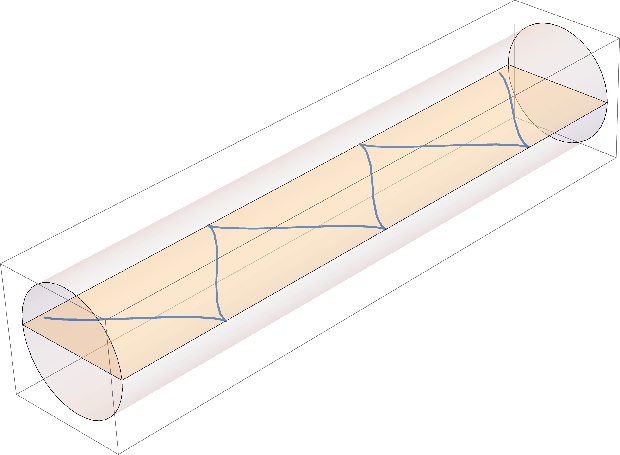
Figure 1: A Legendrian path on the surface of a cylinder.
Characterization of Holonomic Paths
The study progresses into holonomic paths, particularly focusing on Legendrian knots. This involves analyzing paths as integral curves of contact distributions, critical to understanding non-integrable systems in R3. The paper delineates conditions under which paths are considered Legendrian, using signature tensors to provide a clear algebraic characterization. Furthermore, it extends these concepts to encompass (r,l)-holonomic paths, which have significant implications in understanding complex systems represented by higher-order jets.
Applications to ODEs
The paper offers a geometric perspective on ODEs, interpreting solutions as paths contained in specified varieties. It establishes a correlation between the solutions of the ODE and path signatures, providing a unique framework that links algebraic properties with differential equations. This offers new pathways for examining linear and Hamiltonian vector fields, broadening the theoretical understanding of integral curves and their projections onto signature spaces. The study suggests how these techniques are viable for determining paths generated by differential equations in various dimensions and configurations.
Future Directions
Looking ahead, the paper posits several potential advancements in this domain:
- Extension to Analytic Manifolds: Further exploration might involve extending algebraic characterization to manifolds defined by analytic equations, impacting broader systems beyond polynomial structures.
- Rank of Signature Tensors: Investigating rank properties of signature tensors, especially regarding piecewise linear paths and those fulfilling geometric conditions like being Legendrian or lying within a variety.
- Quantitative Methodologies: Introducing quantitative metrics to gauge how closely paths approximate given varieties, enhancing the utility of path signatures in applied mathematics.
- Generalization to Stochastic Differential Equations: The current focus on ODEs suggests intriguing possibilities for characterization within stochastic differential systems, enriching the study's applicability.
Conclusion
In summary, "Path signatures of ODE solutions" provides a profound investigation into how path signatures can be leveraged to interpret solutions of ordinary differential equations through geometric algorithms. By establishing algebraic conditions through signature tensors, the study advances theoretical comprehension of integral curves, linear and Hamiltonian vector fields, and offers a robust framework for future explorations in geometric and analytical mathematics.