- The paper introduces a degradation-aware framework that couples CPFE simulations with polynomial chaos expansion to predict texture-driven plasticity efficiently.
- It calibrates the CPFE model using EBSD-informed microstructural constraints and experimental stress-strain data, achieving prediction errors below 5%.
- Global sensitivity analysis highlights Cube and Goss textures as dominant contributors to mechanical variability, guiding process optimization in welds.
Degradation-Aware, Machine Learning-Driven UQ in CPFE: Texture-Driven Plasticity in 316L Stainless Steel
Overview
This study introduces a hybrid framework for uncertainty quantification (UQ) in crystal plasticity finite element (CPFE) simulations, focusing on the impact of microstructural texture variability in electron beam welded 316L stainless steel. The approach couples physics-based CPFE with surrogate modeling via polynomial chaos expansion (PCE), leveraging high-throughput electron backscatter diffraction (EBSD) data to directly inform microstructural statistical bounds. The resulting surrogate dramatically reduces the computational burden of UQ—replacing thousands of direct CPFE simulations with rapid, statistically rigorous predictions—while preserving physical interpretability and degradation-awareness.
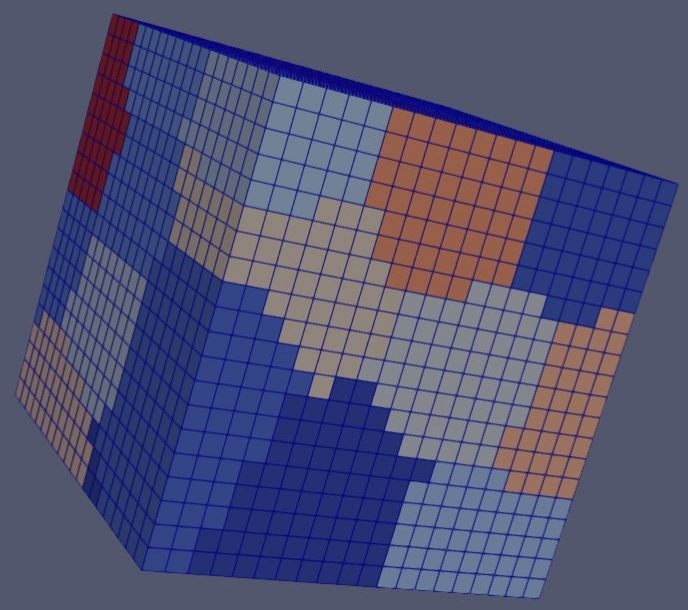
Figure 1: A representative volume element with grains for CPFE simulations.
Microstructural Characterization and Simulation
The mechanical behavior and degradation mechanisms of crystalline alloys are modulated by grain size, morphology, and crystallographic texture, with welded structures exhibiting strong local anisotropy due to process-induced columnar grains and selective solidification. EBSD mapping provided statistical constraints on texture components—including Cube, Goss, Brass, Copper, and Taylor—across multiple weld regions. Representative volume elements (RVEs) were constructed to match these distributions, ensuring that simulation input space was anchored to real-world microstructural heterogeneity.
Mesh convergence studies established that at least 40 finite elements per grain are necessary to resolve intra-grain stress/strain gradients relevant for the early stages of degradation. Simulations with increasing RVE size and grain count revealed that variability in mechanical response (e.g., yield stress, strain localization) flattened markedly beyond ~600 grains, balancing statistical convergence against computational cost.
Calibration of CPFE Constitutive Model
A physically-driven calibration protocol optimized CPFE parameters (SSD density, hardening coefficients, texture orientation, etc.) using experimental stress-strain curves as targets. Parameter fitting minimized RMS error between simulation and experimental data, with convergence achieved through iterative adjustments in a numerically stable, jointly isotropic/kinematic hardening law. Notably, calibration was performed strictly against macro-scale data, avoiding reliance on inaccessible micromechanical measurements, ensuring scalability to practical component assessment.
Polynomial Chaos Surrogate Modeling for UQ
The surrogate model employs a spectral expansion of simulation response in terms of orthogonal polynomials defined over uncertain input distributions (texture modes and fractions). This PCE fits the first 80% of simulation data and validates against unseen samples, predicting mean stress-strain and variance at arbitrary texture configurations with high fidelity. The PCE approach is non-intrusive: it can be constructed using outputs from any baseline CPFE code, allowing flexible wraparound UQ without modifying simulation core routines.
Statistical quantification of stress/strain response at multiple strain levels revealed that variance increases with strain, indicating heightened uncertainty in the plastic regime—a critical zone for fatigue and microcrack initiation. By contrast, elastic regime variability was minimal and tightly bound, consistent across microstructural variability classes.
Sensitivity Analysis: Texture Components as Drivers of Degradation
Global sensitivity analysis using Sobol indices derived from the surrogate identified Cube and Goss textures as the dominant contributors to mechanical response variability under service conditions. Minor textures (Brass, S1, S2, S3, Copper, Taylor) contributed negligibly, suggesting that process optimization (e.g., welding strategies, post-process annealing) should prioritize controlling Cube and Goss texture distributions to mitigate degradation pathways induced via anisotropic strain localization and stress concentration.
Numerical Results
- With only 200 CPFE simulations, the surrogate achieved strong predictive accuracy, exhibiting maximum errors well below 5% compared to full direct simulation for yield stress, plastic strain, and hardening slope.
- For RVEs of ~600 grains reflecting true weld texture distributions, stress variability at 3% strain exceeded 50 MPa across plausible microstructures—demonstrating that conventional Monte Carlo models would underestimate operational risk without texture-aware UQ.
- Texture bounds extracted from EBSD maps yielded Cube fractions from 2.5% to 73.8% and Goss fractions from 0.7% to 63.2%, directly impacting predicted degradation susceptibility.
- Calibration and surrogate modeling together reduced total UQ runtime by several orders of magnitude (from weeks on HPC to hours on workstation-class hardware), without loss of predictive detail.
Practical Implications and Theoretical Significance
This framework enables rapid, interpretable UQ and sensitivity analysis for welded nuclear-grade alloys, making microstructure-aware risk assessment practical for engineering workflows. By integrating experimental data with high-fidelity simulation and advanced surrogate techniques, the method bridges the gap between destructive microstructural characterization and real-time performance prediction. The work refines existing paradigms in digital twin and digital integrity engineering, providing a physical basis for process control and material selection in service-critical environments.
On the theoretical front, the study demonstrates that spectral surrogates retain the mechanistic detail captured in CPFE, enabling physically grounded inversion and global sensitivity quantification—a critical advance over black-box machine learning approaches.
Scope for Future Developments
- Extension to cyclic and multiaxial loading scenarios for fatigue and fracture mechanics, using cyclic calibration and corresponding texture-aware surrogates.
- Deployment in active digital twin environments for in-service monitoring and lifecycle prediction of welded components.
- Generalization to other alloy systems, including precipitation-strengthened and additive-manufactured materials, where microstructural variability fundamentally alters degradation pathways.
- Integration with Bayesian and ensemble UQ methods for robust risk quantification across broader manufacturing variability envelopes.
Conclusion
The degradation-aware, machine learning-driven UQ framework presented effectively couples EBSD-informed texture statistics, CPFE simulation, and polynomial chaos surrogate modeling. It enables efficient and highly resolved prediction of mechanical response variability in 316L weldments under texture-driven uncertainty. Identifying Cube and Goss as critical texture modes equips practitioners with actionable insight for microstructure engineering, while the dramatic reduction in computational cost makes microstructure-sensitive UQ tractable and relevant for industrial deployment in high-reliability sectors.