- The paper demonstrates that TLS defects at amorphous interfaces critically affect transmon qubit coherence, causing spectral dropouts and T1 fluctuations.
- It employs swap spectroscopy and Monte Carlo simulations to map defect coupling and validate the influence of geometric design on performance.
- The findings suggest that optimized fabrication processes and qubit geometries can significantly reduce decoherence, advancing fault-tolerant quantum computing.
Summary of "Statistics of Strongly Coupled Defects in Superconducting Qubits"
The paper "Statistics of Strongly Coupled Defects in Superconducting Qubits" focuses on the impact of discrete defects at amorphous interfaces on superconducting qubits, specifically transmon qubits. These defects lead to decoherence, manifesting as spectral dropouts and fluctuations in energy relaxation time (T1), complicating qubit operation and processor calibration. The study is designed to analyze these effects across different geometries of qubit configurations and pinpoints the defects within close proximity to the qubit junctions, highlighting implications for ongoing and future quantum computing designs.
Experimentation and Findings
The paper investigated the coupling of transmon qubits to dielectric two-level system (TLS) defects through the application of swap spectroscopy over various qubit operating frequencies [Barends2013]. This technique measured energy relaxation across multiple geometries, effectively demonstrating the qubit-TLS interaction and the defects' positions.
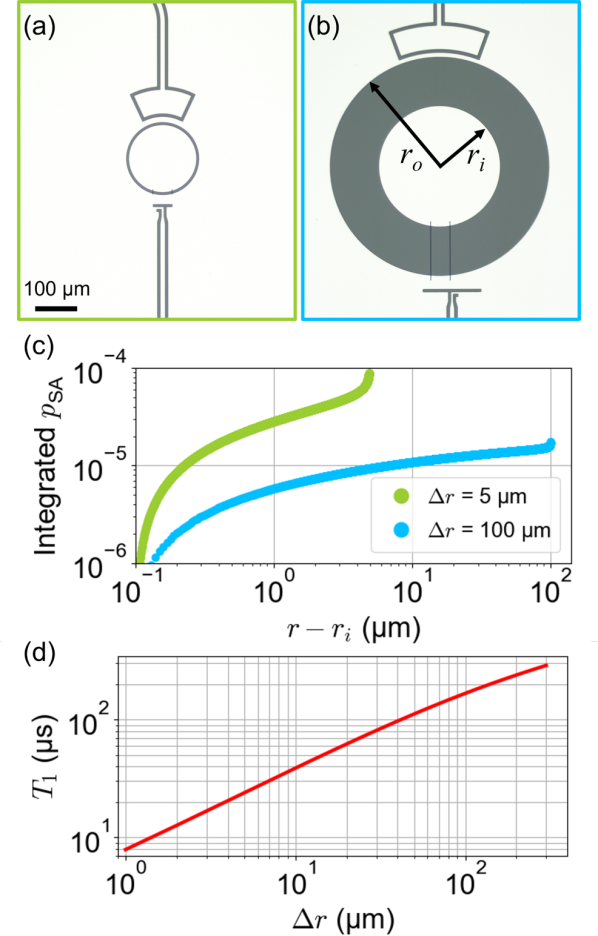
Figure 1: Optical micrograph of single-ended long-liftoff transmon qubits with circular island and gap Δr to ground equal to (a) 5~$\upmu$m and (b) 100~$\upmu$m. (c) Integrated substrate-air (SA) interface participation pSA</p>.</p><p>Theirresultsindicatedalossprimarilydominatedbydiscreteinterfacialdefectswithahighdensitypresentneardeviceinterfaces.Thedatafromtheirswapspectroscopyscanssuggeststhatoptimizedprocessingandadaptedqubitgeometrycanlimitparticipationfromlossyresiduesassociatedwithliftoffprocessing,whichdegradequbitperformance.<imgsrc="https://emergentmind−storage−cdn−c7atfsgud9cecchk.z01.azurefd.net/paper−images/2506−00193/figure2main.png"alt="Figure2"title=""class="markdown−image"loading="lazy"><pclass="figure−caption">Figure2:Measured\Gamma_1vs.operatingfrequencyforshort−liftoffqubitswithgapsof5and100\upmu$m. The inset shows example fits obtained using Eq.~\ref{eq:lorentzian}.</p></p>
<p>The temporal fluctuation of $T_1$ highlighted the influence of spectral diffusion—a phenomenon arising from TLS interaction with thermal fluctuators—and emphasizes the geometric influence in minimizing defect interaction [Klimov2018].</p>
<h2 class='paper-heading' id='modeling-and-analysis'>Modeling and Analysis</h2>
<p>The paper provides an analytical framework to model these TLS interactions by employing a TLS defect density equation and examines electric field scaling within the qubit layouts. The distribution suggests defects' edge proximity considerably affects coupling strengths $g.Figuresportrayingelectricfieldmodelsaroundthequbitjunctionsunderscorethecorrelationbetweenstructuraldesignanddefectdensity.<imgsrc="https://emergentmind−storage−cdn−c7atfsgud9cecchk.z01.azurefd.net/paper−images/2506−00193/figure5main.png"alt="Figure3"title=""class="markdown−image"loading="lazy"><pclass="figure−caption">Figure3:Cumulativehistogramsof(2\pi/g)^2for(a)experimentaldataand(b)<ahref="https://www.emergentmind.com/topics/monte−carlo−simulations"title=""rel="nofollow"data−turbo="false"class="assistant−link"x−datax−tooltip.raw="">MonteCarlosimulations</a>.</p></p><p>MonteCarlosimulationswereusedtovalidateexperimentalfindings,offeringa<ahref="https://www.emergentmind.com/topics/additive−parallel−correction"title=""rel="nofollow"data−turbo="false"class="assistant−link"x−datax−tooltip.raw="">parallel</a>fordefectscouplingstrengthsandspectraldistributionresults.Suchmodelsshowtheimportanceofoptimallyfabricatingjunctionleadswithreducedresiduesfromliftoffprocesses,minimizingstrongdefectinteractions[Martinis2022].</p><h2class=′paper−heading′id=′contribution−to−quantum−computing′>ContributiontoQuantumComputing</h2><p>Theinsightsfromthesedetailedexperimentsandmodelingsuggestcriticalimprovementsforquantumprocessordesigns,particularlyforerror−correctedquantumsystemsthatrelyonconsistencyandreliabilityoverlargearraysofqubits[GoogleQuantum2024].Particularly,thesuppressionofdefectdensitiesvianovelfabricationtechniquesisfundamentalforachievinghigh<ahref="https://www.emergentmind.com/topics/fidelity−alpha−precision"title=""rel="nofollow"data−turbo="false"class="assistant−link"x−datax−tooltip.raw="">fidelity</a>quantumcomputations[Osman2023].<imgsrc="https://emergentmind−storage−cdn−c7atfsgud9cecchk.z01.azurefd.net/paper−images/2506−00193/figure9sup.png"alt="Figure4"title=""class="markdown−image"loading="lazy"><pclass="figure−caption">Figure4:Cumulativehistogramsof(2\pi/g)^2$ for all measured qubits, with data from nominally identical qubits combined into a single trace.
The paper implies that addressing TLS interactions through geometry and process modifications is vital for furtherance toward fault-tolerant, scalable quantum systems.
Conclusion
This study systematically analyzes how strongly coupled TLS defects impede qubit performance, offering insight into their locational effects tied to geometry-specific processing residues. It suggests imperative shifts in fabrication strategies to diminish defect densities and enhance coherence. Through addressing these defects, future quantum processors can substantially improve operational efficiency and reliability, paving the way for advancements in quantum computing scalability and efficacy.