Papers
Topics
Authors
Recent
Search
2000 character limit reached

FinRobot: Generative Business Process AI Agents for Enterprise Resource Planning in Finance

Published 2 Jun 2025 in cs.AI, cs.SE, and q-fin.GN | (2506.01423v1)

Abstract: Enterprise Resource Planning (ERP) systems serve as the digital backbone of modern financial institutions, yet they continue to rely on static, rule-based workflows that limit adaptability, scalability, and intelligence. As business operations grow more complex and data-rich, conventional ERP platforms struggle to integrate structured and unstructured data in real time and to accommodate dynamic, cross-functional workflows. In this paper, we present the first AI-native, agent-based framework for ERP systems, introducing a novel architecture of Generative Business Process AI Agents (GBPAs) that bring autonomy, reasoning, and dynamic optimization to enterprise workflows. The proposed system integrates generative AI with business process modeling and multi-agent orchestration, enabling end-to-end automation of complex tasks such as budget planning, financial reporting, and wire transfer processing. Unlike traditional workflow engines, GBPAs interpret user intent, synthesize workflows in real time, and coordinate specialized sub-agents for modular task execution. We validate the framework through case studies in bank wire transfers and employee reimbursements, two representative financial workflows with distinct complexity and data modalities. Results show that GBPAs achieve up to 40% reduction in processing time, 94% drop in error rate, and improved regulatory compliance by enabling parallelism, risk control insertion, and semantic reasoning. These findings highlight the potential of GBPAs to bridge the gap between generative AI capabilities and enterprise-grade automation, laying the groundwork for the next generation of intelligent ERP systems.
Summary

  • The paper introduces GBPAs as an innovative framework that uses LLMs for dynamic financial ERP workflows.
  • It details a 5W3H1R data schema and a multi-layered architecture, achieving up to 40% faster processing times and reducing error rates by 94%.
  • The study demonstrates practical improvements in ERP systems and paves the way for AI-native enterprise transformations across various industries.

Summary of "FinRobot: Generative Business Process AI Agents for Enterprise Resource Planning in Finance"

The paper introduces Generative Business Process AI Agents (GBPAs) as a novel framework for enhancing Enterprise Resource Planning (ERP) systems in financial institutions. These systems traditionally rely on static, rule-based workflows that lack flexibility and real-time adaptability. GBPAs leverage LLMs and multi-agent orchestration to transform financial processes into intelligent, autonomous, and dynamic workflows.

Introduction

ERP systems are critical for managing the complex operations of financial institutions, yet they struggle with agility and data integration challenges due to their static nature. As financial processes demand high accuracy and speed, the integration of generative AI presents an opportunity to overcome these limitations. GBPAs aim to bring dynamic optimization, reasoning, and autonomy to enterprise workflows, reducing processing time and error rates while improving compliance.

Framework and Methodology

Generative Business Process AI Agents (GBPAs)

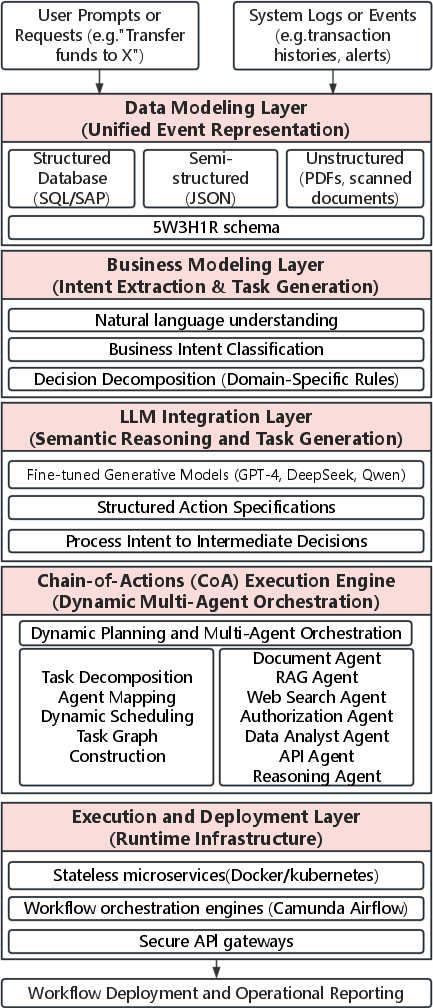
The GBPA framework features multiple layers (Figure 1), each contributing to the intelligent orchestration of financial workflows:

  1. Data Modeling Layer: Integrates diverse data types using an event-centric schema, 5W3H1R, to facilitate LLM reasoning and business process modeling.
  2. Business Modeling Layer: Translates user interactions into structured business process intents.
  3. LLM Integration Layer: Utilizes fine-tuned LLMs for reasoning over business semantics and generating actionable tasks.
  4. Chain-of-Actions (CoA) Execution Engine: Orchestrates dynamic execution plans using a series of specialized sub-agents.
  5. Execution and Deployment Layer: Ensures scalable deployment via microservices and containerization, supporting integration with existing systems like core banking applications (Figure 2). Figure 1

    Figure 1: Architecture of Generative Business Process Al Agents (GBPAs)

Data Transformation

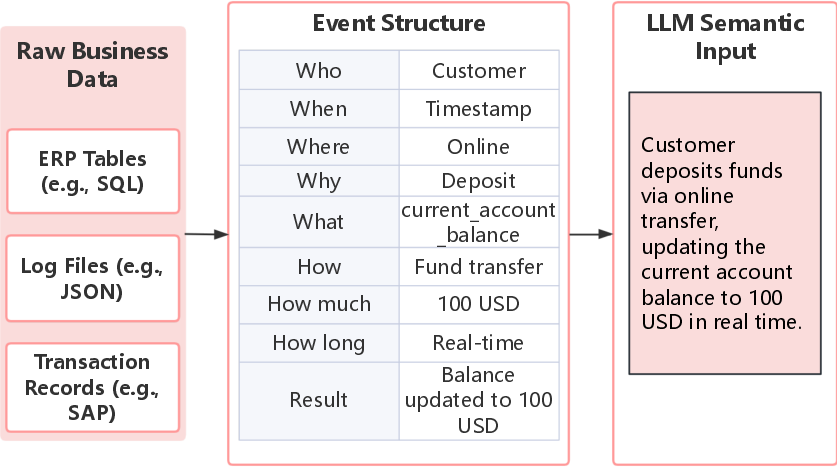
An innovation within GBPAs is the 5W3H1R schema (Figure 3) for transforming business data into LLM-readable semantics. This schema captures key aspects of enterprise events, such as actors, actions, purposes, and outcomes, enabling GBPAs to navigate financial workflows with contextual awareness. Figure 3

Figure 3: Transforming Business Data into LLM-Readable Event Semantics via 5W3H1R

Performance Evaluation

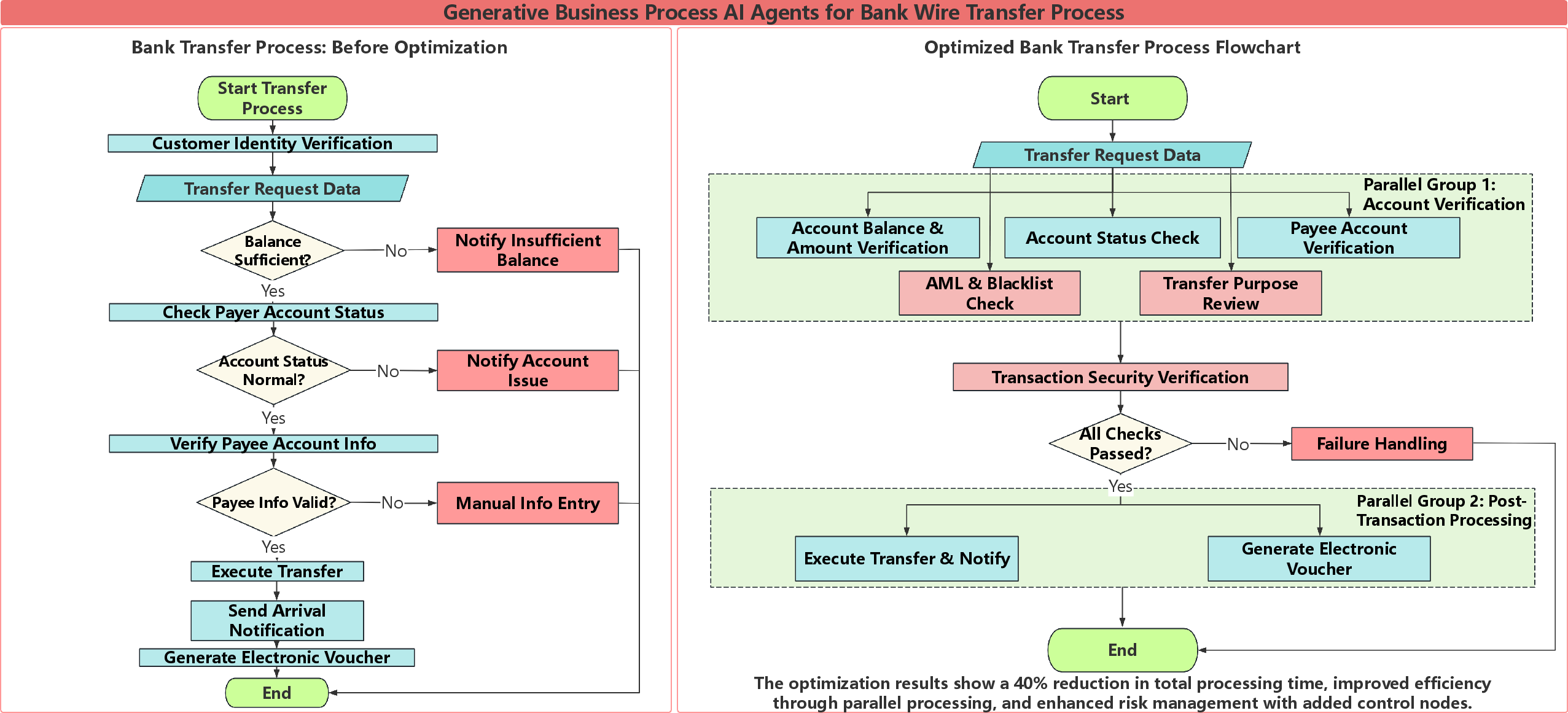
GBPAs were deployed in real-world banking scenarios, such as wire transfers and employee reimbursements, demonstrating significant efficiency gains (Figure 4). The case studies show a reduction in processing time by up to 40% and error rates by 94%, alongside compliance and operational improvements.

Key performance metrics highlight GBPAs' ability to:

  • Parallelize independent task execution
  • Insert dynamic risk controls
  • Reduce manual intervention and error rates Figure 4

    Figure 4: Bank Wire Transfer Process: Traditional vs. GBPAs-Optimized

Practical Implications and Future Directions

The integration of GBPAs in ERP systems provides a robust platform for scalable AI-driven enterprise transformation. While current applications focus on finance, the approach is applicable to diverse data-driven and compliance-intensive domains. Future developments may focus on expanding AI-native architectures beyond isolated enhancements, driving fully autonomous enterprise systems.

Conclusion

GBPAs represent a strategic advancement in applying generative AI to traditional ERP platforms, merging semantic reasoning, modular task execution, and autonomous orchestration. The demonstrated improvements suggest significant potential for GBPAs to redefine ERP processes, offering insights into the broader implications for AI applications in enterprise systems.

Paper to Video (Beta)

Whiteboard

No one has generated a whiteboard explanation for this paper yet.

Open Problems

We haven't generated a list of open problems mentioned in this paper yet.

Collections

Sign up for free to add this paper to one or more collections.

Tweets

Sign up for free to view the 2 tweets with 0 likes about this paper.