Papers
Topics
Authors
Recent
Search
2000 character limit reached

Bilayer triple-Q state driven by interlayer higher-order exchange interactions

Published 5 Jun 2025 in cond-mat.mtrl-sci and cond-mat.mes-hall | (2506.05091v1)

Abstract: Using first-principles calculations and an atomistic spin model we predict the stabilization of a bilayer triple-Q state in an atomic Mn bilayer on Ir(111) due to interlayer higher-order exchange interactions. Based on density functional theory (DFT) we study the magnetic interactions and ground state in a Mn monolayer and bilayer on the Ir(111) surface. We calculate the energy dispersion of spin spirals (single-Q states) to scan a large part of the magnetic phase space and to obtain constants of pair-wise exchange interactions. By including spin-orbit coupling we determine the strength of the Dzyaloshinskii-Moriya interaction. To reveal the role of higher-order exchange interactions in these films, we consider multi-Q states obtained by a superposition of spin spirals. For the Mn monolayer in fcc stacking on Ir(111), the triple-Q state exhibits the lowest total energy in DFT, while the Néel state is most favorable for hcp stacking. For the Mn bilayer on Ir(111), two types of the triple-Q state are possible. In both magnetic configurations, a triple-Q state occurs within each of the Mn layers. However, only in one of them the spin alignment between the layers is such that nearest-neighbor spins of different layers also exhibit the tetrahedron angles which characterize the triple-Q state. We denote this state -- which has the lowest total energy in our DFT calculations -- as the ideal bilayer triple-Q state. This state exhibits significant topological orbital moments within each of the two Mn layers which are aligned in parallel resulting in a large topological orbital magnetization. We interpret the DFT results within an atomistic spin model which includes pair-wise Heisenberg exchange, the Dzyaloshinskii-Moriya interaction, as well as higher-order exchange interactions....
Summary

  • The paper demonstrates that interlayer higher-order exchange interactions play a crucial role in stabilizing the triple-Q magnetic state in Mn bilayers on Ir(111).
  • It employs DFT and atomistic spin models, including FLAPW and PAW methods, to quantify intra- and interlayer magnetic exchanges and energy dispersions.
  • The findings reveal significant energy gains for the 3Q state when tetrahedral spin alignments meet specific symmetry conditions, highlighting potential for spintronic applications.

Bilayer Triple-Q State Driven by Interlayer Higher-Order Exchange Interactions

Introduction

This paper explores the magnetic properties of a manganese (Mn) bilayer on the Ir(111) surface, focusing on the stabilization of a triple-Q magnetic state influenced by higher-order exchange interactions. Using state-of-the-art density functional theory (DFT) and an atomistic spin model, the study elucidates the interplay between intra- and interlayer exchange interactions, expanding the understanding of complex spin structures in magnetic systems.

Methodology

Computational Approach

The research employs a combination of first-principles calculations and spin models to predict and analyze the magnetic states of Mn layers on Ir(111) using both the full-potential linearized augmented plane wave (FLAPW) method and the projector augmented wave (PAW) method. The in-plane lattice constants, interlayer distances, energy dispersions of spin spirals, and Dzyaloshinskii-Moriya interactions (DMI) were explored extensively.

Results

Monolayer Findings

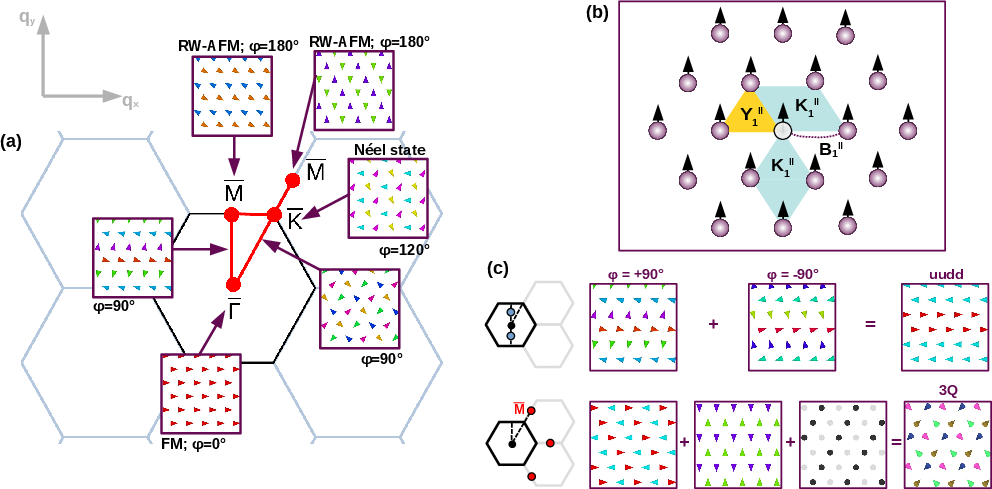
  • Intralayer Exchange: Mn monolayers on Ir(111) exhibited strong antiferromagnetic (AFM) exchange with geometric frustration leading to non-collinear spin structures, notably the 3Q state which becomes the ground state for fcc stacking due to higher-order interactions.
  • Higher-Order Interactions: For Mn monolayers, deviations in energy for prototypical multi-Q states relative to single-Q states confirmed the influence of higher-order terms such as biquadratic and 4-spin interactions, contributing significantly to the stabilization of complex magnetic textures. Figure 1

    Figure 1: Sketch of the 2D hexagonal BZ and examples of spin spiral states and multi-Q construction in Mn monolayers.

Bilayer Findings

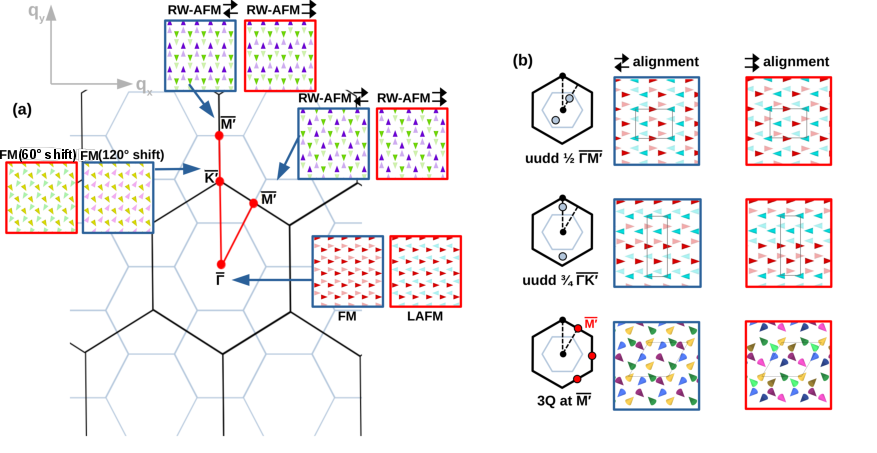
  • Intralayer vs. Interlayer Dynamics: The Mn bilayer presented a nuanced scenario where strong interlayer AFM exchange, especially in contact with the Ir substrate, favored row-wise AFM states. Notably, the ideal bilayer 3Q state emerged due to facilitated coupling among intra- and interlayer spins, characterized by tetrahedron angles.
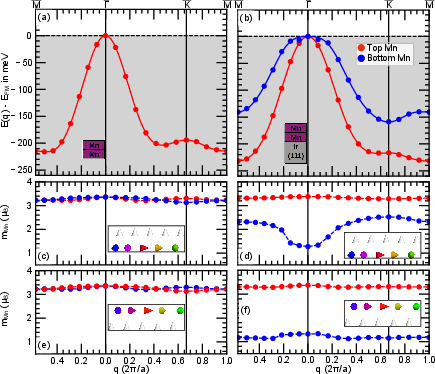
  • Energy Contributions and Spin Models: Advanced analysis revealed that higher-order interactions can be classified into even and odd with respect to spin alignment, which was critical for the stabilization of the bilayer 3Q state. The Mn bilayer on Ir(111) showcased a profound energy gain for the 3Q state, indicating the necessity of considering both intralayer and interlayer higher-order exchanges. Figure 2

    Figure 2: Illustration of spin spiral states in a bilayer, highlighting high symmetry points and alignment differences.

Discussion

The study demonstrates that while pair-wise Heisenberg exchanges are pivotal, higher-order interactions are indispensable for accurate modeling of complex magnetic states such as 3Q, which are stabilized when tetrahedral angles satisfy certain conditions. These findings have substantial implications for the design of magnetic materials where topological phenomena can be exploited for spintronic applications.

Conclusion

This work highlights the intricate balance of exchange interactions in bilayers, especially the significant role of interlayer higher-order interactions in stabilizing complex magnetic states. The predictive capability developed here underscores the potential for advanced material design leveraging non-trivial spin textures, furthering the frontier of skyrmionic and spintronic innovations. Figure 3

Figure 3: Comparison of bilayer spin spiral behaviors evidencing energy dispersion shifts and experimental states.

Paper to Video (Beta)

No one has generated a video about this paper yet.

Whiteboard

No one has generated a whiteboard explanation for this paper yet.

Open Problems

We haven't generated a list of open problems mentioned in this paper yet.

Collections

Sign up for free to add this paper to one or more collections.