POCO: Scalable Neural Forecasting through Population Conditioning
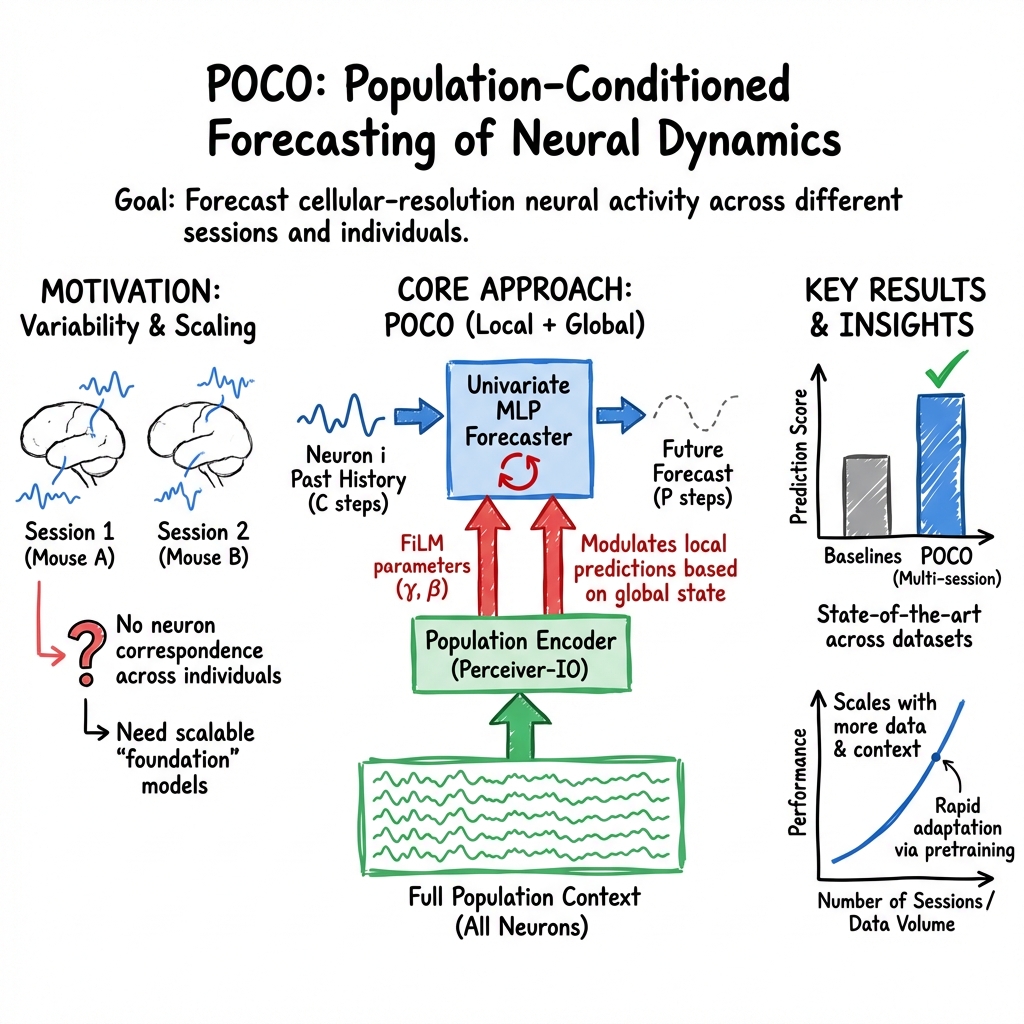
Abstract: Predicting future neural activity is a core challenge in modeling brain dynamics, with applications ranging from scientific investigation to closed-loop neurotechnology. While recent models of population activity emphasize interpretability and behavioral decoding, neural forecasting-particularly across multi-session, spontaneous recordings-remains underexplored. We introduce POCO, a unified forecasting model that combines a lightweight univariate forecaster with a population-level encoder to capture both neuron-specific and brain-wide dynamics. Trained across five calcium imaging datasets spanning zebrafish, mice, and C. elegans, POCO achieves state-of-the-art accuracy at cellular resolution in spontaneous behaviors. After pre-training, POCO rapidly adapts to new recordings with minimal fine-tuning. Notably, POCO's learned unit embeddings recover biologically meaningful structure-such as brain region clustering-without any anatomical labels. Our comprehensive analysis reveals several key factors influencing performance, including context length, session diversity, and preprocessing. Together, these results position POCO as a scalable and adaptable approach for cross-session neural forecasting and offer actionable insights for future model design. By enabling accurate, generalizable forecasting models of neural dynamics across individuals and species, POCO lays the groundwork for adaptive neurotechnologies and large-scale efforts for neural foundation models.
Paper Prompts
Sign up for free to create and run prompts on this paper using GPT-5.
Top Community Prompts
Collections
Sign up for free to add this paper to one or more collections.