- The paper demonstrates that incorporating the SYK model into a wormhole-inspired teleportation protocol can significantly enhance fidelity compared to traditional TFIM approaches.
- It employs a quantum circuit simulation with controlled parameters (β and coupling constant g) and introduces a novel Pauli stabilizer-based measure for multi-qubit Bell state teleportation.
- The study establishes an effective coherence scale (βc) and reveals that temporal dynamics influenced by quantum chaos are critical for optimizing recovery times in teleportation.
SYK Model-Based Teleportation Protocol Simulation
Introduction
The paper presents a rigorous exploration of quantum chaos and teleportation dynamics using a Wormhole-Inspired Teleportation Protocol (WITP), leveraging the Sachdev-Ye-Kitaev (SYK) model. This is an extension of recent works on holographic duality and wormhole simulations within quantum circuits. The SYK model is utilized to construct an analog of a traversable wormhole in conjunction with the Thermofield Double (TFD) state, with the objective of enhancing teleportation fidelity compared to the Transverse Field Ising Model (TFIM).
Quantum Circuit and Wormhole Analog
The setup employs a quantum circuit to simulate the wormhole-like behavior essential for teleportation. The SYK Hamiltonian's chaotic nature allows the system to attain higher teleportation fidelity. The protocol commences by initializing the message as a two-qubit Bell state, embedding this within the quantum circuit, and then manipulating parameters like the inverse temperature (β) and coupling constant (g). The SYK and TFIM models are compared, revealing superior fidelity in the SYK-based teleportation.
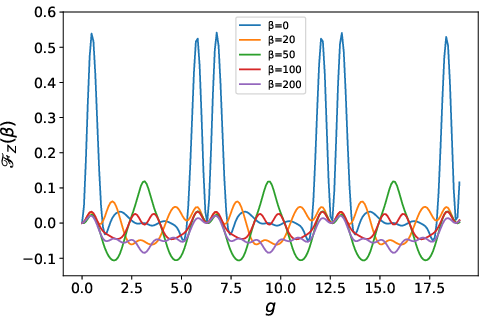
Figure 1: Teleportation fidelity for N=6 SYK Hamiltonian with Δ(0,1) operator for a range of β values.
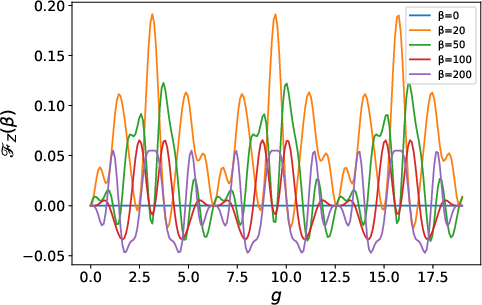
Figure 2: Teleportation fidelity for N=6 SYK Hamiltonian with Δ(0,2) operator for a range of β values.
Parameter Manipulation and Random Matrix Theory
The research explores variance in teleportation fidelity contingent on different β values and the application of the SWAP operator. The Random Phase Theory aids in explaining these parametric variations due to its disorder-oriented nature, aligning with the chaotic SYK system. The decline in teleportation fidelity with increasing β is attributed to the diminished entanglement in TFD states as they become increasingly mixed.
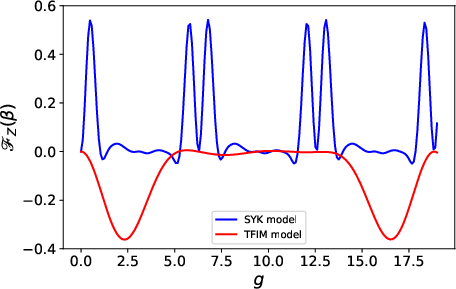
Figure 3: Comparison of teleportation fidelity for the N=6 SYK and N=6 TFIM models for g values at β=0.
Bell State Teleportation and Fidelity Analysis
For Bell state teleportation, a novel Pauli stabilizer-based fidelity measure was developed to diagnose the teleportation channel's effectiveness. This measure revealed that multi-qubit teleportation results in considerable enhancements in fidelity over single-qubit scenarios, due to the more complex entangled structure being teleported, which benefits from the SYK model's chaotic scrambling properties.
The fidelity's temporal fluctuation was analyzed, providing insight into the quantum dynamics as governed by the SYK Hamiltonian. The spectral gap of the system directly influenced the recovery time for teleported messages, with smaller spectral gaps leading to faster recovery times. The fidelity reaches its peak within a narrow temporal window, demonstrating coherent information propagation in a quantum chaotic medium.
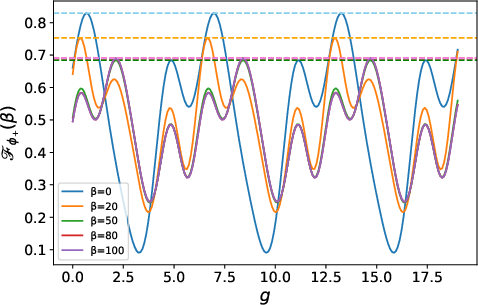
Figure 4: Variation of fidelity for N=3 SYK + N=2 message channel Bell state teleportation for a range of coupling constant (g) values for different β.
Effective Coherence Scale and Future Implications
A vital outcome was establishing an effective coherence scale (βc), demarcating regimes of high and low fidelity. This scale aligns with thermal suppression theories, showing that the system achieves optimal teleportation fidelity below this threshold. Future work could advance the facilitation of quantum communication over larger distances and tackle challenges in accurately simulating more sophisticated quantum gravitational systems using comparable holographic principles.
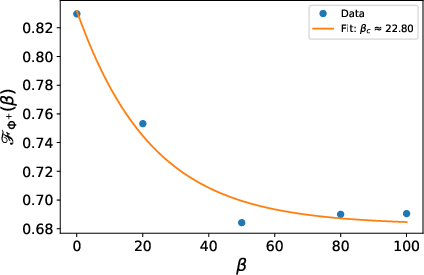
Figure 5: Effective thermal coherence suppression scale plotted as a curve fit in a range of β values and FΦ+ for Bell state teleportation protocol.
Conclusion
In conclusion, this paper sets a precedent in applying the SYK model for enhancing quantum teleportation protocols, particularly in wormhole-inspired settings. It underscores the potential of leveraging quantum chaotic systems to achieve high fidelity in quantum information transfer, paving the way for more complex quantum simulations and potential practical quantum communication systems.

