- The paper presents InPTA's second data release featuring seven years of high-precision multi-band pulsar observations critical for GW detection.
- It employs robust methodologies, including wavelet-smoothed template generation and high-precision DM estimation with DMCalc, to mitigate delays.
- The results demonstrate DM measurement precision in the 10⁻⁵ pc cm⁻³ range, enhancing IPTA integrations and informing SMBHB research.
The Indian Pulsar Timing Array Data Release 2: Dataset and Timing Analysis
Introduction
The advent of gravitational wave (GW) astronomy has profoundly influenced astrophysical research, primarily through observations of binary systems via radio pulsars. The Indian Pulsar Timing Array (InPTA) leverages the unique attributes of the upgraded Giant Metrewave Radio Telescope (uGMRT) to monitor millisecond pulsars (MSPs) within the International Pulsar Timing Array (IPTA). This research note outlines the significance of InPTA's second data release, encompassing seven years of high-precision data on 27 MSPs, with particular emphasis on sub-banded Times of Arrival (ToAs), Dispersion Measures (DM), and the generated timing ephemerides crucial for GW detection and analysis.
Observations
The InPTA employs the uGMRT configured as an interferometer with 30 antennas. Observations are conducted across four bands, though primarily in the 300-500 MHz (Band 3) and 1260-1460 MHz (Band 5) ranges. The dual-band observation strategy improves timing precision by mitigating frequency-dependent delays and extensively calibrating instrumental and geometric phase delays. This configuration facilitates simultaneous multi-band recording, a key advantage of the uGMRT within the global PTA collaboration.
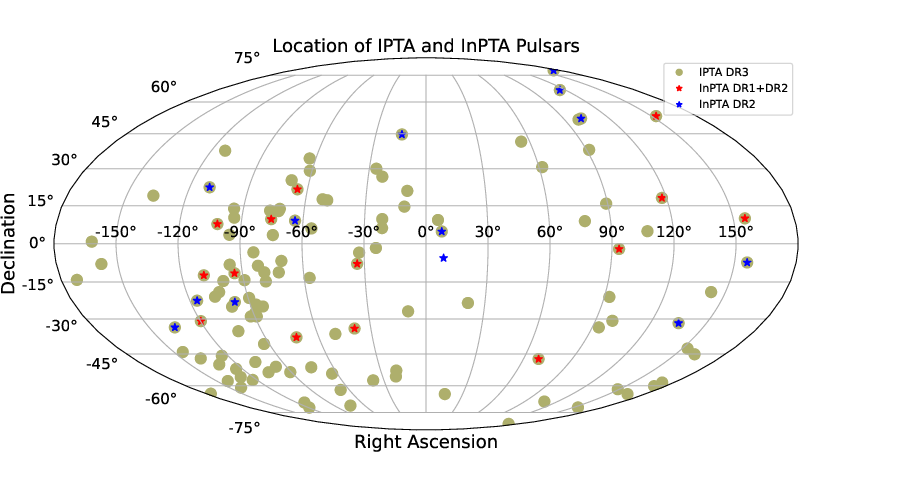
Figure 1: The sky distribution for 27 pulsars included in this data release is shown, reflecting the observations conducted between November 2016 and March 2024.
Data Processing and Analysis
Data from the uGMRT is initially processed using the Pipeline for the Indian Pulsar Timing Array (PINTA), ensuring consistency and correcting systematics. The PINTA pipeline manages RFI mitigation and ephemeris corrections efficiently, transitioning historical data to maintain uniformity. The critical first step involves deploying these standardized archives, which undergo pre-processing adjustments essential for accurate timing analysis.
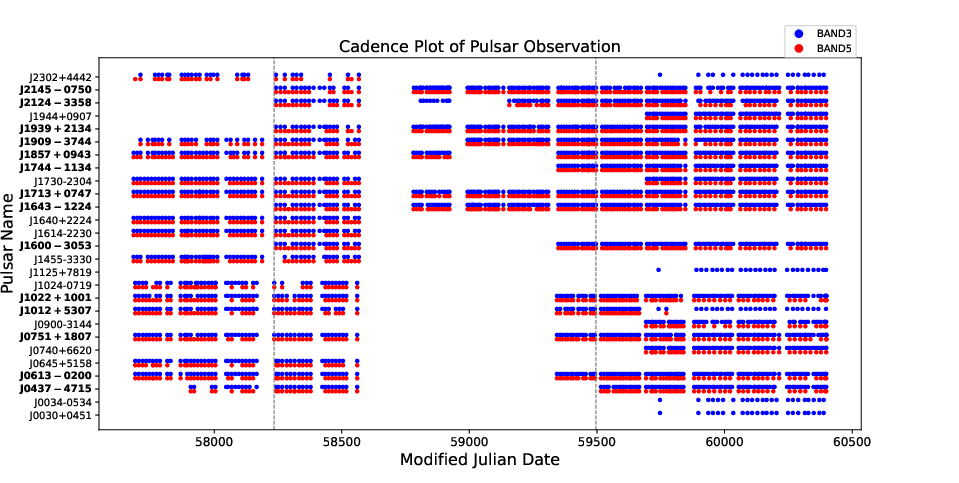
Figure 2: Observation cadence for the 27 pulsars shows concurrent observations in bands 3 and 5.
Template Generation
Precision in ToA and DM estimation is contingent upon noise-free template generation. The dataset employs templates derived from high-S/N epochs, with improvements through equalizing bandpass shapes and employing wavelet smoothing. This technique mitigates profile evolution errors and ensures alignment across frequency channels, allowing for a precise definition of fiducial DMs which are crucial for accurate ToA extraction.
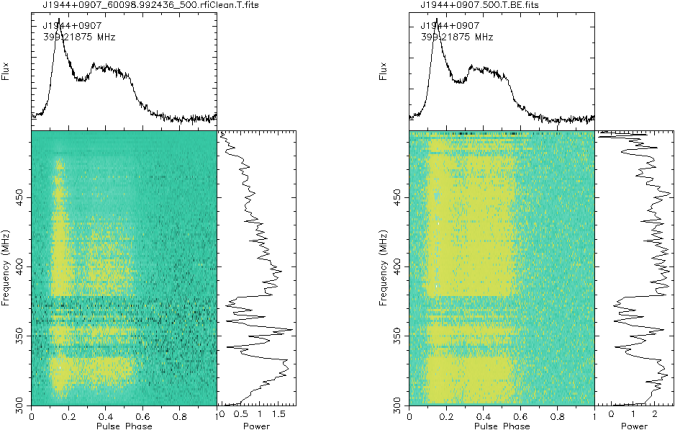
Figure 3: Pulse profile for PSR J1944+0907 illustrating band equalization efficacy in template generation.
Dispersion Measure and Timing Analysis
A key advancement in the InPTA effort is the high-precision DM estimation methodology, crucial for correcting interstellar medium (IISM) disturbances and optimizing GW detections. The use of DMCalc enables accurate epoch-wise DMX fitting for residual mitigation, distinguishing this dataset with unprecedented DM measurement precision, supportive of multi-frequency PTA operations.
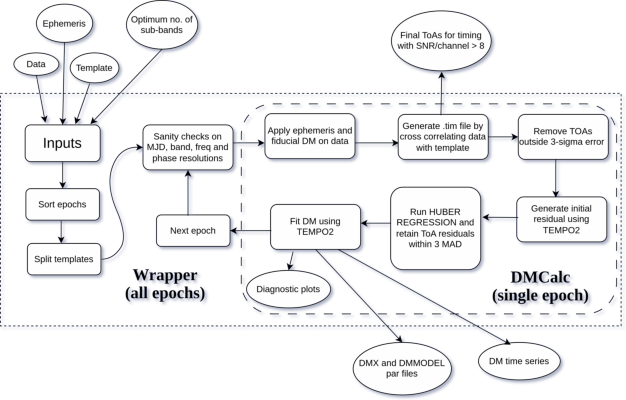
Figure 4: DMCalc workflow delineating the methodology for estimating ToA and DM across all observational epochs.
Results and Implications
The dataset exhibits exceptional precision in DM measurements (10−5 pc cm−3 range), essential for future IPTA data integrations. Observations corroborate prior findings on solar wind-induced DM variations, highlighting the potential of InPTA’s methodologies to offer new insights into stochastic GW backgrounds from Supermassive Black Hole Binaries (SMBHBs). Moreover, the dataset promises enhanced characterization of DM noise, integral to advancing nHz GW astronomy.
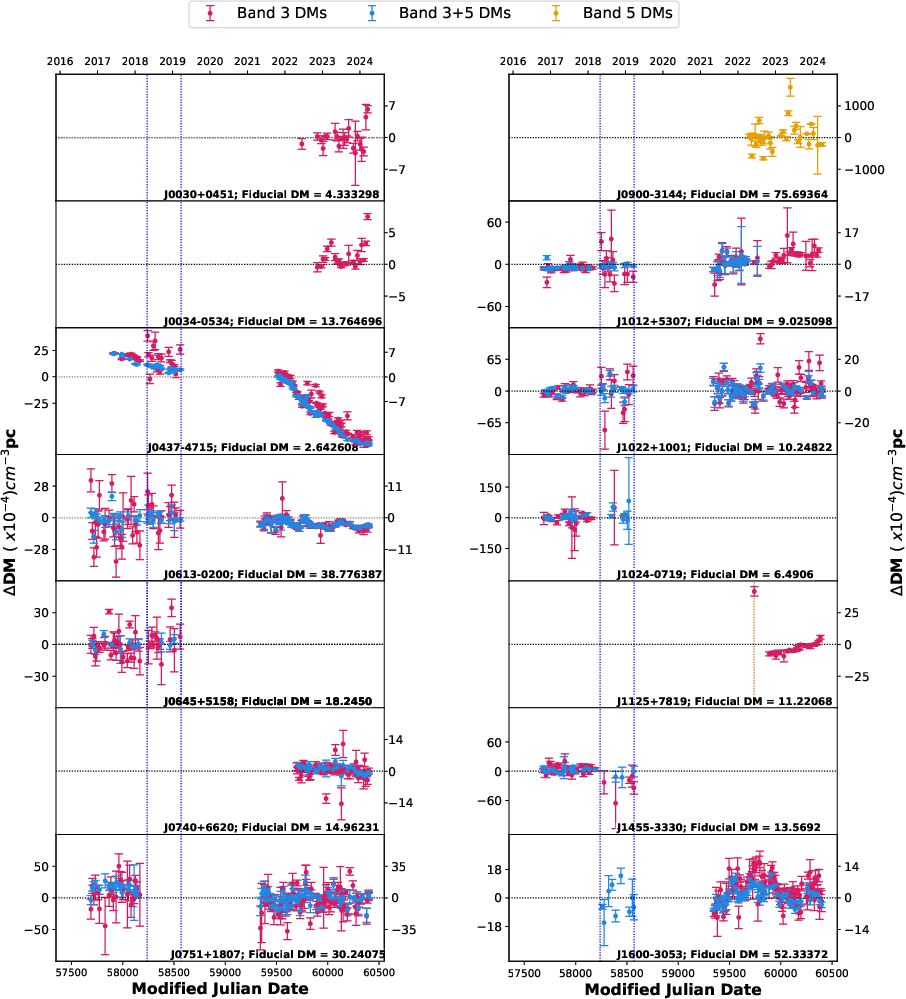
Figure 5: Time series of DM variations across 14 pulsars illustrating solar wind and IISM perturbations.
Conclusion
InPTA's second data release contributes a robust dataset pivotal in enhancing the IPTA's collective efforts toward detecting and characterizing low-frequency GW signals. The dataset's integration with international observatories will further refine our understanding of galactic dynamics and cosmological phenomena. The progressive transition towards Square Kilometer Array-based observations, as the paper suggests, will expand these frontiers, amplifying the precision of celestial clocks in the pursuit of gravitational astronomy.
This research firmly positions the InPTA project within the global effort to advance PTA methodologies, reflecting a sustained progression in the broader quest to decipher the universe’s rhythmic perturbations through precision pulsar timing.