Projected Normal Distribution: Moment Approximations and Generalizations
Published 20 Jun 2025 in stat.ME and q-bio.NC | (2506.17461v1)
Abstract: The projected normal distribution, also known as the angular Gaussian distribution, is obtained by dividing a multivariate normal random variable $\mathbf{x}$ by its norm $\sqrt{\mathbf{x}T \mathbf{x}}$. The resulting random variable follows a distribution on the unit sphere. No closed-form formulas for the moments of the projected normal distribution are known, which can limit its use in some applications. In this work, we derive analytic approximations to the first and second moments of the projected normal distribution using Taylor expansions and using results from the theory of quadratic forms of Gaussian random variables. Then, motivated by applications in systems neuroscience, we present generalizations of the projected normal distribution that divide the variable $\mathbf{x}$ by a denominator of the form $\sqrt{\mathbf{x}T \mathbf{B} \mathbf{x} + c}$, where $\mathbf{B}$ is a symmetric positive definite matrix and $c$ is a non-negative number. We derive moment approximations as well as the density function for these other projected distributions. We show that the moments approximations are accurate for a wide range of dimensionalities and distribution parameters. Furthermore, we show that the moments approximations can be used to fit these distributions to data through moment matching. These moment matching methods should be useful for analyzing data across a range of applications where the projected normal distribution is used, and for applying the projected normal distribution and its generalizations to model data in neuroscience.
The paper derives analytical approximations for the first and second moments of the projected normal distribution using Taylor expansions and Gaussian quadratic forms.
It employs moment matching techniques to effectively estimate distribution parameters across varying dimensions and diverse application domains.
The introduced generalizations, including ellipsoidal projections, enhance the distribution's applicability in fields like neuroscience and machine learning.
Projected Normal Distribution: Moment Approximations and Generalizations
Introduction
The paper "Projected Normal Distribution: Moment Approximations and Generalizations" (2506.17461) explores the projected normal distribution, a distribution defined on the unit sphere. This distribution emerges from radially projecting a multivariate normal random variable onto the sphere. Despite its potential in modeling data across fields such as neuroscience and machine learning, its adoption has been limited due to the absence of closed-form moment formulas. The authors address this gap by deriving analytical approximations for the first and second moments using Taylor expansions and properties of quadratic forms in Gaussian vectors.
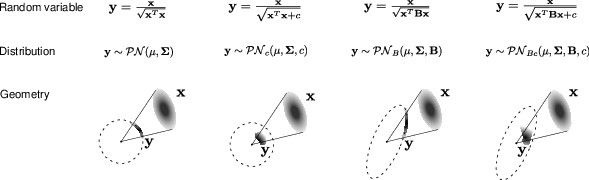
Figure 1: Geometry of the projected normal for the 2D case, and generalizations considered in this work.
The authors further extend the distribution by incorporating a denominator of the form xTBx+c, allowing for more flexibility and applicability, particularly in systems neuroscience. These generalizations provide a wider applicability in data modeling by fitting these distributions to data through moment matching, demonstrating accuracy across varying dimensions and distribution parameters.
Moment Approximations
The moment approximations are central to the paper, providing tools to estimate the distribution's moments without closed-form solutions. The authors employ Taylor expansions to approximate the first and second moments, a technique known for its efficacy in approximating functions near a point. They also utilize the theory of quadratic forms in Gaussian random variables to derive these moments.
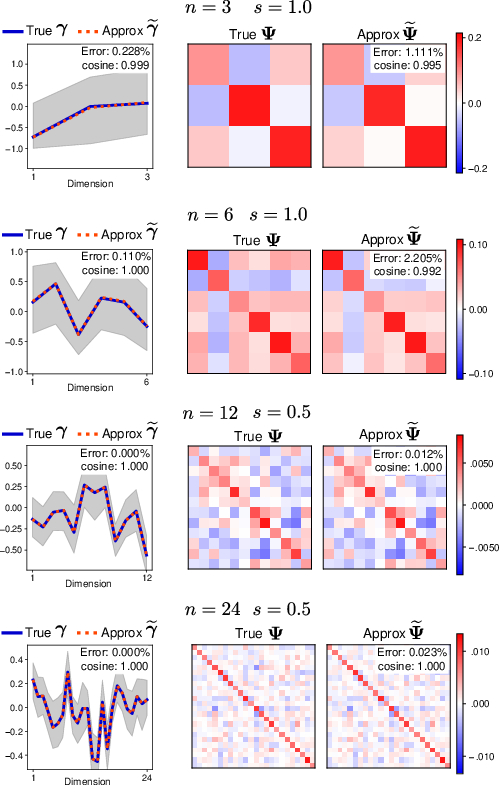
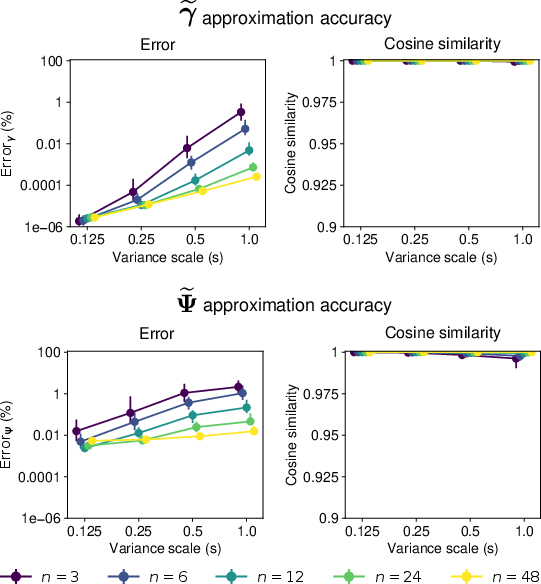
The first moment approximation involves defining auxiliary variables and evaluating expectations using Taylor expansions. The covariance is similarly approximated, leveraging known results on Gaussian quadratic forms. These approximations prove to be accurate across a range of dimensions and parameters, as validated by empirical tests.
Figure 2: Moments approximation examples for PN showing the alignment of true and approximated moments across dimensions.
Figure 3: Accuracy of moments approximation showcasing the relative errors and cosine similarities across dimensionality and parameter scale.
Moment Matching and Applications
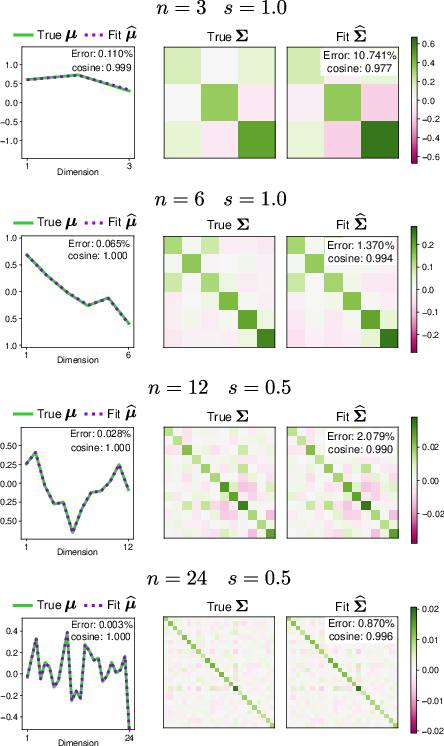
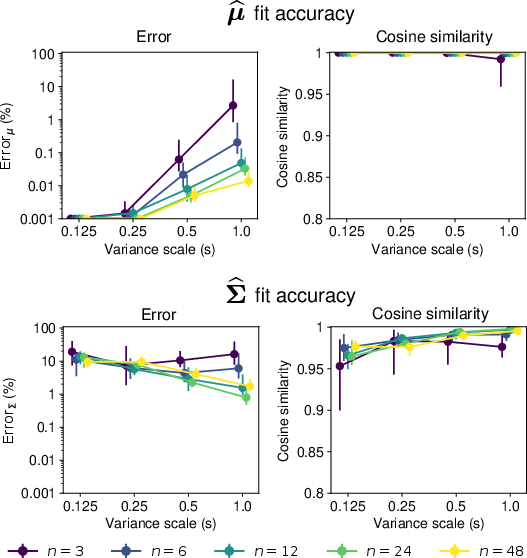
The moment approximations enable moment matching methods for parameter estimation, offering a practical approach to fitting the projected normal distribution and its extensions to empirical data. Moment matching leverages the approximated moments to align theoretical moments with observed data, optimizing distribution parameters efficiently.
Figure 4: Moment matching examples showing the alignment of true and estimated parameters in different scenarios.
The authors showcase the utility of these methods in systems neuroscience, particularly in modeling neural population responses where divisive normalization and noise are pivotal.
Generalizations of the Projected Normal Distribution
The paper introduces three key generalizations of the projected normal distribution:
Denominator with Additive Constant: Projects within the unit sphere, incorporating constants in the normalization factor, advantageous in divisive normalization models prevalent in neuroscience.
Quadratic Form with Matrix B: Projects onto an ellipsoid surface, offering a richer geometric and statistical structure for advanced modeling needs.
Combination of Quadratic Form and Constant: Projects within an ellipsoid, providing flexibility in capturing complex data structures.
Each generalization is carefully analyzed for its moment properties and potential applications, with moment approximations empirically validated for accuracy.
Figure 5: Accuracy of moment matching for various distributions highlighting the fit errors and cosine similarities.
Conclusion
This paper provides a substantial contribution to the field by addressing a significant gap in the analysis and application of the projected normal distribution. Through rigorous derivation and validation of moment approximations, it enhances the utility of this distribution in practical scenarios, particularly in neuroscience and data modeling. The generalizations introduced further expand the distribution's applicability, making it a versatile tool for researchers handling spherical data.
The insights and methodologies presented hold promise for future research directions, fostering advancements in statistical modeling and data analysis where directional data play a crucial role.