- The paper introduces a novel methodology for parsing and statistically analyzing agent trajectories using metrics like token consumption and iteration count.
- The paper identifies that successful trajectories feature balanced exploration and validation, while failures exhibit prolonged iterations and redundant actions.
- The paper concludes that high coherence between an agent’s thought and action steps is critical for improving design and automating complex software tasks.
Understanding Software Engineering Agents
This essay provides a detailed summary of the paper titled "Understanding Software Engineering Agents: A Study of Thought-Action-Result Trajectories" (2506.18824). The paper examines the internal processes of LLM-based agents and their application in software engineering tasks, particularly focusing on the trajectories these agents create in automating tasks like program repair and issue resolution.
Introduction
The paper investigates LLM-based agents that autonomously perform complex software engineering tasks by iterating through thought-action-result cycles. Despite their effectiveness, the decision-making processes of these agents are not well understood, limiting improvements and reliability. The authors conducted a large-scale empirical study of the trajectories of three state-of-the-art agents: Repair, Auto, and Open. By analyzing over 2,822 interactions across 120 trajectories, the paper identifies key features that differentiate successful from unsuccessful executions and provides actionable insights for optimizing agent design.
Methodology
The authors present a novel methodology for analyzing agent trajectories, consisting of the following steps:
- Trajectory Parsing and Representation: Trajectories are parsed into a standardized format, enabling consistent analysis across different agents.
- Statistical Analysis: The authors compute metrics such as trajectory length, token consumption, and success rates to understand agent behavior patterns.
- Categorizing Actions: Actions are categorized into eight distinct types, such as Explore, Locate, Search, etc., to facilitate sequence pattern mining.
- Sequential Action Patterns: The authors mine frequent action sequences to identify agent decision-making patterns and operational motifs.
- Semantic Relationships: Through open coding, semantic relationships between trajectory components are analyzed to assess coherence and consistency.
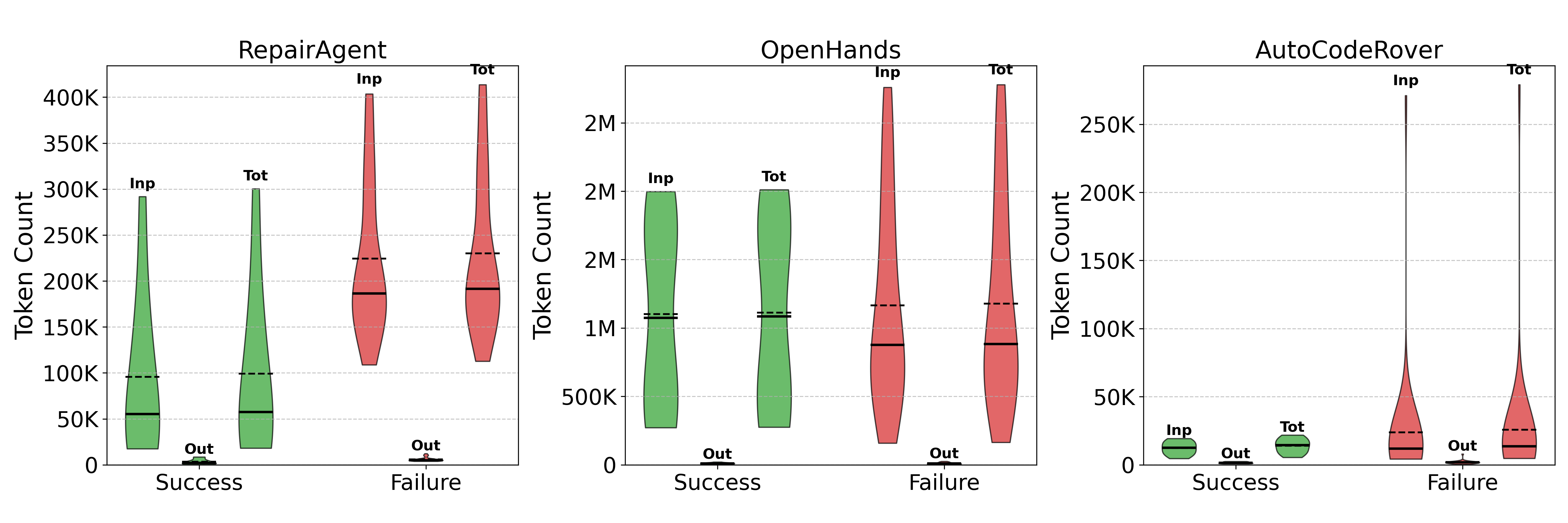
Figure 1: Input, Output, and Total tokens over successful trajectories and unsuccessful ones. The y-axis differs for each agent.
Results and Discussion
Trajectory-Level Properties
The findings indicate that unsuccessful trajectories often have longer iteration counts and consume more tokens, particularly in test-driven agents like Repair. Successful Auto trajectories are shorter, reflecting streamlined processes. The data visualization of token usage highlights how failed trajectories involve sustained complexity, while success may depend on input context.
Actions and Patterns of Action Sequences
The study categorizes and analyzes eight high-level action categories. The paper identifies action sequences characteristic of successful trajectories, such as balanced exploration and validation versus repetitive cycles in unsuccessful ones. Anti-patterns such as excessive repetition without progression, premature task termination, and failure to test fixes are noted.
Semantic Relationships
The paper highlights the importance of coherence between agent thoughts and actions. Successful agents demonstrate high thought-action alignment, while failures often involve misalignment and redundancy. Thought-thought relationships reveal the significance of follow-up and refinement strategies to avoid contradiction and wasted effort. Effective agents ensure results guide reasoning and subsequent actions.
Limitations and Future Research
The study notes potential subjectivity in annotation and the limited generalizability across agents and tasks. Expanding the dataset, refining classification techniques, and developing automated failure detection strategies could enhance future research in LLM agents.
Conclusion
The paper offers a thorough examination of LLM agents operating in software engineering contexts, identifying crucial behaviors and anti-patterns to guide improvements. By balancing exploration, explanation, and validation steps, agents can improve efficiency and reliability, serving as valuable tools in automating complex tasks. Further research should explore broader applications and automatic trajectory optimization techniques.