- The paper introduces Diffusion Explorer, an interactive browser-based tool that visualizes the evolution of diffusion models in real time.
- It leverages TensorFlow.js for on-the-fly training and employs animation to illustrate transitions from noise to complex data distributions.
- User feedback and rapid convergence in approximately 10 seconds underscore its potential for educational and research applications.
Diffusion Explorer: Interactive Exploration of Diffusion Models
Diffusion models have become prominent in the machine learning domain for generating complex data from random noise. "Diffusion Explorer" introduces an interactive tool intended to elucidate the geometric properties of diffusion models through a user-friendly, browser-based interface. This essay explores its methodological innovations, system design, and implications for educational and research settings.
Introduction to Diffusion Models
Diffusion models are probabilistic frameworks that invert the diffusion process inherent in stochastic data sampling. They constitute a central element in state-of-the-art systems for image, video, and text generation. Despite their significance, most existing explanatory resources focus on either advanced theoretical frameworks or application-specific architectures, leaving a gap in accessible tools to explore their intrinsic properties.
"Diffusion Explorer" emerges as an innovative approach to visualize these properties interactively, catering to non-experts through simplified 2D datasets within web browsers. This tool primarily leverages animation, known for enhancing algorithmic understanding and user engagement, by illustrating the evolution of sample distributions over time.
System Design
"Diffusion Explorer" operates in a fully client-side environment, utilizing TensorFlow.js for on-the-fly training and inference. The system's architecture is organized around three primary components:
- Control Bar: Empowers users to choose training objectives, sampling algorithms, and dataset types, facilitating comparative exploration of model dynamics.
- Diffusion View: Provides a comprehensive visual interface where users can observe initial source distributions transform into complex data distributions. This view includes both individual sample trajectories and holistic distribution transformations using contour plotting.
- Time Slider: Allows manipulation of sampling progress, enabling users to interpolate between the noise and data distributions, fostering an intuitive understanding of the temporal dynamics in diffusion processes.
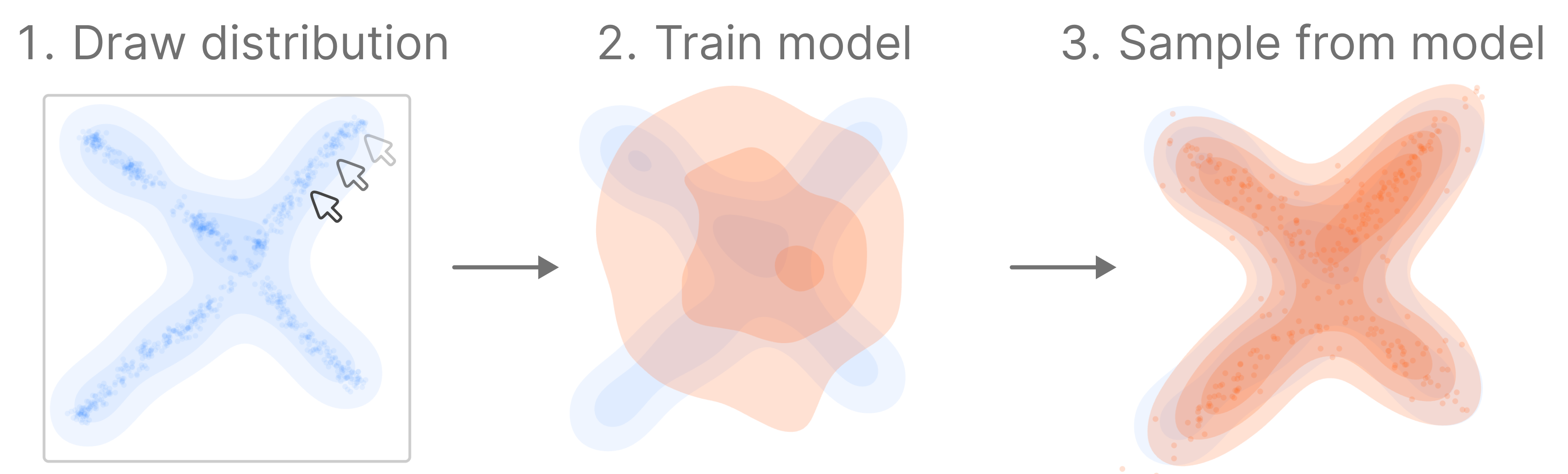
Figure 1: With DiffusionExplorer, users can (1) draw a custom distribution with their mouse, (2) train the model in browser, observing the evolution of the distribution as the model converges, and (3) sample from the trained model.
Interactive Sampling and Training
An outstanding feature of "Diffusion Explorer" is its support for both pre-trained and custom model training. Users can select predefined datasets like smiley faces or specify their own through interactive drawing. The tool simulates the transformation of samples from simple Gaussian sources to more intricate target distributions solely in the browser. This interactive framework allows real-time visualization of training convergence—significantly, the models train in approximately 10 seconds to achieve acceptable fidelity.
By encompassing different sampling strategies and display configurations, the tool offers diverse visual and practical experiences, deepening the understanding of stochastic processes that drive diffusion models.
User Feedback and Future Directions
Initially released to positive reception, the tool has garnered over 750 GitHub stars and significant engagement from the community. The open-source nature of "Diffusion Explorer" permits integration into educational curricula and personal exploration by individual researchers.
Future plans include expanding its library of sampling techniques and integrating narrative-driven educational content to supplement its effectiveness as a pedagogical tool. These enhancements aim to transform "Diffusion Explorer" into a holistic learning environment for diffusion processes.
Conclusion
"Diffusion Explorer" fills a pivotal gap in the visualization of diffusion models by rendering their geometric and stochastic properties accessible to non-experts in an interactive format. It exemplifies the potential of combining machine learning with interactive visualization, offering a scalable, user-friendly platform for training and sampling exploration. As advancements continue, such tools can play an integral role in broadening comprehension and application of sophisticated generative models in machine learning.