- The paper presents an innovative framework employing Tikhonov regularization and multi-frequency data to mitigate the ill-posedness of stochastic inverse source problems.
- It demonstrates effective reconstruction of Fourier mode strength functions, achieving reliable results with only 2–4 frequency data points even under noisy conditions.
- The study offers rigorous error analysis using spectral decomposition, paving the way for advanced applications in seismic modeling and financial market analysis.
Inverse Source Problems for the Stochastic Wave Equations
This paper examines inverse source problems related to stochastic wave equations, primarily focusing on making these inherently ill-posed problems tractable through innovative computational methodologies. The research establishes theoretical foundations and develops practical schemes for specific stochastic wave equations driven by finite-jump Lévy processes.
Introduction to the Problem
Stochastic wave equations describe phenomena where wave propagation is affected by random disturbances. The inverse source problem involves identifying unknown source terms from observed data, typically the wave field's behavior at a given time. Such problems are notoriously ill-posed due to the potential for multiple source configurations to produce similar or indistinguishable wave fields. This paper tackles these challenges by introducing a novel computational framework aimed at ensuring well-posedness and reliability in numerical reconstructions.
Methodology
Stochastic Helmholtz Equation
The paper begins by addressing the inverse source problem for the one-dimensional stochastic Helmholtz equations without attenuation, characterized by its solutions to numerous complex radiation fields. The primary approach ameliorates ill-posedness via computational strategies, such as efficient numerical methods and regularization techniques. Specifically, Tikhonov regularization is employed, leveraging multi-frequency data to stabilize solutions and provide meaningful reconstructions.
Figures in the paper, such as those depicting single and multiple Fourier modes, illustrate how reconstructions improve when leveraging multi-frequency data (Figure 1) and (Figure 2).
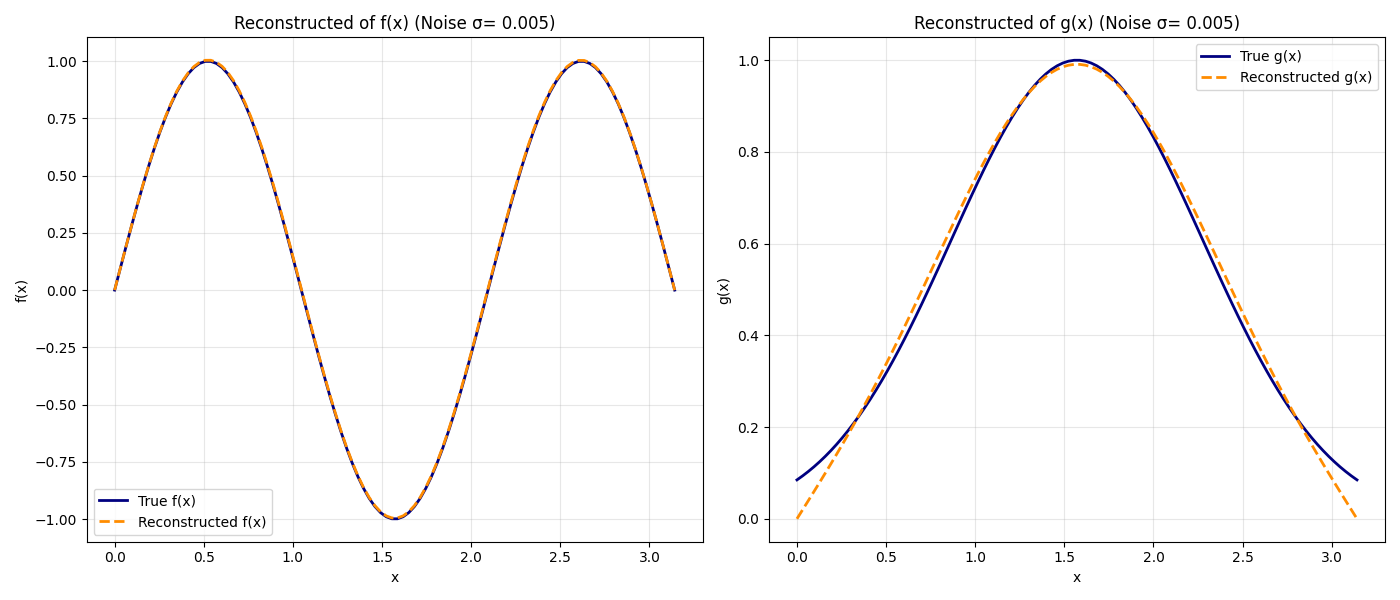
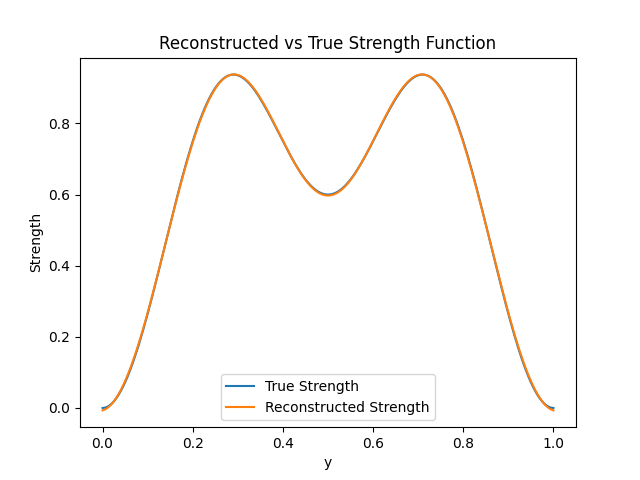
Figure 1: Single Fourier mode.
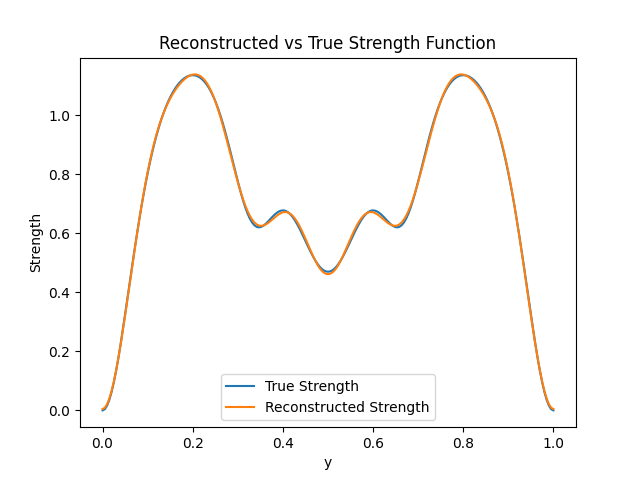
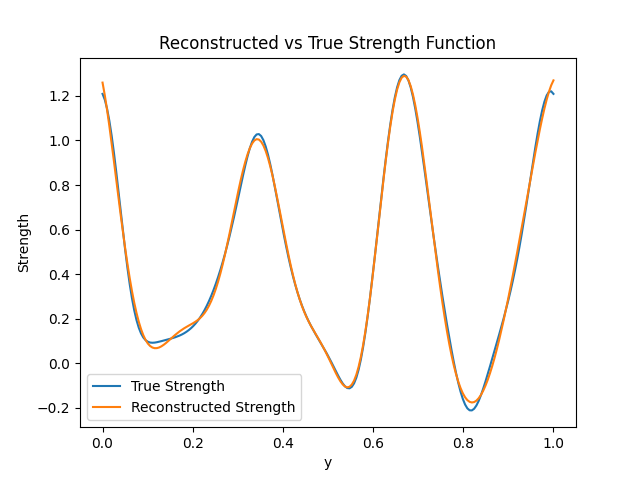
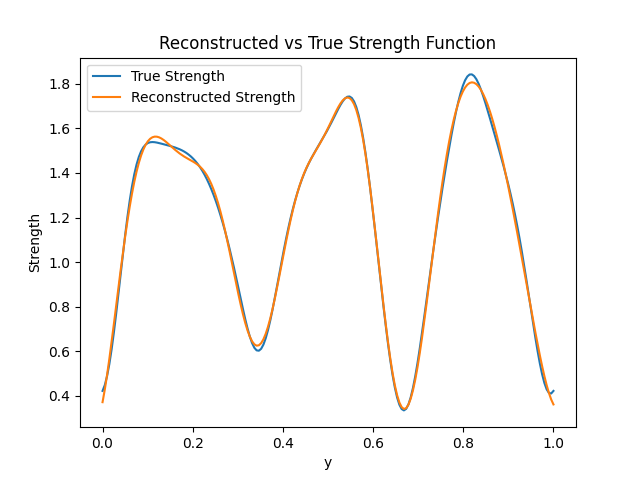
Figure 2: Multiple Fourier mode.
Finite-Jump Lévy Processes
For stochastic wave equations driven by finite-jump Lévy processes, a detailed examination of the direct problem is provided. The study includes constructing a mild solution and devising methods to recover the source terms using final-time wave field data. The analysis exploits the equation's unique characteristics, particularly regarding finite-jump stochastic processes, offering stability estimates and theoretical insights.
Results
Efficient Numerical Scheme
One of the key results is a robust computational scheme that significantly mitigates ill-posedness in the stochastic Helmholtz equation problem. By employing a combination of advanced mathematical techniques involving multi-frequency data, the researchers demonstrate substantial improvements in reconstruction stability and accuracy. Notably, in cases where single Fourier mode strength functions were assumed, good results were achievable with as few as 2-4 frequency data points.
Reconstruction under Noise
The paper features comprehensive numerical experiments revealing the effectiveness of the proposed methods, even amidst significant noise. The figures illustrating reconstructed effects under different levels of noise, such as (Figure 3) and (Figure 4), highlight the capability of these methods to extract meaningful information from noisy data.
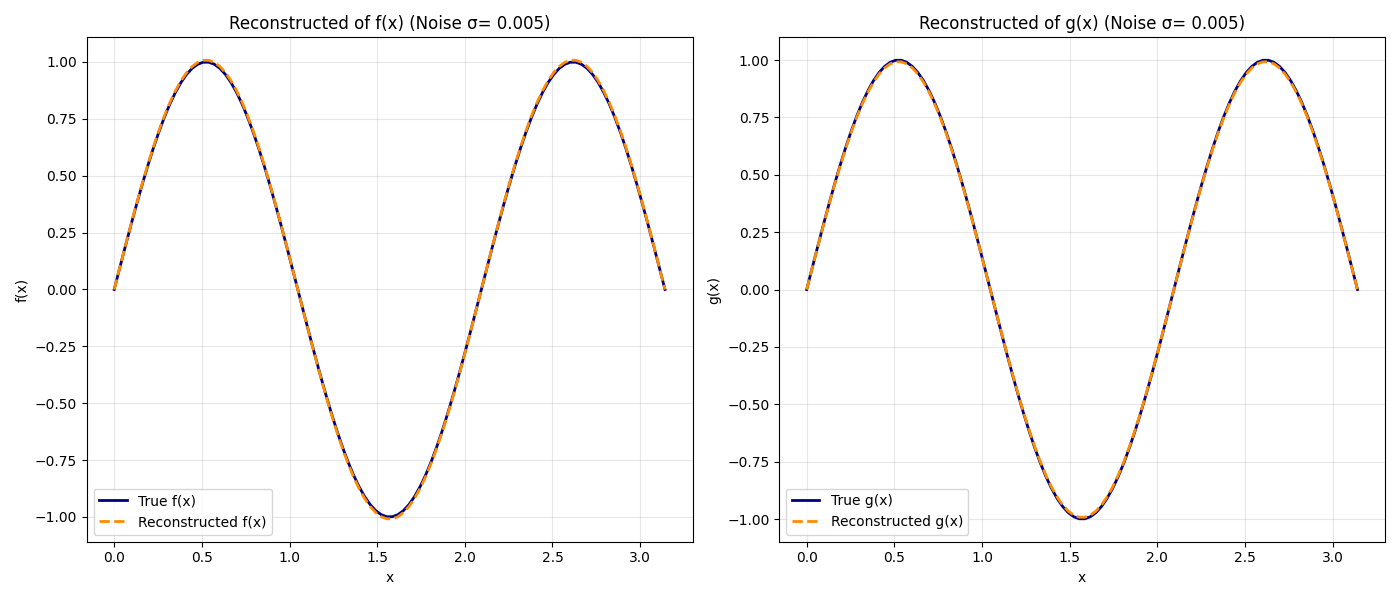
Figure 3: Reconstructed effect with noise σ=0.005.
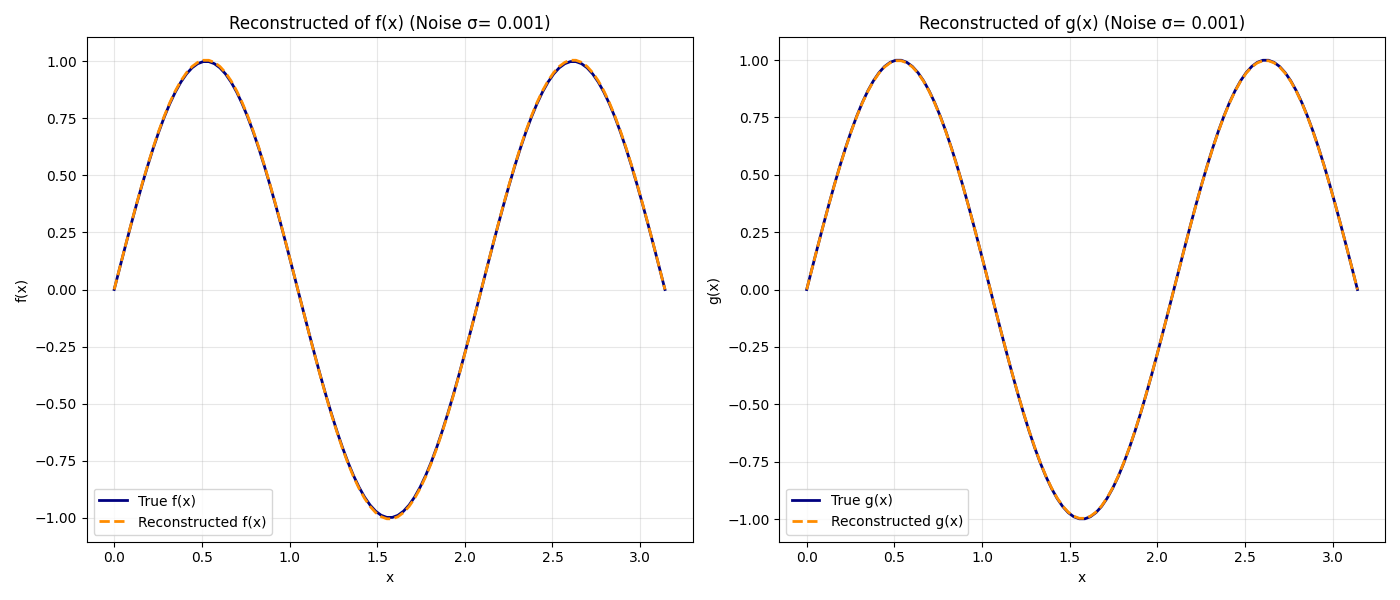
Figure 4: Reconstructed effect with noise σ=0.001.
Advanced Error Analysis
Error estimates provided in the results showcase the precision of the reconstructions in both low and high-noise scenarios. The use of advanced spectral decomposition and optimization techniques is particularly effective, as evidenced by the low relative L2 errors even when reconstructing multiple Fourier-modes.
Conclusion
The research presented in this paper substantially advances the field of stochastic inverse source problems by addressing the core challenge of ill-posedness. Through innovative mathematical frameworks and powerful computational algorithms, it opens up new possibilities for applying stochastic wave equations to complex real-world scenarios, such as seismic wave analysis and financial market modeling. Future research directions include exploring more complex scenarios, such as those involving infinite-jump processes, to further extend the applicability of these solutions.