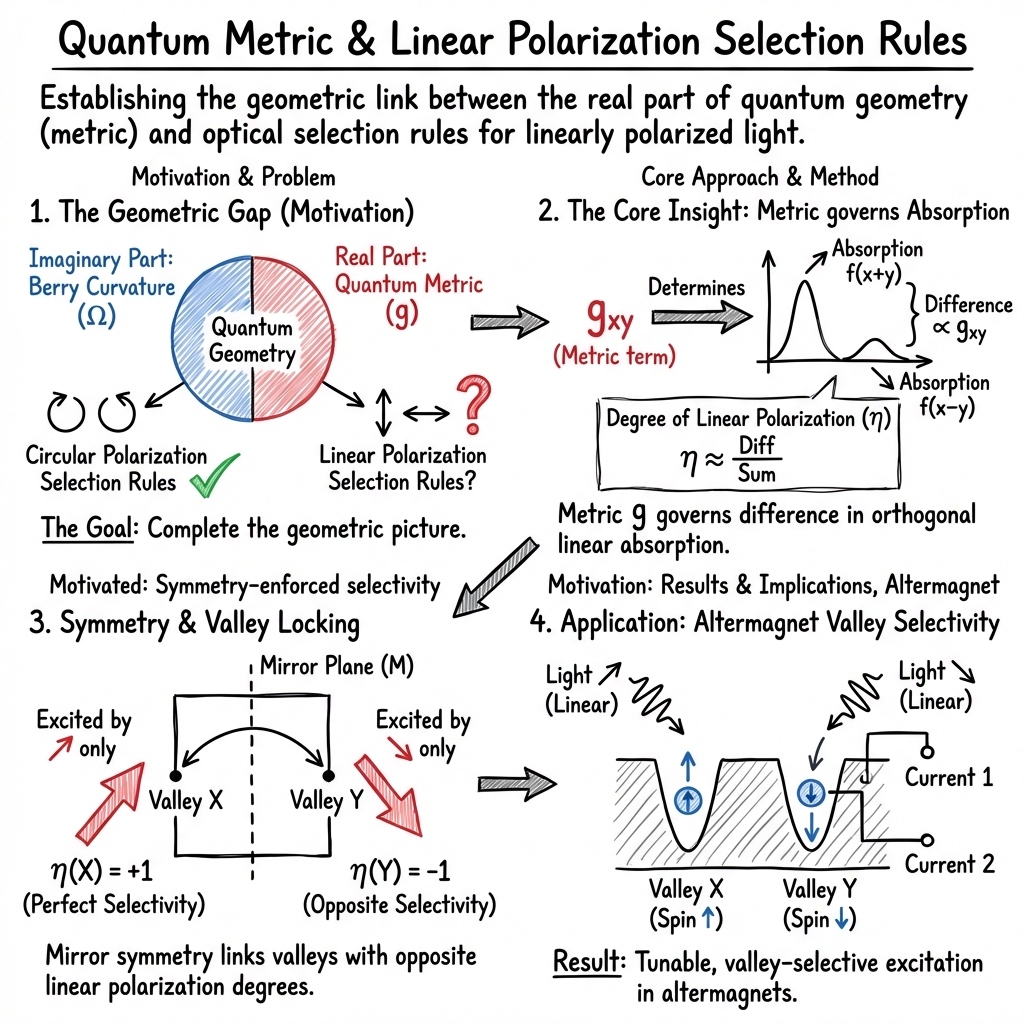
- The paper introduces quantum metric-based optical selection rules that link oscillator strength to linear polarization and valley symmetry.
- It rigorously validates the framework using altermagnet and Kane-Mele models, emphasizing spin-valley locking and symmetry-induced transitions.
- The study demonstrates practical material realization in monolayer V2SeSO, paving the way for advanced spintronic and valleytronic applications.
Quantum Metric-Based Optical Selection Rules
Introduction
The study described in "Quantum metric-based optical selection rules" (2507.09260) presents a seminal advancement in understanding optical selection rules, particularly emphasizing the role of quantum metrics as opposed to traditional reliance on Berry curvature. Optical selection rules fundamentally determine the allowed transitions between energy states under specific symmetry conditions, significantly impacting the designing of optoelectronic devices and manipulating exciton quantum states. The research introduces quantum metric-based selection rules, focusing on linear polarization, which complements existing Berry curvature-focused rules for circularly polarized light.
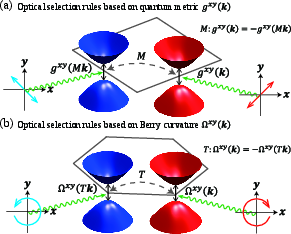
Figure 1: Schematics of the quantum metric-based optical selection rules for linearly polarized light (a) and the Berry curvature-based optical selection rules for circularly polarized light (b).
Theoretical Framework
The paper elucidates a comprehensive theoretical framework that delineates the coupling between quantum metrics and oscillator strengths, establishing foundational correspondence and extending selection rules phenomenology beyond Berry curvature for circularly polarized light. Traditional paradigms predominantly relied on Berry curvature, the imaginary component of quantum geometry, whereas quantum metrics—the real component—offer novel pathways for symmetric transition regulations. The predominant contribution of this work is showcasing orthogonal linear polarizations linked to distinct valleys via mirror and rotational symmetries. The quantum metric tensor significantly influences oscillator strength, with its components governing transitions selectively dependent on the polarization alignment relative to the valley symmetries.
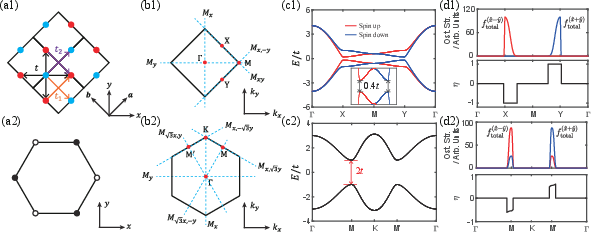
Figure 2: The quantum metric-based optical selection rule for linearly polarized light in the altermagnet model and Kane-Mele model.
Model Evaluation
Two critical models, the altermagnet (AM) and Kane-Mele (KM), were employed to validate the theoretical propositions, facilitating pragmatic insights into quantum metric rules. The AM model, characterized by its unique spin-valley locking and mirror symmetries, exemplifies the selective excitation of valleys aligned orthogonally to the polarization direction. Similarly, the KM model further consolidates functional understanding through complex band configurations sensitive to symmetry constraints, emphasizing the interplay between quantum metrics and linear polarization within specific valley geometries.
Material Realization
The realization of these concepts in practical material systems is demonstrated with monolayer V2SeSO, illustrating valley-contrasted quantum metric-based optical selection with fully spin-polarized currents induced by linear polarization. This material exhibits indispensable features like d-wave altermagnets, making it a pivotal platform for valleytronic and spintronic applications, exploiting the spin-valley locking attributes to harness polarized current generation.
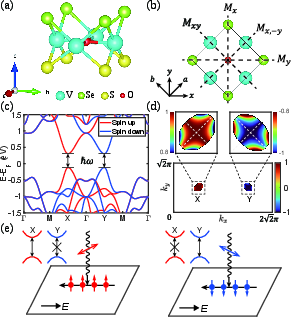
Figure 3: Valley-contrasted quantum metric-based optical selection rules and fully spin-polarized currents induced by linearly polarized light in altermagnet V2SeSO.
Implications and Future Perspectives
Incorporating quantum metrics into optical selection rules significantly enriches the theoretical landscape, promoting the geometric dimensions in optical transition dynamics. The potential application of these rules in materials possessing distinctive symmetry properties like AM models promises advancements in spintronics and optoelectronic devices. As understanding of quantum metrics deepens, further exploration in high-symmetry material systems could unveil sophisticated control mechanisms over electronic transitions and facilitate the development of cutting-edge optoelectronic technologies.
Conclusion
"Quantum metric-based optical selection rules" contributes substantially to the field of solid-state physics, providing an enriched framework for optical selection dynamics via quantum metrics. The potential applications in spintronic and valleytronic contexts reinforce the strategic importance of these findings, inviting future research to explore broader materials and technological adaptations. Through presenting both theoretical and practical insights, the paper extends the geometric origin narratives, enhancing the prospects for innovative device engineering and quantum state manipulations.