- The paper demonstrates that consistent EFTs for massive spin-3/2 particles require the inclusion of gravity, and in some cases supersymmetry, to satisfy positivity bounds.
- It employs on-shell methods to analyze 2-to-2 scattering amplitudes, revealing that tuning contact terms relative to the Planck mass is essential for consistency.
- The analysis extends to both Majorana and Dirac scenarios, showing that unitarity and causality force the gauging of global symmetries and yield novel UV constraints like the Goldstino EFT-hedron.
(Super)Gravity from Positivity
This essay summarizes the key findings and implications of the paper "(Super)Gravity from Positivity" (2507.12535), which explores the constraints imposed by causality and unitarity, as expressed through positivity bounds, on effective field theories (EFTs) of massive spin-3/2 particles. The paper demonstrates that consistent EFTs of such particles inevitably require the presence of gravity and, in certain scenarios, supersymmetry, arising directly from S-matrix consistency conditions.
Theoretical Framework
The paper operates within the context of EFTs for massive spin-3/2 particles, subject to the assumptions of large scale separation (Λ≫m) and weak coupling. Positivity bounds, derived from the fundamental principles of causality and unitarity, are applied to the scattering amplitudes of these particles. The central question addressed is whether gravity and supersymmetry are necessitated by the consistency of such theories.
The analysis involves constructing 2→2 scattering amplitudes using on-shell methods, ensuring CP invariance, and examining both Majorana and Dirac spin-3/2 particle scenarios. The Dirac case further incorporates a U(1) symmetry. The strategy involves an iterative process of identifying the dominant terms in the amplitudes, imposing positivity bounds, and modifying the EFT by introducing new light degrees of freedom until a non-trivial, consistent theory is achieved or ruled out.
Majorana Spin-3/2 Particle
The paper first investigates the EFT of a massive Majorana spin-3/2 particle, starting with an isolated particle and progressively introducing additional light degrees of freedom. It is shown that an isolated Majorana spin-3/2 particle is either free or has a cutoff scale close to its mass (Λ≃m). The inclusion of additional light degrees of freedom, such as scalars and gravitons, is then explored.
A key result is the demonstration that gravity is necessary for a valid EFT of a Majorana spin-3/2 state. Specifically, the coefficients of certain contact terms must be tuned in a way that relates them to the Planck mass. This tuning leads to an EFT that describes the scattering of Goldstinos, with a decay constant related to the spin-3/2 particle mass and the Planck mass. The picture that emerges is that of spontaneously broken N=1 supergravity, where the spin-3/2 particle is the Gravitino.
Dirac Spin-3/2 Particle
The analysis is then extended to a massive Dirac spin-3/2 particle with a global U(1) symmetry. Similar to the Majorana case, gravity is found to be necessary for consistency. Additionally, the U(1) symmetry must be gauged, implying the presence of a massless photon. The paper demonstrates that causality and unitarity necessitate the gauging of the global U(1) symmetry, providing a bottom-up realization of the no-global symmetries conjecture in gravitational theories. Furthermore, the electric charge is shown to saturate the weak gravity conjecture bound.
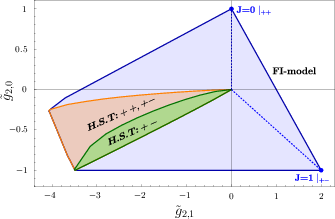
Figure 1: Allowed regions for the normalised Wilson coefficients g~2,0 and g~2,1.
Goldstino EFT-hedron
In the limit where the transverse modes of the spin-3/2 particle decouple, the paper focuses on the EFT of the longitudinal components, the Goldstinos. A novel class of t-u symmetric dispersion relations is developed, leading to an elegant organization of ultraviolet constraints imposed by positivity and crossing symmetry. These constraints bound the space of Wilson coefficients, defining the Goldstino EFT-hedron.
The analysis identifies extremal regions of this space, corresponding to known supersymmetry-breaking models, such as O'Raifeartaigh models. It also uncovers new UV models involving higher-spin particles. The paper highlights the importance of considering both elastic and inelastic channels in deriving these constraints.
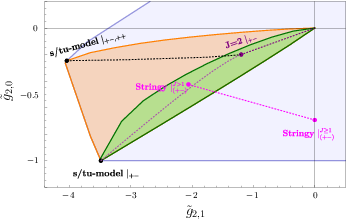
Figure 2: Zooming in the higher-spin UV model portion of Fig.~\ref{posbound1}.
Implications and Future Directions
The paper's findings have significant theoretical implications for the consistency of EFTs involving massive higher-spin particles. The necessity of gravity and, in some cases, supersymmetry, as dictated by positivity bounds, underscores the interconnectedness of these fundamental concepts. The paper also suggests potential phenomenological implications, particularly for the discovery and characterization of spin-3/2 particles and their couplings.
Future research directions include extending the analysis to particles of higher spin, exploring the implications for classical spinning bodies, and further investigating the interplay between gravity, supersymmetry, and higher-spin states.