- The paper introduces a novel deep learning pipeline, WhoFi, that encodes Wi-Fi CSI data to create robust biometric signatures for person re-identification.
- The methodology employs a Transformer-based encoder and an in-batch negative loss function to optimize feature clustering and separation.
- Experimental results show a Rank-1 accuracy of 95.5% and mAP of 88.4%, demonstrating the effectiveness of Wi-Fi signals as a privacy-preserving biometric modality.
WhoFi: Deep Person Re-Identification via Wi-Fi Channel Signal Encoding
The paper "WhoFi: Deep Person Re-Identification via Wi-Fi Channel Signal Encoding" (2507.12869) introduces a novel deep learning pipeline, WhoFi, for person Re-ID utilizing Wi-Fi Channel State Information (CSI). The system extracts biometric features from CSI data and processes them through a modular Deep Neural Network (DNN) featuring a Transformer-based encoder. The network is trained using an in-batch negative loss function to learn robust and generalizable biometric signatures. The study demonstrates competitive results on the NTU-Fi dataset, affirming the effectiveness of identifying individuals via Wi-Fi signals.
Background and Motivation
Traditional person Re-ID systems rely on visual data, which are susceptible to limitations such as poor lighting, occlusion, and viewpoint variations. Wi-Fi-based person Re-ID offers a non-visual alternative, leveraging the principle that Wi-Fi signals are altered by the presence and physical characteristics of individuals. CSI provides detailed measurements of how radio signals interact with the environment, capturing biometric information. The paper addresses the underexplored area of Wi-Fi-based Re-ID by developing scalable deep learning methods that generalize across individuals and sensing environments.
Methodology
The proposed WhoFi pipeline consists of data pre-processing, data augmentation, a DNN architecture, and a loss function.
Data Pre-processing and Augmentation
The pre-processing stage involves cleaning CSI data to extract meaningful biometric features. This includes amplitude filtering using a Hampel filter to remove outliers and phase sanitization to correct phase shifts caused by hardware synchronization issues.
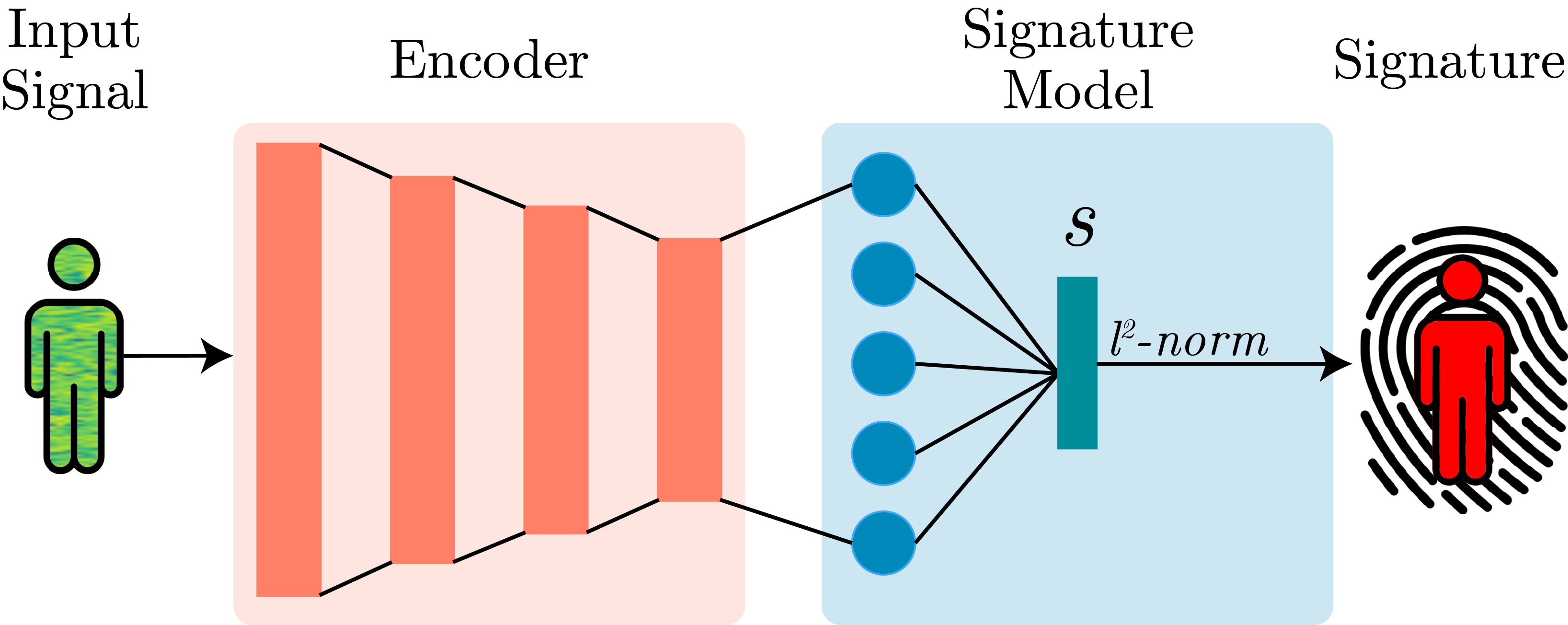
Figure 1: The system processes input signals through an encoder, extracts latent representations, computes a signature vector, normalizes the signature, and uses the normalized signature as a unique identifier.
Deep Neural Network Architecture
The DNN architecture comprises an Encoder module (Me) and a Signature Module (Ms). The Encoder module extracts relevant information from CSI measurements using LSTM, Bi-LSTM, or Transformer networks. The Signature module then generates a biometric signature, applying l2 normalization to ensure uniformity and facilitate similarity computations.
Loss Function
The pipeline employs an in-batch negative loss function to train the model. This loss function encourages signatures from the same person to cluster together in the embedding space while maximizing the distance between signatures from different individuals. A custom batch sampler constructs batches with query and gallery lists, and a similarity matrix is computed using cosine similarity.
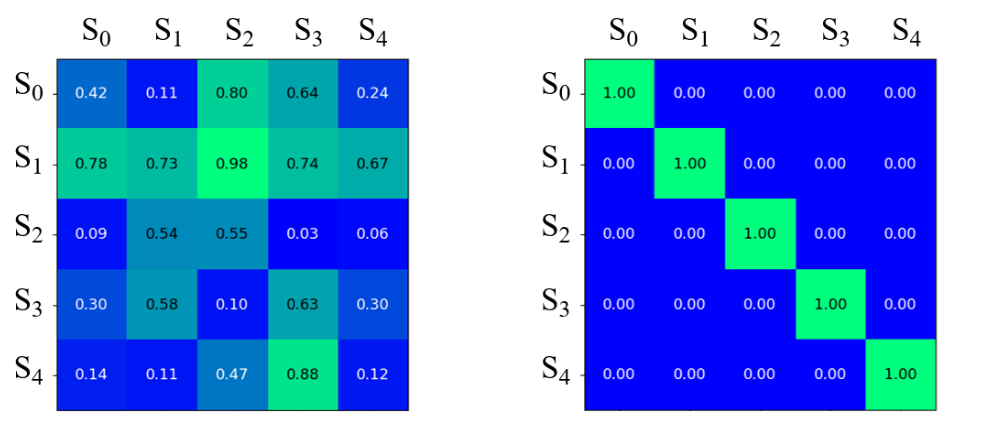
Figure 2: A similarity matrix is constructed with diagonal elements representing similarities between query signatures and corresponding positive gallery signatures.
Experimental Results
The experiments were conducted on the NTU-Fi dataset, evaluating the performance of LSTM, Bi-LSTM, and Transformer-based models. The Transformer-based model achieved superior results, with a Rank-1 accuracy of 95.5% and a mean Average Precision (mAP) of 88.4%. Ablation studies explored the impact of amplitude filtering, data augmentation, packet size, and model depth. The results indicated that the Transformer encoder benefits from longer input sequences and performs optimally with a single layer.
Discussion
The results demonstrate the effectiveness of the Transformer-based model in capturing discriminative temporal patterns within Wi-Fi amplitude sequences. The ablation studies provide insights into the importance of pre-processing steps and the impact of data augmentation on model performance. The findings suggest that Wi-Fi signals can serve as a robust and privacy-preserving biometric modality for person Re-ID.
Conclusion
The paper presents a deep learning pipeline for person Re-ID using Wi-Fi CSI, leveraging a DNN to generate biometric signatures. The study demonstrates the viability of Wi-Fi signals as a biometric modality and establishes a baseline for future research in CSI-based person re-identification.