Papers
Topics
Authors
Recent
Search
2000 character limit reached

Enhancing POI Recommendation through Global Graph Disentanglement with POI Weighted Module

Published 19 Jul 2025 in cs.IR, cs.AI, and cs.SI | (2507.14612v1)

Abstract: Next point of interest (POI) recommendation primarily predicts future activities based on users' past check-in data and current status, providing significant value to users and service providers. We observed that the popular check-in times for different POI categories vary. For example, coffee shops are crowded in the afternoon because people like to have coffee to refresh after meals, while bars are busy late at night. However, existing methods rarely explore the relationship between POI categories and time, which may result in the model being unable to fully learn users' tendencies to visit certain POI categories at different times. Additionally, existing methods for modeling time information often convert it into time embeddings or calculate the time interval and incorporate it into the model, making it difficult to capture the continuity of time. Finally, during POI prediction, various weighting information is often ignored, such as the popularity of each POI, the transition relationships between POIs, and the distances between POIs, leading to suboptimal performance. To address these issues, this paper proposes a novel next POI recommendation framework called Graph Disentangler with POI Weighted Module (GDPW). This framework aims to jointly consider POI category information and multiple POI weighting factors. Specifically, the proposed GDPW learns category and time representations through the Global Category Graph and the Global Category-Time Graph. Then, we disentangle category and time information through contrastive learning. After prediction, the final POI recommendation for users is obtained by weighting the prediction results based on the transition weights and distance relationships between POIs. We conducted experiments on two real-world datasets, and the results demonstrate that the proposed GDPW outperforms other existing models, improving performance by 3% to 11%.
Summary

  • The paper introduces a novel GDPW framework that disentangles temporal and categorical preferences for improved POI recommendations.
  • It employs three global graph structures and contrastive learning to capture intricate spatial-temporal dynamics in user mobility data.
  • Experimental results show that GDPW significantly outperforms existing models with a 3% to 11% boost in recommendation accuracy.

Enhancing POI Recommendation with Global Graph Disentanglement

The paper presents a framework called Graph Disentangler with POI Weighted Module (GDPW) for improving the accuracy of Point-of-Interest (POI) recommendations. GDPW is designed to address the shortcomings of conventional POI recommendation models by incorporating novel graph-based learning strategies and disentangling techniques to capture both temporal and categorical preferences in user mobility patterns.

Framework Architecture

Global Graph Construction

GDPW utilizes three primary graph structures: a Global Category Graph, a Global Category-Time Graph, and a Global Universal Gravity (UG) Graph. Each graph serves different purposes in learning representations necessary for accurate POI recommendations.

  • Global Category Graph: Captures the transition relationships between POI categories, enabling the model to learn how users typically move across different categories.
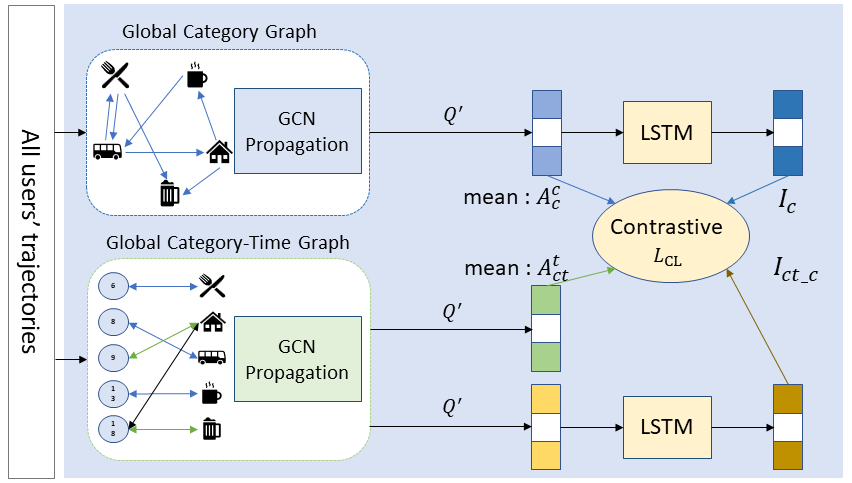
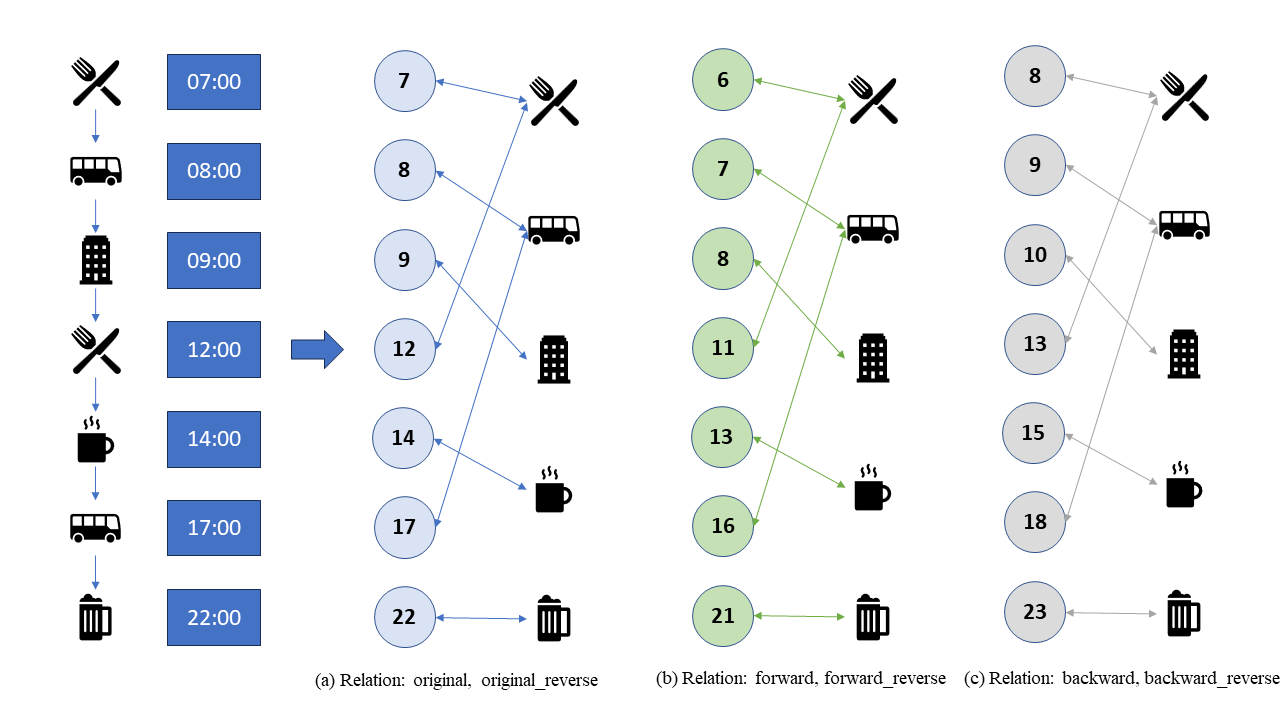
  • Global Category-Time Graph: Introduces temporal dimensions into category evaluation, constructing edges based on discrete time intervals for weekdays and weekends. This graph aids in learning the correlation between POI categories and the specific times they are visited. Figure 1

    Figure 1: Global Category-Time Graph.

  • Global UG Graph: Focuses on spatial information, weighing POIs based on Newton’s law of universal gravitation which considers check-in frequency and distance using the Haversine formula. Figure 2

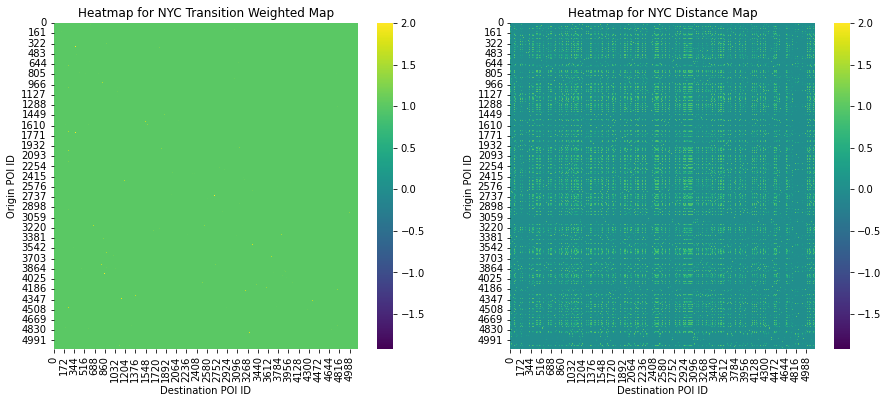
    Figure 2: NYC Transition Weighted Map and Distance Map visualization.

Category-Time Disentangle Layer

In this layer, GDPW employs Graph Convolutional Networks (GCN) to learn category and time representations independently by propagating information through the constructed global graphs. This layer emphasizes disentangling category and time representation using contrastive learning techniques. Figure 3

Figure 3: Category-Time Disentangler.

Contrastive learning is applied to facilitate the separation of intrinsic category and time information captured in proxies derived from raw user data, optimizing the model's capability to accurately predict POIs in relation to temporal visit dynamics.

POI Weighted Layer

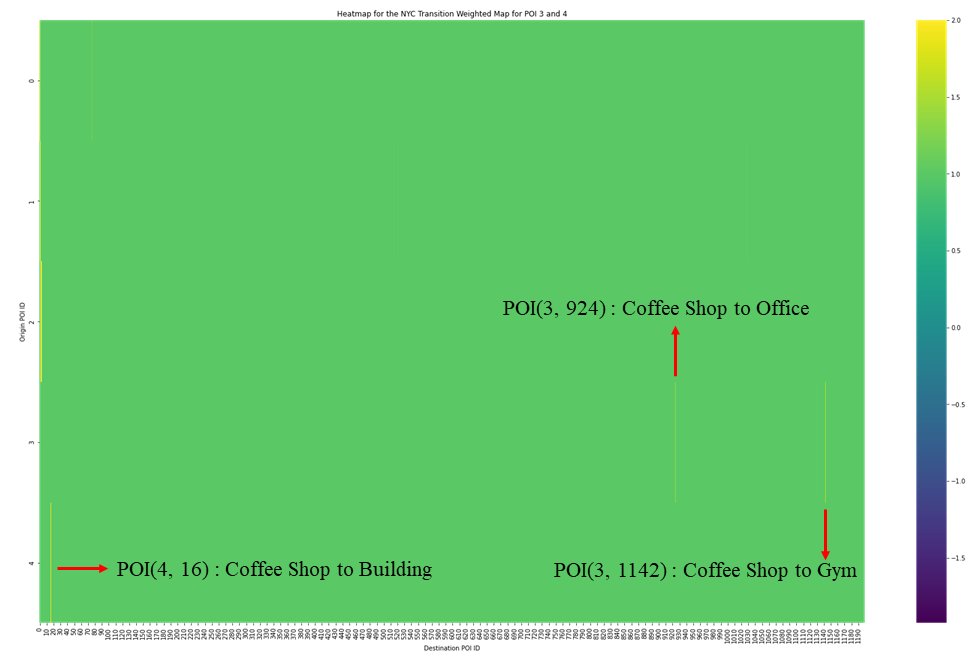
This layer integrates POI attributes such as popularity, spatial transition weights, and geographic distance through the Transition Weighted Map and Distance Map, providing a balanced view of user interactions based on distance and frequency. Figure 4

Figure 4: Heatmap for NYC Transition Weighted Map for POI 3 and POI 4.

Prediction Layer

The final POI recommendations result from combining learned representations, spatial dynamics captured in maps, and user identity embeddings. A personalized weighting system harnesses transition weights and distances between POIs to offer tailored recommendations.

Experimental Analysis

Performance Evaluation

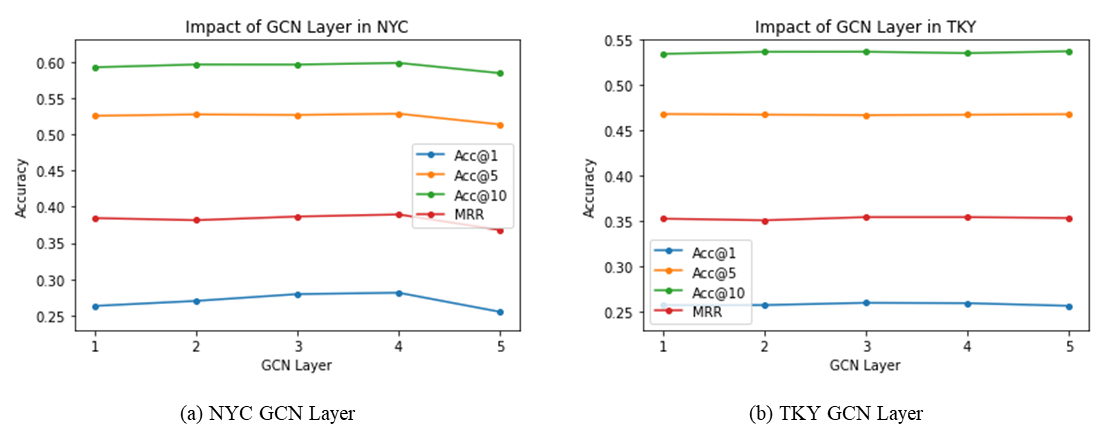
GDPW demonstrates substantial improvements in recommendation accuracy across two real-world datasets and various metrics. It achieves 3% to 11% improvement over existing models, affirming the advantage of integrating global graph disentanglement and multifaceted POI weighting. Figure 5

Figure 5: Impact of GCN layers.

Ablation Studies

Testing different components of GDPW, such as the absence of graph structures or disentanglement operations, confirms that each contributes distinctively to improved overall performance, especially the POI Weighted Layer which optimizes spatial and relational inputs.

Visualizations

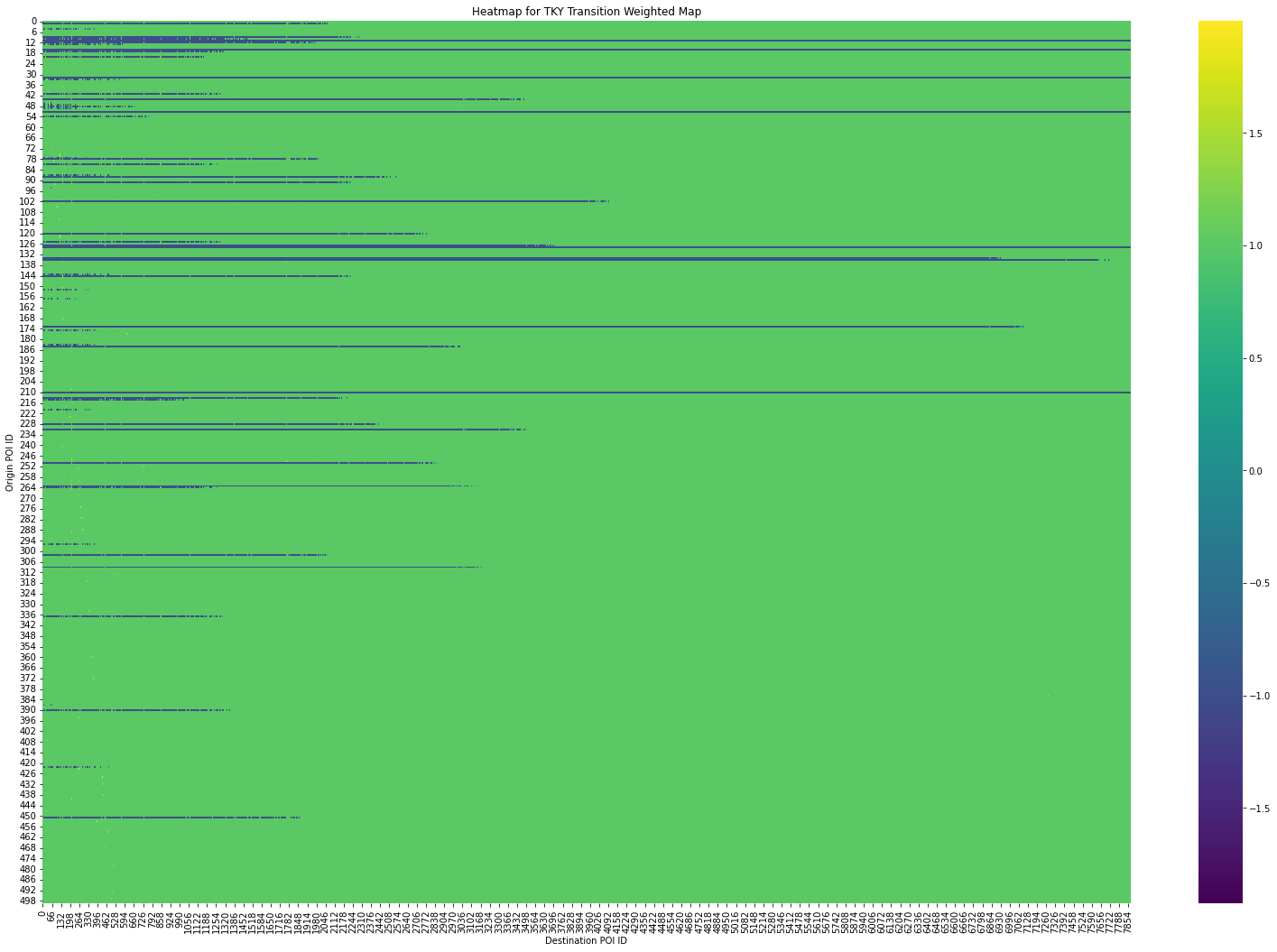
Heatmaps of the NYC and TKY datasets visualize the effective differential weighting applied in Transition and Distance Maps, highlighting GDPW’s ability to model intricate spatial-temporal dynamics effectively. Figure 6

Figure 6: Heatmap for TKY Transition Weighted Map.

Conclusion

GDPW effectively enhances POI recommendations by employing advanced graph-based structures and disentangled learning methods to integrate category-time relationships with personalized spatial weighting. Future work could explore hybrid GNN approaches and refine dynamic fusion techniques to further improve prediction accuracy and computational efficiency.

Paper to Video (Beta)

No one has generated a video about this paper yet.

Whiteboard

No one has generated a whiteboard explanation for this paper yet.

Open Problems

We haven't generated a list of open problems mentioned in this paper yet.

Collections

Sign up for free to add this paper to one or more collections.

Tweets

Sign up for free to view the 2 tweets with 1 like about this paper.