Building Intuition for Dynamical Mean-Field Theory: A Simple Model and the Cavity Method
Published 22 Jul 2025 in cond-mat.dis-nn and physics.bio-ph | (2507.16654v1)
Abstract: Dynamical Mean-Field Theory (DMFT) is a powerful theoretical framework for analyzing systems with many interacting degrees of freedom. This tutorial provides an accessible introduction to DMFT. We begin with a linear model where the DMFT equations can be derived exactly, allowing readers to develop clear intuition for the underlying principles. We then introduce the cavity method, a versatile approach for deriving DMFT equations for non-linear systems. The tutorial concludes with an application to the generalized Lotka--Volterra model of interacting species, demonstrating how DMFT reduces the complex dynamics of many-species communities to a tractable single-species stochastic process. Key insights include understanding how quenched disorder enables the reduction from many-body to effective single-particle dynamics, recognizing the role of self-averaging in simplifying complex systems, and seeing how collective interactions give rise to non-Markovian feedback effects.
The paper demonstrates that DMFT effectively reduces high-dimensional disordered dynamics to a tractable single-variable stochastic process.
It derives exact DMFT equations for a linear model and generalizes the approach to nonlinear systems using the cavity method.
Numerical validations confirm that the framework accurately captures key properties, as shown in applications to ecological models like the generalized Lotka–Volterra system.
Building Intuition for Dynamical Mean-Field Theory: A Simple Model and the Cavity Method
Introduction and Motivation
Dynamical Mean-Field Theory (DMFT) provides a systematic approach for reducing the high-dimensional dynamics of large, disordered systems to effective single-variable stochastic processes. Originally developed in the context of spin glasses, DMFT has become a central tool in the analysis of complex systems with dense, heterogeneous interactions, including neural networks and ecological communities. The core idea is to exploit the self-averaging properties and quenched disorder in large systems to derive closed, self-consistent equations for the dynamics of a representative degree of freedom.
This work presents a pedagogical yet rigorous introduction to DMFT, beginning with an exactly solvable linear model and progressing to the cavity method, which generalizes the approach to non-linear systems. The tutorial culminates in an application to the generalized Lotka–Volterra (GLV) model, demonstrating the reduction of many-body dynamics to a tractable single-species stochastic process.
Exact DMFT for a Linear Model
The starting point is a linear dynamical system with N degrees of freedom, each coupled via a random, skew-symmetric matrix Aij:
dtdxi=j=1∑NAijxj(t),i=1,…,N
where Aij are i.i.d. Gaussian variables (subject to Aij=−Aji) with variance σ2/N. The initial conditions are also Gaussian. The goal is to derive an effective equation for a randomly chosen degree of freedom, xα(t), by integrating out the remaining N−1 variables.
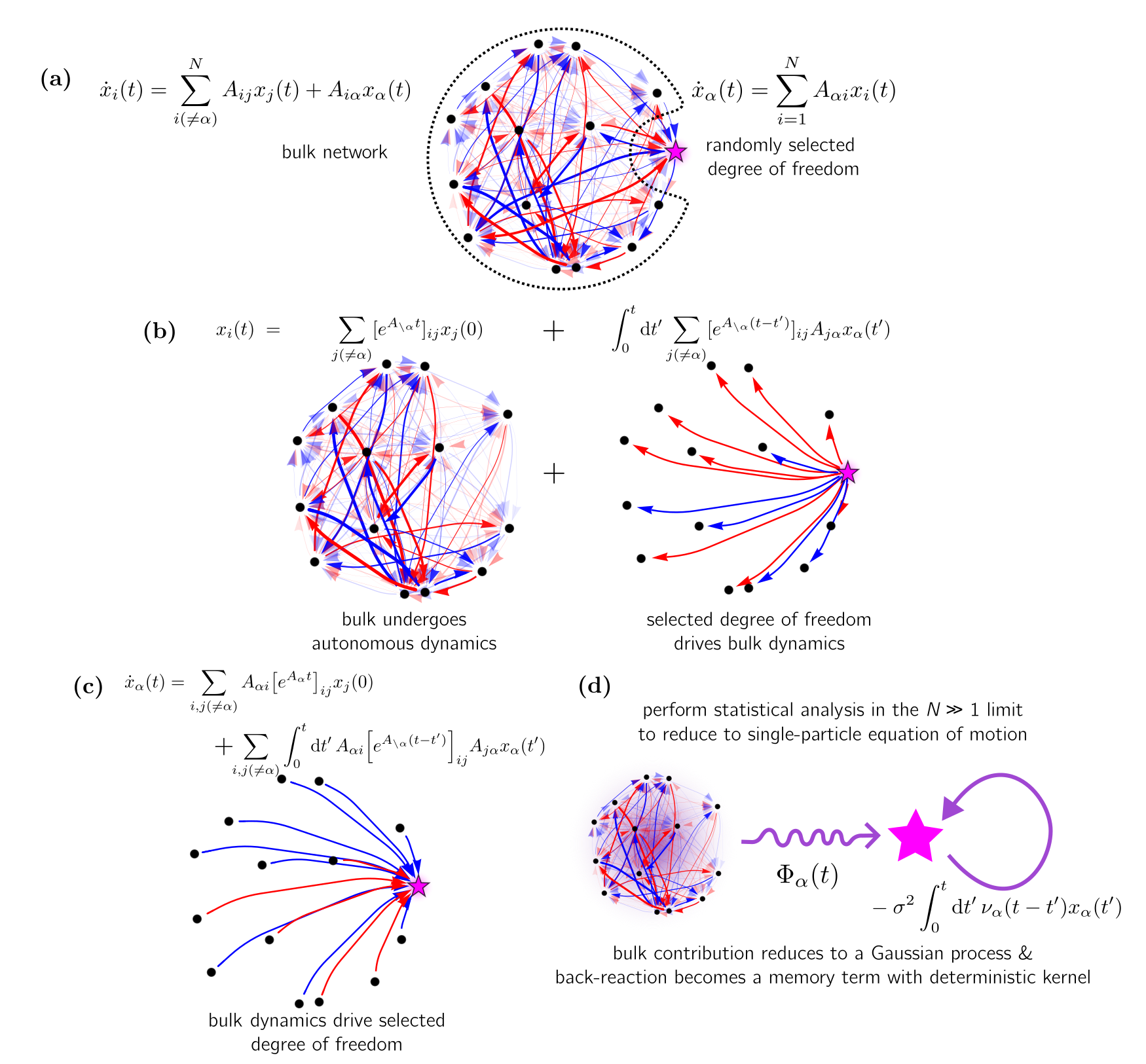
The derivation proceeds by explicitly solving for xi(t) (i=α) in terms of xα(t) and substituting back, yielding an integro-differential equation for xα(t) with two key terms: a Gaussian process Φα(t) representing the net effect of the other variables, and a memory kernel να(t) encoding non-Markovian feedback.
Figure 1: Schematic of the DMFT derivation for the linear model, illustrating the reduction from a fully connected network to an effective single-variable stochastic process with memory.
A detailed statistical analysis shows that, in the thermodynamic limit (N→∞), both Φα(t) and να(t) become self-averaging. The resulting DMFT equation is:
dtdx=Φ(t)−σ2∫0tν(t−t′)x(t′)dt′
where Φ(t) is a zero-mean Gaussian process with autocovariance σ2σ02σ∣t−s∣J1(2σ∣t−s∣), and ν(t) is given by the same Bessel function structure. This reduction is exact for the linear model and provides a transparent illustration of the DMFT mechanism.
The Cavity Method
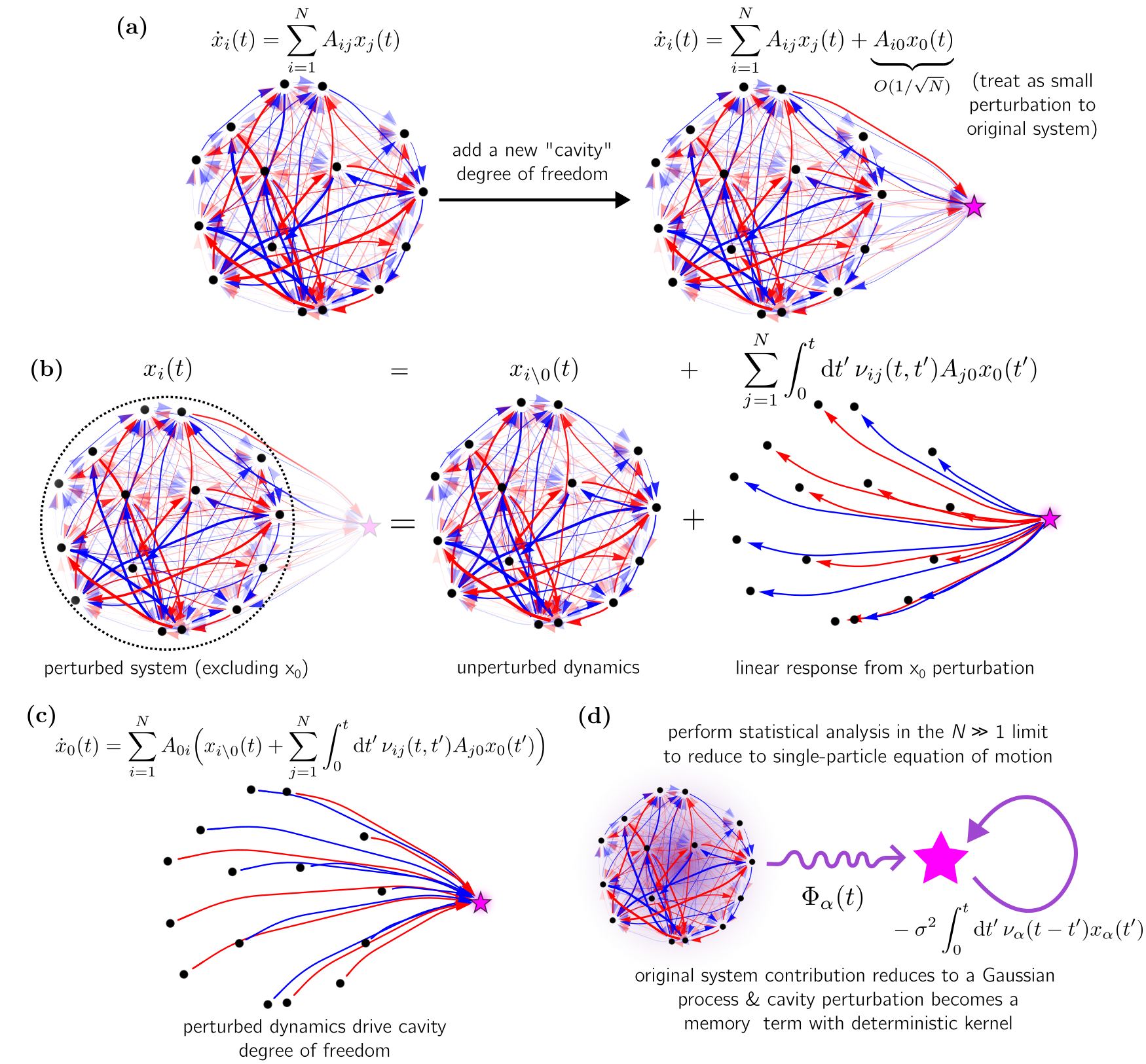
The cavity method generalizes the DMFT approach to non-linear and more complex systems. The central idea is to consider the effect of adding a new "cavity" degree of freedom to a large system and analyze its dynamics as a perturbation. The method proceeds in several steps:
Add the cavity variable: Introduce a new variable x0 coupled to the existing N variables.
Linear response: Treat the influence of x0 on the original system as a small perturbation, justified by the O(1/N) scaling of the couplings.
Obtain the cavity equation: Substitute the perturbed dynamics back into the equation for x0, yielding an effective stochastic equation with a memory term.
Statistical analysis: Average over the quenched disorder to obtain self-consistent equations for the order parameters (correlation and response functions).
Self-averaging closure: Assert that, in the large N limit, the order parameters can be computed from the statistics of the cavity variable itself.
Figure 2: Schematic of the cavity method, showing the addition of a cavity variable and the feedback loop between the cavity and the bulk system.
For the linear model, the cavity method reproduces the exact DMFT equations derived previously, but its true power lies in its applicability to non-linear systems.
Application to the Generalized Lotka–Volterra Model
The generalized Lotka–Volterra (GLV) model describes the population dynamics of S interacting species:
dtdNi=Ni1−Ni−j=i∑AijNj
with Aij random interactions. Applying the cavity method, the dynamics of a newly added species N0 are governed by:
where m(t), C(t,t′), and ν(t,t′) are the mean, autocovariance, and response function of the species abundances, and η(t) is a Gaussian process with covariance C(t,t′). These order parameters are determined self-consistently from the statistics of N0(t).
This reduction enables the analysis of complex phenomena such as phase transitions, chaos, and stability in large ecological communities. While the resulting DMFT equations are not analytically tractable in general, they can be efficiently solved numerically via iterative schemes.
Analysis and Implications
Correlation and Response Functions
The DMFT framework provides explicit predictions for the autocorrelation and response functions of individual degrees of freedom. For the linear model, the autocorrelation decays as t−3/2 with oscillations determined by the spectrum of Aij, reflecting the underlying random matrix structure. The response to perturbations is captured by the same kernel, and the Lyapunov exponent can be computed via a two-particle cavity construction, yielding zero for the linear skew-symmetric case.
Power Spectrum
The power spectral density of the dynamics is given by the Fourier transform of the autocorrelation function, resulting in a semicircular distribution with sharp cutoffs, mirroring the Wigner semicircle law for the eigenvalues of Aij. This correspondence highlights the deep connection between DMFT and random matrix theory.
Nonlinear Dynamics and Phase Structure
In the GLV model, the DMFT reduction reveals how macroscopic properties such as stability, diversity, and chaos emerge from microscopic randomness. The feedback (back-reaction) term, parameterized by γ, encodes the degree of symmetry in the interactions and controls the nature of collective regulation (self-limitation vs. cooperation). The steady-state analysis leads to truncated Gaussian distributions for species abundances and enables the identification of phase boundaries.
Numerical Results and Validation
The theoretical predictions of DMFT are validated by direct numerical simulations, showing excellent agreement for correlation functions and power spectra even for moderate system sizes (N∼100). The self-averaging property ensures that single realizations are representative, justifying the use of DMFT in practical applications.
Limitations and Future Directions
While DMFT provides a powerful reduction for large, disordered systems, its applicability relies on the validity of self-averaging and the absence of anomalous fluctuations. In systems with strong correlations or non-ergodic behavior, these assumptions may break down, necessitating more sophisticated approaches (e.g., replica methods or extensions to non-self-averaging regimes).
Future developments may include:
Extension to systems with structured (non-random) interactions or sparse connectivity.
Incorporation of time-dependent or non-stationary disorder.
Application to learning dynamics in neural networks and inference in high-dimensional statistics.
Analytical and numerical exploration of phase transitions and critical phenomena in non-linear DMFT equations.
Conclusion
This work provides a comprehensive and technically detailed introduction to DMFT, emphasizing both the exact solution of a linear model and the general cavity method. The reduction of high-dimensional, disordered dynamics to effective single-variable stochastic processes, with self-consistent order parameters, is a central paradigm for understanding complex systems in physics, biology, and beyond. The methods and insights presented here form a robust foundation for further research into the dynamics of large, heterogeneous systems.