- The paper demonstrates that every generalized Legendre transform is equivalent to an ordinary Legendre-Fenchel transform applied to an affine-deformed convex function.
- It provides explicit parameterizations of affine deformations and establishes an involutive structure that preserves convexity and duality properties.
- The study interprets these findings within information geometry, linking dual coordinate systems with the invariance of divergence measures.
Introduction
This note provides a rigorous analysis of the Artstein-Avidan-Milman (AAM) characterization of generalized Legendre transforms (GLFTs) on the space of proper lower semi-continuous convex functions. The main result establishes that all such GLFTs are, in fact, ordinary Legendre-Fenchel transforms (LFTs) applied to affine-deformed functions. This equivalence is formalized through explicit parameterizations and involutive transformations, and the implications are further interpreted within the framework of information geometry, particularly in the context of dually flat spaces and their associated divergences.
Theoretical Foundations
Let Γ0 denote the space of proper, lower semi-continuous, extended real-valued convex functions on Rm. The Legendre-Fenchel transform LF of F∈Γ0 is defined as
(LF)(η)=θ∈Rmsup{⟨θ,η⟩−F(θ)}.
The biconjugate property (F∗)∗=F holds for F∈Γ0, and the transform is order-reversing.
AAM's theorem characterizes all invertible, order-reversing transforms T on Γ0 as affine deformations of the LFT: (TF)(η)=λ(LF)(Eη+f)+⟨η,g⟩+h,
where λ>0, E∈GL(Rm), f,g∈Rm, and h∈R.
Affine deformations of a function F are parameterized as
FP(θ)=λF(Aθ+b)+⟨θ,c⟩+d,
with P=(λ,A,b,c,d). Such deformations preserve convexity and lower semi-continuity, ensuring FP∈Γ0 for all admissible P.
The Legendre transform of FP yields another affine-deformed convex conjugate: L(FP)=(LF)P⋄,
where the involutive parameter transformation P↦P⋄ is given by
P⋄=(λ,λ1A−1,−λ1A−1c,−A−1b,⟨b,A−1c⟩−d).
This involution property ensures that applying the transformation twice returns the original parameters, i.e., (P⋄)⋄=P.
The central result is that any GLFT can be realized as an ordinary LFT on an affine-deformed function: (TF)(η)=L(FP⋄)(η).
This demonstrates that the apparent generality of GLFTs is subsumed by the structure of the ordinary LFT, provided one allows for affine changes of variables and scaling.
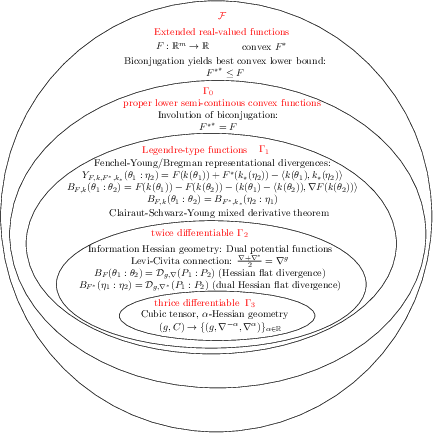
Figure 1: The ordinary Legendre transform on classes of functions: Relationships with representational Fenchel-Young and Bregman divergences, flat Hessian divergence, and α-geometry in information geometry.
Subgradients and Reciprocal Gradients
The analysis extends to non-differentiable convex functions, where subgradients replace gradients. For Legendre-type functions (strictly convex, differentiable, and steep at the boundary), the gradients of conjugate pairs are reciprocal: ∇F∗=(∇F)−1,∇F=(∇F∗)−1.
This property is crucial for the geometric interpretation and for applications in optimization and information geometry.
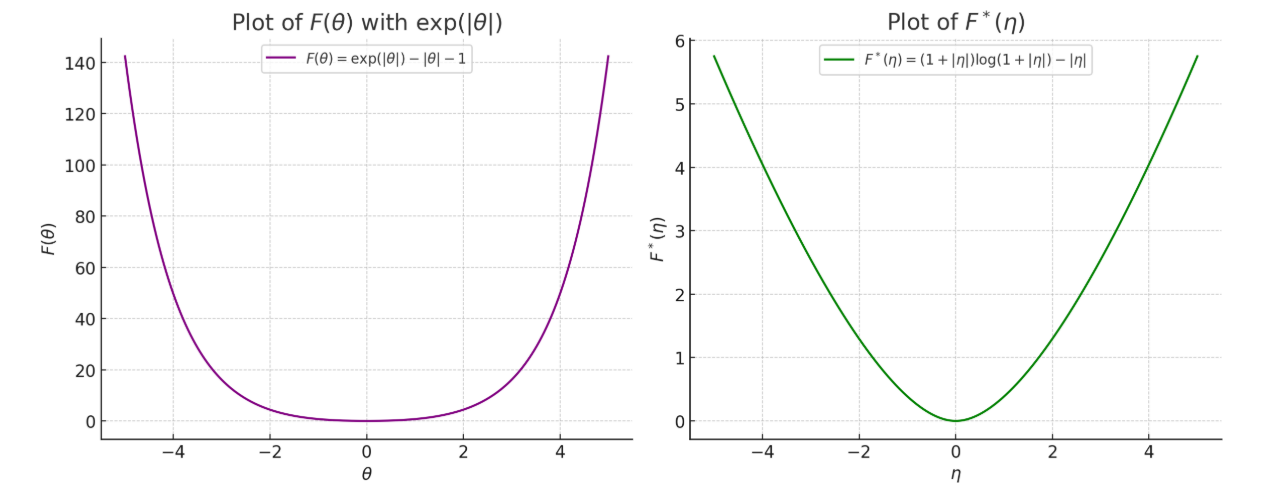
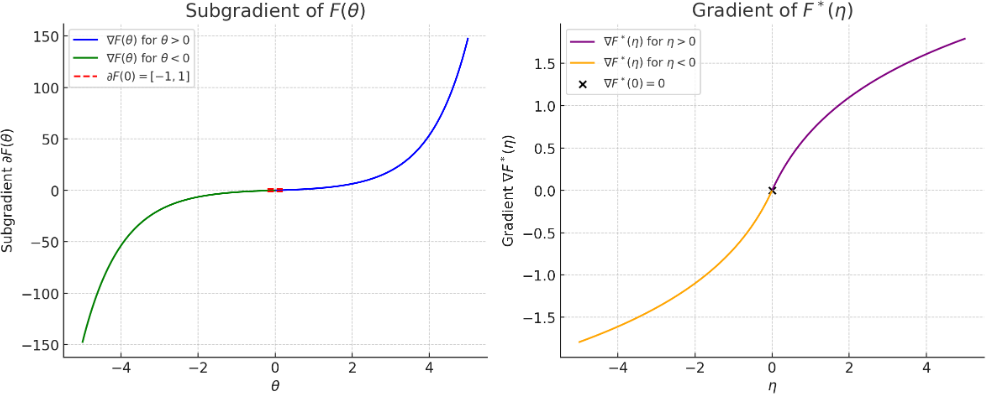
Figure 2: A pair (F(θ),F∗(η)) of conjugate functions (top) with their subgradients plotted (bottom). F(θ) is not differentiable at θ=0 and thus admits a subgradient ∂F(0) at θ=0. F∗(η) is everywhere differentiable, and when θ=0, ∇F∗=(∇F)−1.
The result is interpreted through the lens of information geometry, where a strictly convex function F induces a dually flat manifold (M,g,∇,∇∗). The affine freedom in the choice of coordinates and potential functions corresponds precisely to the affine deformations in the GLFT characterization. The Fenchel-Young inequality and the associated divergences (Fenchel-Young, Bregman, and dually flat divergences) are invariant under these affine transformations, leading to an equivalence relation on the moduli space of dually flat spaces.
The parameter λ corresponds to scaling the metric and connections, reflecting the geometric invariance of the divergence structure under such rescalings. The duality between the primal and dual coordinate systems, and the associated potential functions, is preserved under the affine-deformed LFT framework.
Implications and Future Directions
The identification of all GLFTs as ordinary LFTs on affine-deformed functions has several implications:
- Convex Analysis: The result provides a complete classification of order-reversing involutive transforms on Γ0, reducing the study of GLFTs to the well-understood theory of LFTs and affine transformations.
- Optimization: Algorithms that rely on convex conjugacy (e.g., in Fenchel duality, mirror descent, or variational inference) can be generalized to accommodate affine-deformed settings without loss of generality.
- Information Geometry: The affine invariance elucidated here underpins the geometric structure of dually flat spaces, with direct consequences for the study of divergences, exponential families, and statistical manifolds.
- Theoretical Generalization: The involutive structure and parameterization may inform further generalizations, such as to infinite-dimensional settings or to other classes of duality transforms.
Conclusion
This note rigorously demonstrates that the Artstein-Avidan-Milman generalized Legendre transforms are, in essence, ordinary Legendre-Fenchel transforms applied to affine-deformed convex functions. The involutive parameterization and the information-geometric interpretation provide a unified perspective that bridges convex analysis, optimization, and information geometry. This equivalence simplifies the theoretical landscape and offers a robust foundation for further developments in the analysis and application of convex duality and geometric structures.