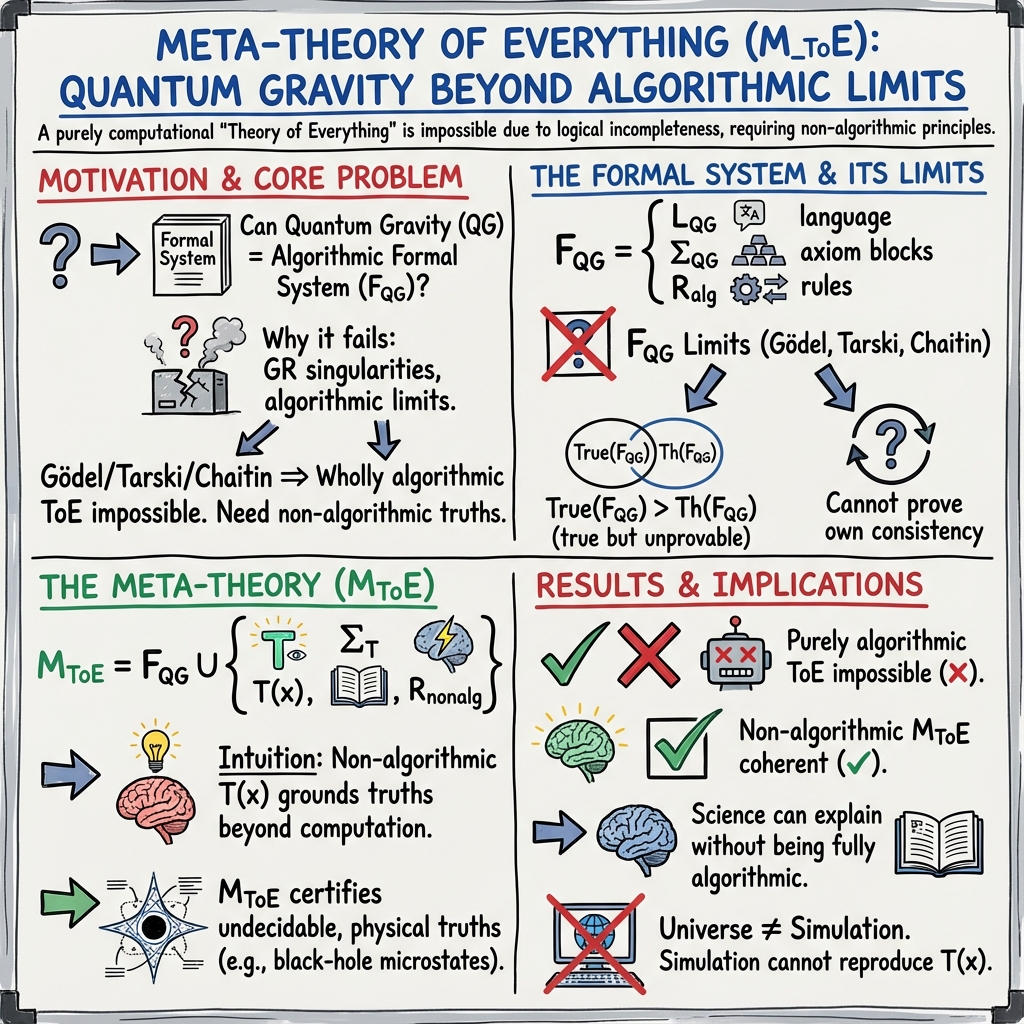
- The paper demonstrates that intrinsic undecidability, as highlighted by Gödel, Tarski, and Chaitin, limits the formulation of a fully algorithmic Theory of Everything.
- It employs a meta-theory integrating non-algorithmic components to address unresolved issues in quantum gravity and the black-hole information paradox.
- It reveals that simulation frameworks and other computational models cannot fully capture physical truth, underscoring a need for non-computational reasoning.
Consequences of Undecidability in Physics on the Theory of Everything
Introduction
This paper titled "Consequences of Undecidability in Physics on the Theory of Everything" (2507.22950) examines theoretical limitations in formulating a complete and consistent "Theory of Everything" (ToE) due to intrinsic undecidability in computational systems. The authors explore the axiomatic structure of quantum gravity and the inherent inability of any algorithmic framework to encapsulate all aspects of physical reality. The discussion is grounded in prominent mathematical theorems by Gödel, Tarski, and Chaitin, which establish fundamental constraints on computational deducibility.
Undecidability in Quantum Gravity
Quantum gravity is envisioned as an axiomatic theory that generates spacetime through algorithmic processes. However, the paper argues that such a program is fundamentally limited by Gödel's incompleteness theorems, Tarski's undefinability theorem, and Chaitin's incompleteness theorem. Gödel's theorems imply that any computationally complete formal system will contain true statements that are unprovable within the system. Tarski's theorem illustrates that truth cannot be internally defined within sufficiently complex systems, and Chaitin's theorem demonstrates limits on the complexity of statements that can be decided algorithmically.
Incorporating these insights, the authors propose a "Meta-Theory of Everything" that includes non-algorithmic components to address and integrate these undecidable phenomena. This meta-theory posits that the computational limitations do not imply the breakdown of science but instead necessitate non-algorithmic understanding as part of a comprehensive physical theory.
Implications of Computational Limits
The inability to fully algorithmize quantum gravity implies significant consequences for several unresolved problems. Notably, it impacts the black-hole information paradox, suggesting that Planck-scale microstates, which contribute to black-hole entropy, might inherently elude a finite computational description due to their complexity. This raises questions about the algorithmic nature of purportedly "thermalized" states and evolutionary phenomena, supported by examples from both string theory and loop quantum gravity.
Moreover, phenomena such as thermalization, renormalization-group trajectories, and the behaviour of tensor networks in many-body physics display undecidable characteristics, indicating that specific aspects of spacetime emergence transcend computational capability. The meta-theory proposed by the authors integrates non-algorithmic resources to tackle these phenomena, thereby ensuring continuity and consistency in the framework.
Addressing the Simulation Hypothesis
The authors further explore the implications of undecidability on the simulation hypothesis, which suggests that the universe might be a computational simulation. They argue that the meta-theoretic structure containing non-computable truths implies that no simulation can encapsulate the complete nature of our universe, given that many physical truths remain inaccessible to algorithmic verification.
Conclusion
The paper concludes that a comprehensive and consistent ToE demands a deeper description that transcends purely algorithmic understanding. By expanding the theoretical space to include non-computational elements grounded in both empirical and non-algorithmic reasoning, the proposed meta-theory aims to restore logical soundness and offer exhaustive explanatory scope in quantum gravity. The authors propose that both 'its' (physical reality) and 'bits' (information theory) are insufficient individually for a complete depiction of reality, advocating for an overview of approaches that embrace the limitations placed by undecidability on computational physics.