- The paper introduces a novel framework by recasting classical path signatures as Wilson line observables through matrix Lie group developments and non-commutative probability techniques.
- The paper constructs quantum path signatures using quantum circuits and Trotterisation, and proposes the QSigKer algorithm that outperforms classical Monte Carlo methods.
- The paper derives a universal integro-differential equation for signature kernels and establishes quantitative error bounds, paving the way for scalable quantum-enhanced data analysis.
Quantum Path Signatures: Matrix Model Developments and Quantum Algorithms
Introduction and Motivation
This paper establishes a rigorous connection between path signature theory and matrix models in quantum field theory (QFT), with a particular focus on their implications for machine learning and quantum computing. The authors reinterpret path signatures—classically defined via iterated integrals—as Wilson line observables in gauge theory, enabling the use of non-commutative probability and matrix model techniques to study randomised path developments. This perspective leads to the formulation of loop equations for path-dependent observables and the construction of quantum analogues of path signatures and signature kernels, realised via quantum circuits.
Path Signatures and Matrix Model Developments
The path signature S(γ) is defined as the solution to the tensor differential equation $\dif y = y \otimes \dif\gamma$ in the free tensor algebra T((Rd)). The signature encodes the sequence of iterated integrals of the path, forming a non-commutative analogue of the exponential function. The authors leverage the Stone–Weierstrass theorem to argue that linear functionals on signatures are dense in the space of continuous real-valued functions on compact subsets of unparameterised paths, justifying the use of signatures as universal feature maps for sequential data.
The central technical innovation is the development of γ into a matrix Lie group GN via the controlled differential equation:
$\dif U(\gamma; M)_t = U(\gamma; M)_t \cdot M(\dif\gamma_t),$
where M is a map from Rd to the Lie algebra gN. The solution, expressed as a path-ordered exponential, is interpreted as parallel transport in a GN bundle along a Wilson line.
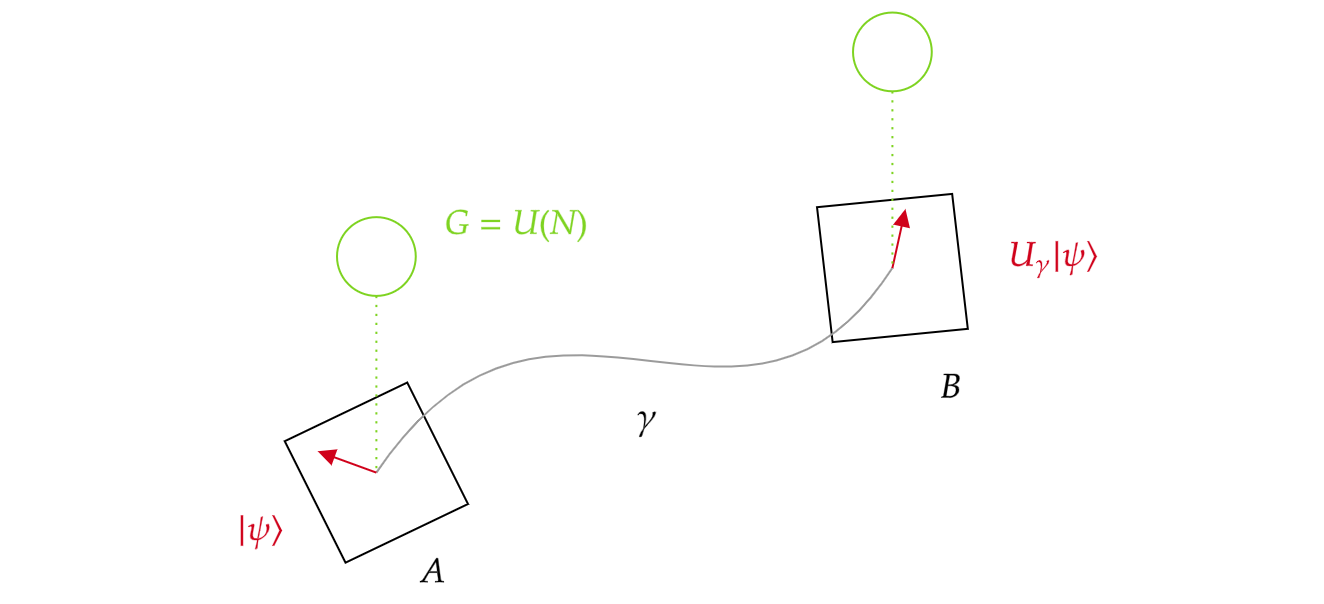
Figure 1: The path development as parallel transport in a G=U(N) bundle along a Wilson line.
Randomising the choice of vector fields M via a matrix model measure μVN on u(N), the authors study the large-N behaviour of inner products of path developments, leading to the definition of the signature kernel:
kμV∞(γ,σ):=N→∞limEM∼μVN[tr(U(γ;M)U(σ;M)†)].
This kernel is shown to satisfy a path-dependent integro-differential equation generalising the Goursat PDE for classical signature kernels.
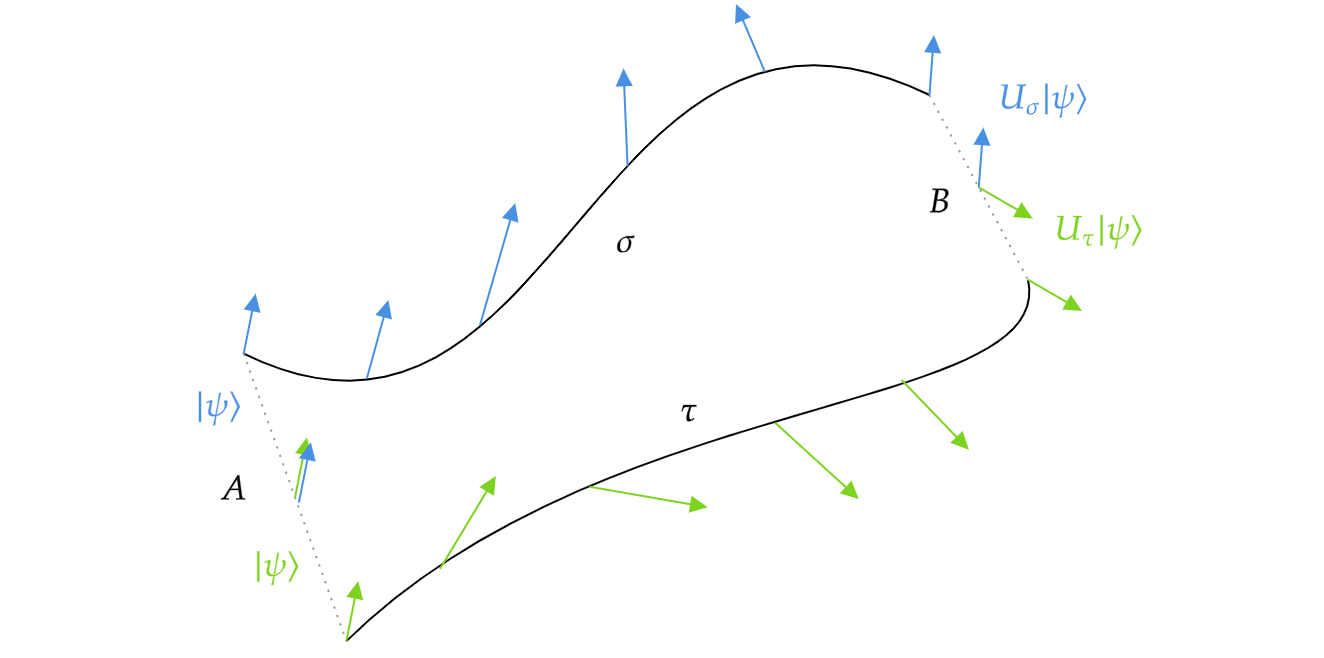
Figure 2: The kernel as parallel transport along τ compared with parallel transport along σ.
Non-Commutative Probability and Loop Equations
The paper rigorously formulates the randomised path development problem using non-commutative probability theory. The expectation values of matrix model observables are characterised by non-commutative laws satisfying Schwinger-Dyson equations, which generalise the Gaussian integration by parts formula to the matrix-valued setting. For polynomial potentials V on the Lie algebra, the limiting behaviour of trace observables is governed by unique non-commutative laws τV.
The main result is the derivation of a universal integro-differential equation for the limiting kernel functional $\pdg{s}{t}$:
$\pdg{s}{t}=1-\int\limits_{s\leq u\leq v\leq t}\pdg{s}{u}\pdg{u}{v}\langle\dif\gamma_u,\dif\gamma_v\rangle - \sum_{k=1}^d\int_s^t\DD_V^k\pdg{s}{u}\dif\gamma_u^k,$
where $\DD_V^k$ are pathwise derivatives determined by the potential V. This equation generalises previous results for the Gaussian Unitary Ensemble (GUE) and provides a framework for studying interacting path kernels.
Quantum Path Signatures and Quantum Algorithms
The authors introduce quantum analogues of path signatures and signature kernels by representing path developments as unitary operators on the Hilbert space of n qubits, H=(C2)⊗n. The generators of unitary evolution are random linear combinations of Pauli strings, and the path development is implemented as a quantum circuit via Trotterisation:
UγQ(α(m),n,K)=l=1∏L[ν=1∏di=1∏mPwi,ν(Δlνανwi/K)]K,
where Pw(θ) denotes a Pauli rotation.
The quantum path signature is defined as the mean embedding of the path into the space of quantum states:
SQ(γ):=Eα(m)[UγQ(α(m),n,K)∣0⟩⟨0∣UγQ(α(m),n,K)†].
A quantum algorithm (QSigKer) is proposed for estimating the GUE signature kernel using the one-clean-qubit model. The algorithm achieves additive error ϵ with failure probability δ using log(1/ϵ,1/δ) qubits and poly(1/ϵ,1/δ) gates, outperforming classical Monte Carlo approaches in both time and space complexity for large N.
Numerical Results and Efficiency Claims
The paper provides strong quantitative bounds for the approximation error of the quantum path development:
$\mathbb{E}\left[\left(\mathrm{tr}\left(U^{\text{SP}}_{\gamma_{s,t}}(\alpha(m),n)\right)-\pdg{s}{t}\right)^2\right] < C\left(m^{-1}+4^{-n}\right),$
where C depends only on the path length and dimension. The quantum algorithm is shown to be efficient, with resource requirements scaling polynomially in 1/ϵ and logarithmically in 1/δ.
Theoretical and Practical Implications
The theoretical framework developed in this paper generalises classical signature kernel methods to the quantum setting, enabling the study of interacting kernels via matrix model techniques. The quantum path signature construction provides a principled approach to embedding sequential data into quantum feature spaces, with potential applications in quantum-enhanced time series analysis, finance, and other domains where path-dependent functionals are relevant.
The efficient quantum algorithm for signature kernel estimation opens the possibility of leveraging quantum hardware for large-scale kernel methods, particularly in regimes where classical computation is prohibitive due to exponential scaling in path dimension or truncation level.
Future Directions
The authors highlight several avenues for future research:
- Extension to more general matrix model potentials and exploration of universality phenomena in quantum path signatures.
- Application of topological recursion to compute $1/N$ corrections for multi-path correlators, enabling systematic study of finite-N effects.
- Theoretical analysis of generalisation bounds and sample complexity for interacting and quantum signature kernels.
- Integration of quantum path signatures into hybrid classical-quantum machine learning pipelines.
Conclusion
This work establishes a rigorous bridge between path signature theory and matrix models in QFT, providing new tools for the analysis of sequential data and kernel methods in both classical and quantum settings. The quantum path signature and associated quantum algorithm offer efficient and theoretically justified approaches to kernel computation, with broad implications for machine learning and quantum information science.