- The paper introduces a novel method using Gutzwiller projections on Euler insulator PEPS to generate spinful models with a doubled bond dimension.
- It employs tensor network analysis to quantify entanglement entropy and spectrum, with linear scaling suggesting a lack of intrinsic topological order.
- Structure factor calculations reveal clear Bragg peaks, indicating localized order and correspondence with gapped local Hamiltonians.
Gapped Spinful Phases from Gutzwiller Projections of Euler States
Introduction
This paper explores the construction of spinful interacting Euler models derived from non-interacting Euler insulators, employing Gutzwiller projections. It leverages an exact representation of certain Euler insulators as PEPS with bond dimension D=2. This technique transforms the state, effectively doubling the bond dimension to D=4. Utilizing tensor network formalism, the authors evaluate these phases, focusing on their entanglement entropy and spectrum, and the structure factor to assess order and topological features.
Construction of PEPS for Euler States
The construction begins with spinless fermions configured in a kagome lattice encapsulated in PEPS form, which uses virtual fermions in W states. Mapping these virtual components to physical entities involves localized mappings via M^j. The application of Gutzwiller projection on two such PEPS copies results in a new spinful PEPS state, as articulated:
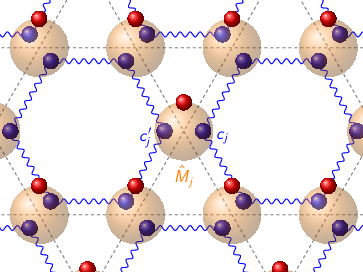

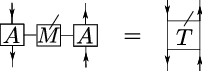
Figure 1: Construction of the exact free fermionic Euler state [source].
Following this formulation, two copies of the stated M^j mappings undergo Gutzwiller projections to form spin systems. This conversion uses tensor network methodology, adapting calculations for PEPS tensor assessments, heading towards spin model implementations:
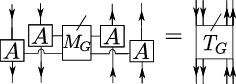
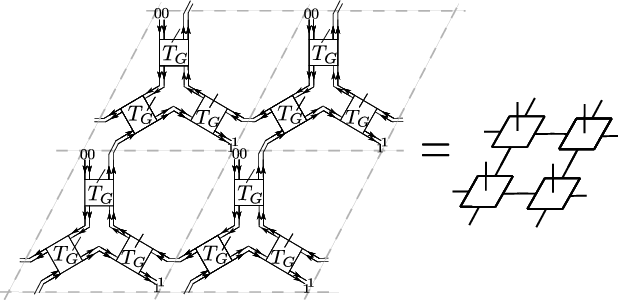
Figure 2: Construction of the PEPS tensor TG of $|\psi_{\text{spin}\rangle. Obtaining a square lattice PEPS.</p></p>
<h3 class='paper-heading' id='results-analysis'>Results Analysis</h3>
<p>Key metrics analyzed include entanglement entropy and spectrum. Calculations on cylinder geometries reveal pertinent traits of the engaged system. Specifically, the entanglement entropy's linear scaling indicates negligible topological correction, suggesting the absence of intrinsic topological order.</p>
<p>Another critical aspect explored is the entanglement spectrum on cylindrical configurations. With visible spectrum cusps at momentum $K = 0,thesecharacteristicsaffirmnotableinteractionsthatresemblenon−interactingEulerinsulators:<imgsrc="https://emergentmind−storage−cdn−c7atfsgud9cecchk.z01.azurefd.net/paper−images/2508−10957/entanglemententropy.png"alt="Figure3"title=""class="markdown−image"loading="lazy"><pclass="figure−caption">Figure3:Entanglemententropyasafunctionofcylindercircumference(reddots).Thedashedlineindicatesalinearfit,demonstratingtheabsenceoftopologicalcorrections.</p><imgsrc="https://emergentmind−storage−cdn−c7atfsgud9cecchk.z01.azurefd.net/paper−images/2508−10957/entanglementspectrum.png"alt="Figure4"title=""class="markdown−image"loading="lazy"><pclass="figure−caption">Figure4:EntanglementspectrumforacylindercircumferenceN_y = 7.Kdenotesthemany−bodymomentumandentanglementenergies.</p></p><h3class=′paper−heading′id=′transfer−operator−gap−analysis′>TransferOperatorGapAnalysis</h3><p>Anotherpivotalexplorationaddressesthegapfoundinthetransferoperatoronthecylinder.The<ahref="https://www.emergentmind.com/topics/transfer−gap"title=""rel="nofollow"data−turbo="false"class="assistant−link"x−datax−tooltip.raw="">transfergap</a>impliespotentialcorrespondencewithgappedlocalHamiltonians.Compensationforeven−oddfluctuationsincomputationsdepictsconsistencywithafinitegapinsimulatedthermodynamiclimits.<imgsrc="https://emergentmind−storage−cdn−c7atfsgud9cecchk.z01.azurefd.net/paper−images/2508−10957/transfergap.png"alt="Figure5"title=""class="markdown−image"loading="lazy"></p><p><imgsrc="https://emergentmind−storage−cdn−c7atfsgud9cecchk.z01.azurefd.net/paper−images/2508−10957/transfergappeps.png"alt="Figure5"title=""class="markdown−image"loading="lazy"><pclass="figure−caption">Figure5:GapofthetransferoperatorasafunctionoftheinversecylindercircumferenceN_y.
Structure Factor and Local Order
The structure factor calculations further assess local order presence. Results exhibit clear Bragg peaks, demonstrating localized order within the constructed states. With configurations projected upon varying cylinder dimensions, the implications reaffirm conditional stability across geometrically varied implementations:
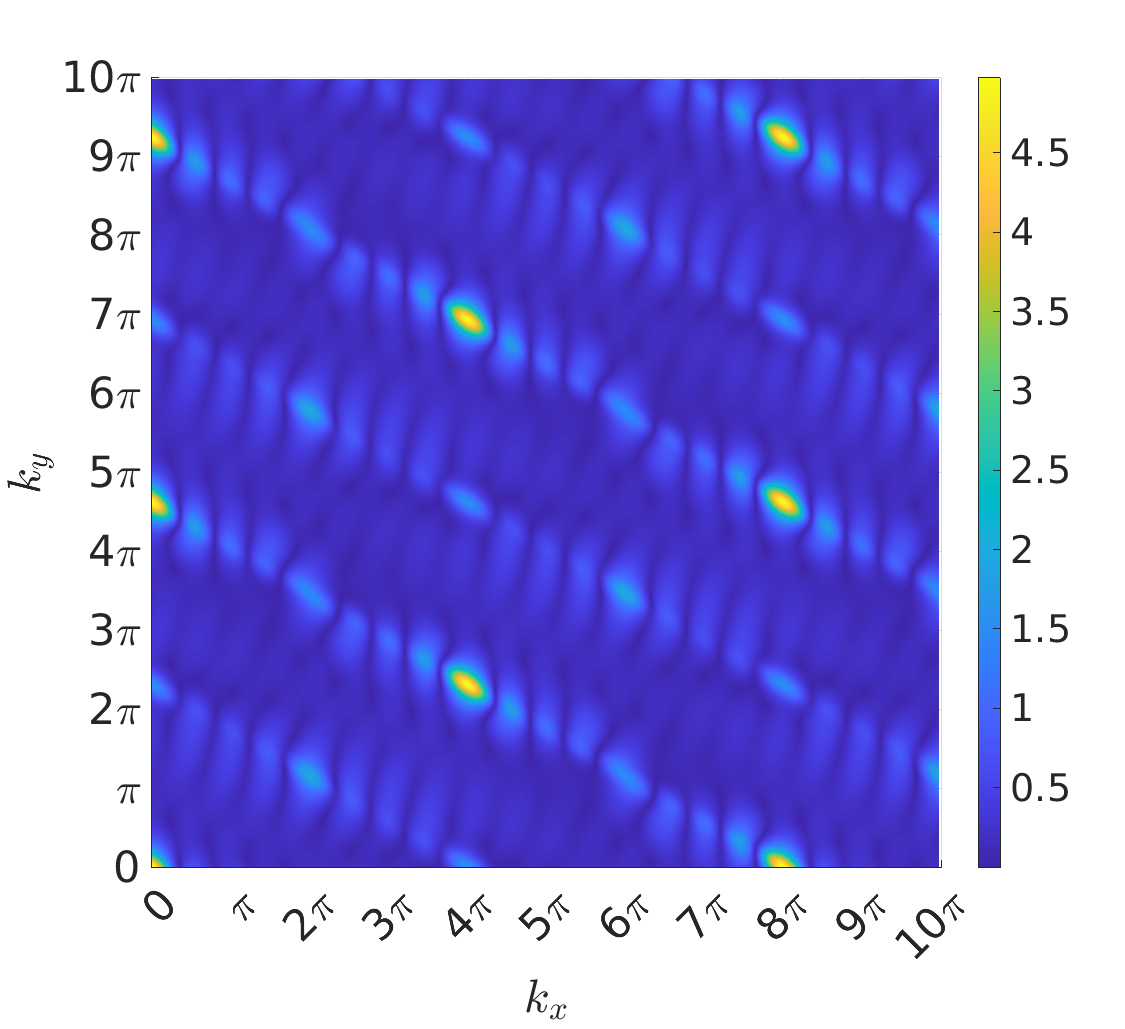
Figure 6: Magnitude of the structure factor |S(k)| manifesting local order presence with distinct Bragg peaks.
Conclusion
The paper successfully highlights that Gutzwiller projections on Euler insulators yield spinful models with particular entanglement signatures, analogous to non-interacting systems, without intrinsic topological order. However, these states maintain local order, reflected in calculated structure factors. This establishes foundational advancements in understanding spinful representations within Euler phase frameworks, steering further studies to discern interactions across dynamic settings.
The research provides an overview of potential symmetry and topological implications of emergent phase states, opening avenues for more extended exploration within such intricate intensive physics formulations.