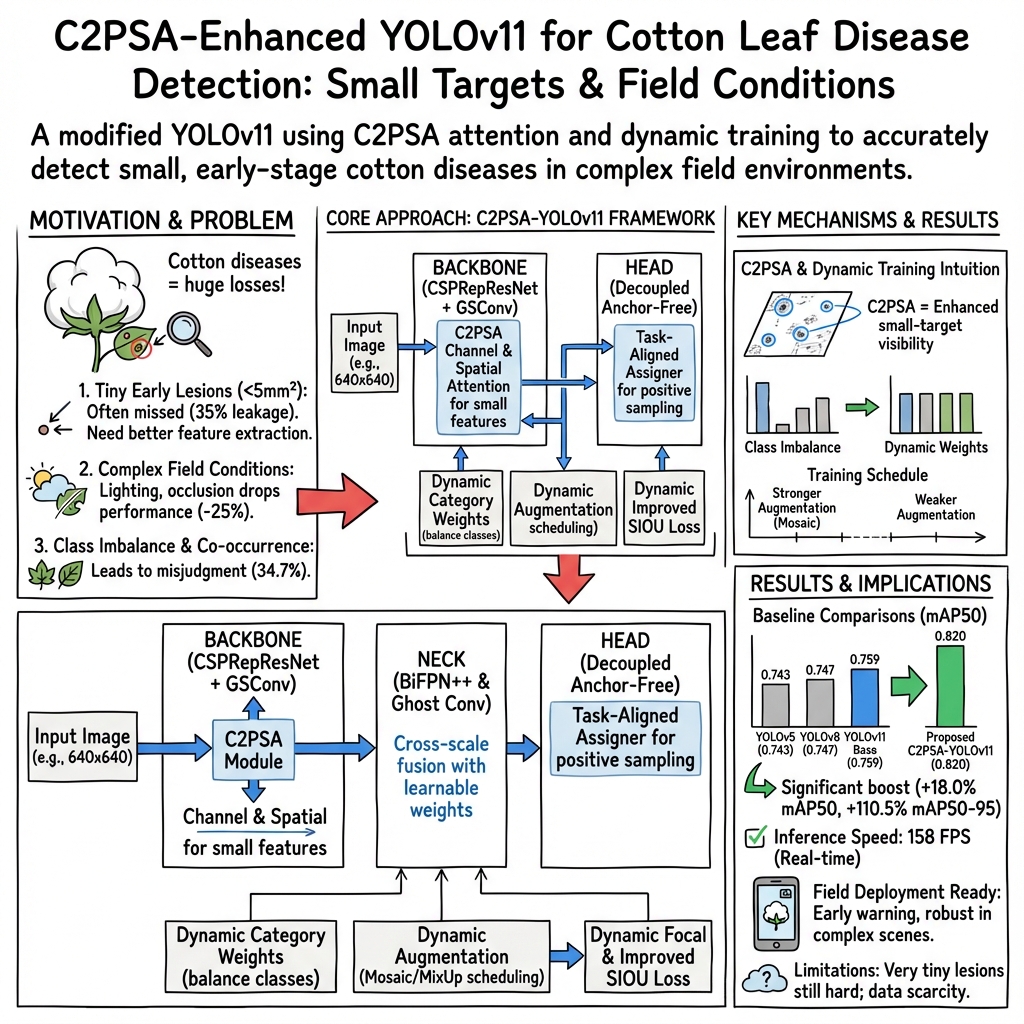
- The paper presents a novel YOLOv11 architecture enhanced with the C2PSA module to improve small target detection in cotton disease diagnosis.
- It introduces dynamic category weight allocation and Mosaic-MixUp data augmentation, achieving mAP50 of 0.820 and 158 FPS for real-time monitoring.
- Results show superior performance over YOLOv5 and YOLOv8, providing a robust solution for early disease detection in complex agricultural settings.
C2PSA-Enhanced YOLOv11 Architecture for Small Target Detection in Cotton Disease Diagnosis
Introduction
The paper "C2PSA-Enhanced YOLOv11 Architecture: A Novel Approach for Small Target Detection in Cotton Disease Diagnosis" (2508.12219) presents a significant advance in the application of deep learning to agricultural disease detection, specifically focusing on cotton. Cotton diseases are a major concern due to their potential economic impact, and traditional detection methods are limited by inefficiencies and subjectivity. This paper addresses the challenges of early disease detection, category imbalance, and conditions in complex field environments by enhancing the YOLOv11 framework with novel optimization techniques.
Model Optimization Techniques
The study introduces a modified YOLOv11 architecture, incorporating the C2PSA module for dynamic feature fusion. This module improves the model's ability to detect small targets, which are critical in early disease recognition. The architecture is further enhanced through dynamic category weight allocation to resolve the issue of sample imbalance and a dynamic Mosaic-MixUp data augmentation strategy to bolster robustness against the environmental complexities typical in agricultural settings.
Key numerical results highlight the efficacy of these enhancements: the model achieved mAP50 and mAP50-95 scores of 0.820 and 0.705, respectively, indicating a significant improvement over baseline models. The system operates at 158 FPS, facilitating real-time monitoring, essential for practical application in agricultural settings.
Experimental Design and Dataset
Utilizing a dataset comprising 4,078 images, the study meticulously delineates the data's collection and annotation process to ensure high-quality input for training. The dataset includes images sourced from PlantVillage, AI agriculture challenges, and web crawlers, diversified across disease categories such as blight, leaf curl, and grey mildew.
The paper emphasizes the importance of structured data preprocessing, including size normalization and format conversion, ensuring consistency and quality for input into the model. The dataset is strategically divided for training, validation, and testing, allowing robust assessment of the model’s performance.
Comparative Analysis and Results
In comparing YOLOv5, YOLOv8, and the proposed YOLOv11 architecture, the paper presents evidence of superior performance by YOLOv11, particularly in challenging disease categories and small target detection. The C2PSA-enhanced model demonstrated higher precision and recall metrics across various categories, with notable improvements in detection capabilities for grey mildew and leaf spots—diseases traditionally difficult to detect.
The proposed model also incorporates innovative data augmentation and weight adjustment strategies, enabling it to dynamically adapt to the variance in sample distribution and enhancing its applicability in diverse field conditions.
Conclusions and Implications
The research offers a comprehensive and scalable solution to the pressing issue of cotton disease detection, supporting both theoretical and practical advancements in the field. The integration of the C2PSA module and innovative model design addresses the critical bottlenecks of existing detection frameworks, particularly in complex agricultural scenarios.
The paper successfully demonstrates that with tailored enhancements, the model's accuracy and efficiency are significantly improved, thereby offering practical applications in real-time disease monitoring and management. This work not only bolsters the capabilities of AI-driven agricultural monitoring systems but also lays a foundational framework for future developments aimed at optimizing disease detection across other crop types.
The findings imply a substantial impact on agricultural productivity and economic outcomes, driving further research in intelligent agriculture and expanding the scope of machine learning applications in this domain.