- The paper introduces a closed-form Hilbert metric for the symmetric positive-definite bicone in the extended Gaussian family using four extreme eigenvalues.
- The derived metric demonstrates invariance under identity-complement and orthonormal conjugation, elucidating the unique isometry group of the non-symmetric cone.
- The study highlights the metric’s computational efficiency over traditional affine-invariant methods, facilitating advanced geometric computations in high-dimensional models.
Hilbert Geometry of the Symmetric Positive-Definite Bicone and Its Application to Extended Gaussian Families
Introduction and Motivation
The paper investigates the Hilbert geometry of the symmetric positive-definite bicone, which arises as the parameter space of the extended Gaussian family. The extended Gaussian family is constructed by closing the set of zero-centered Gaussian distributions under both covariance and precision degeneracies, resulting in a parameter space that is the intersection of two positive semi-definite (PSD) cones joined at their bases—a bicone. This geometric structure is central to understanding the behavior of Gaussian distributions with degenerate covariance or precision matrices, which are relevant in open stochastic systems and in the context of information geometry.
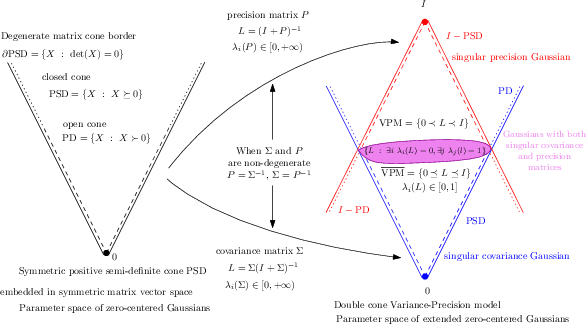
Figure 1: The parameter space of the extended Gaussian family forms a closed double cone.
The bicone structure generalizes the familiar symmetric positive-definite (SPD) cone, and in two dimensions, it can be visualized as a double Lorentz cone in R3. This geometric perspective enables the study of metric properties, invariance, and isometries within the extended Gaussian family, with implications for both theoretical analysis and practical algorithms.
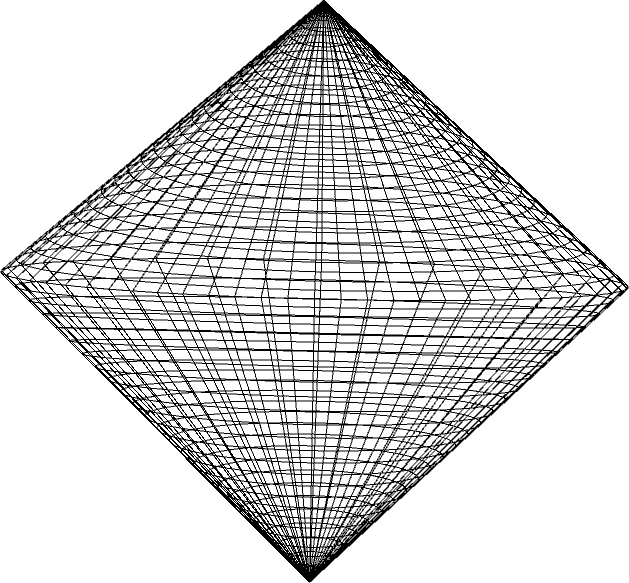
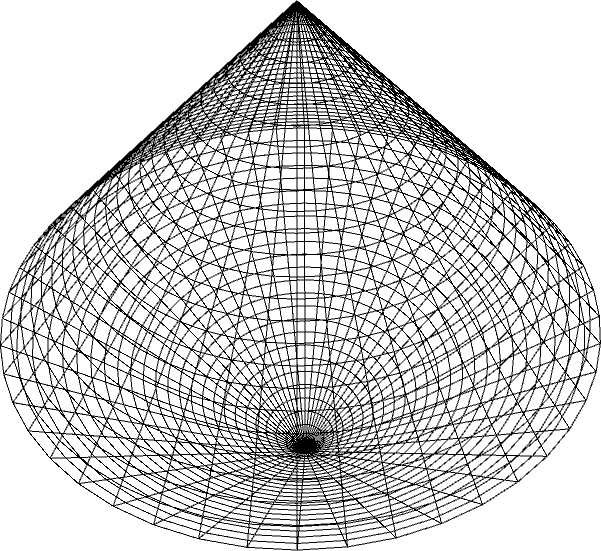
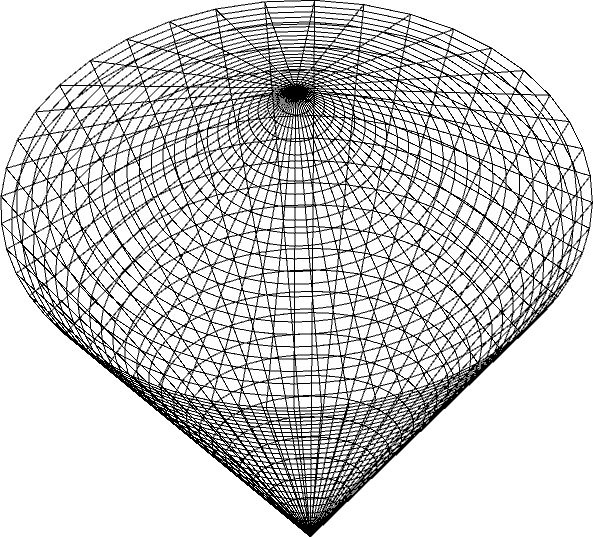
Figure 2: The parameter space of (2) can be viewed as a double Lorentz cone in R3: Three views of the double Lorentz cone.
Hilbert and Birkhoff Geometries in the Bicone Domain
Hilbert geometry is defined on open bounded convex domains and provides a projective metric where straight lines are geodesics. The Hilbert metric dH is constructed using cross-ratios of boundary intersections along lines, and is independent of the choice of norm. Birkhoff projective geometry, defined on open regular cones, introduces a projective distance dB that is invariant under positive scaling and is closely related to the Hilbert metric when the domain is a cone slice.
For the SPD cone, the Birkhoff distance between matrices P and Q is given by
dB(P,Q)=logλmin(PQ−1)λmax(PQ−1)
where only the extreme eigenvalues are required. In contrast, the affine-invariant Riemannian metric (AIRM) requires the full spectrum.
The variance-precision manifold (VPM), defined as
VPM(n):={X∈Sym(n):0≺X≺I}
is shown to be open, convex, and bounded. Its closure corresponds to matrices with eigenvalues in [0,1], and it is invariant under both X↦I−X and orthonormal conjugation X↦U⊤XU.
A central contribution is the derivation of a closed-form formula for the Hilbert metric in the VPM domain. For A,B∈VPM(n),
dH(A,B)=logmin(λmin,μmin)max(λmax,μmax)
where
- λmin,λmax are the minimal and maximal eigenvalues of B−1A,
- μmin,μmax are the minimal and maximal eigenvalues of (I−B)−1(I−A).
This formula leverages the Birkhoff characterization and the Loewner order, and only requires computation of four extreme eigenvalues, making it computationally efficient compared to AIRM.
Invariance and Isometry Characterization
The Hilbert metric in VPM is invariant under two transformations:
- Identity-complement: X↦I−X,
- Orthonormal conjugation: X↦U⊤XU for U∈O(n).
These are proven to be the only isometries of the VPM for n≥2, via projective geometry and cone automorphism arguments. The group of isometries is generated by these two operations, and the VPM cone is shown to be non-symmetric, distinguishing its isometry group from that of symmetric cones.
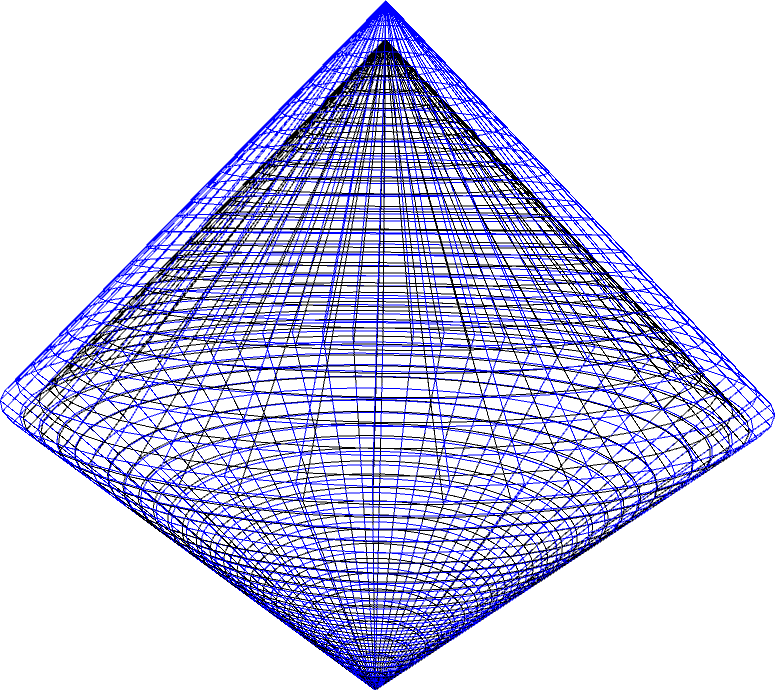
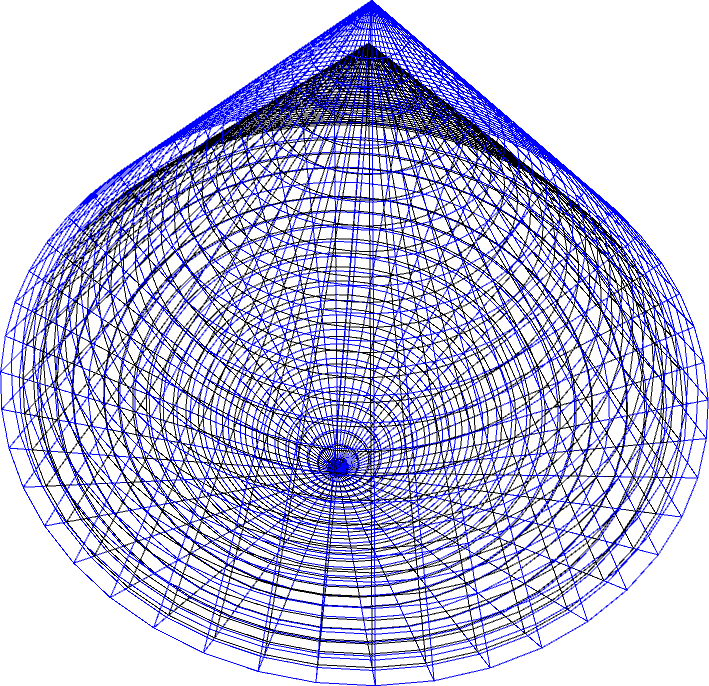
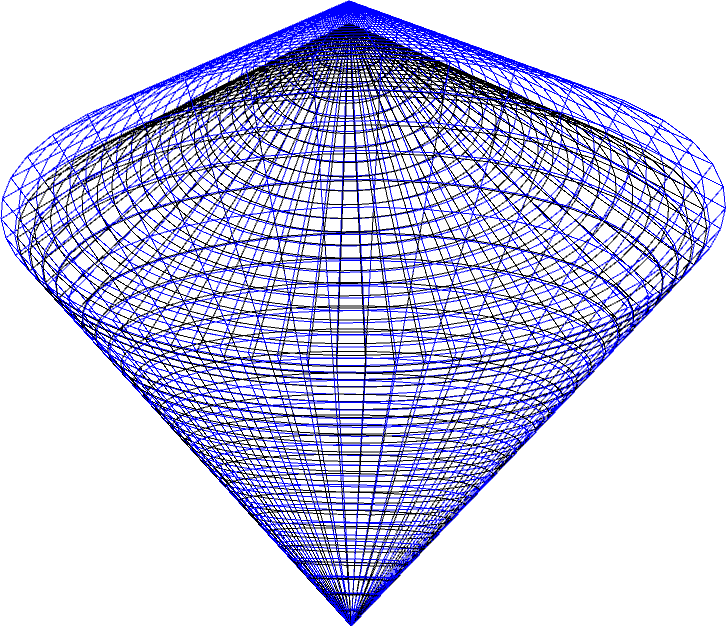
Figure 3: The parameter space of (2) (viewed as a Lorentz bicone in R3): Three views of the boundary of the Lorentz bicone with VPMϵ (in blue) encapsulating VPM (in black).
Comparison with Affine-Invariant Riemannian Metric
A detailed comparison between the Hilbert VPM distance and the AIRM is provided:
| Feature |
AIRM Distance |
Hilbert VPM Distance |
| Eigenvalues used |
All eigenvalues of Q1Q2−1 |
Extreme eigenvalues of Q1Q2−1 and Mob(Q1,Q2) |
| Invariance under inversion |
Yes |
No (replaced by identity-complement invariance) |
| Invariance under GL(n) |
Yes |
No |
| Invariance under O(n) |
Yes |
Yes |
The Hilbert VPM metric is less restrictive in terms of invariance, but more efficient computationally, and is particularly suited for applications where only extreme eigenvalues are accessible or relevant.
Computational Geometry Applications
The Hilbert geometry of the VPM enables efficient implementation of computational geometry primitives, such as the smallest enclosing ball (SEB) problem. The SEB can be approximated using iterative geodesic-cut algorithms, leveraging the straight-line geodesics of Hilbert geometry.
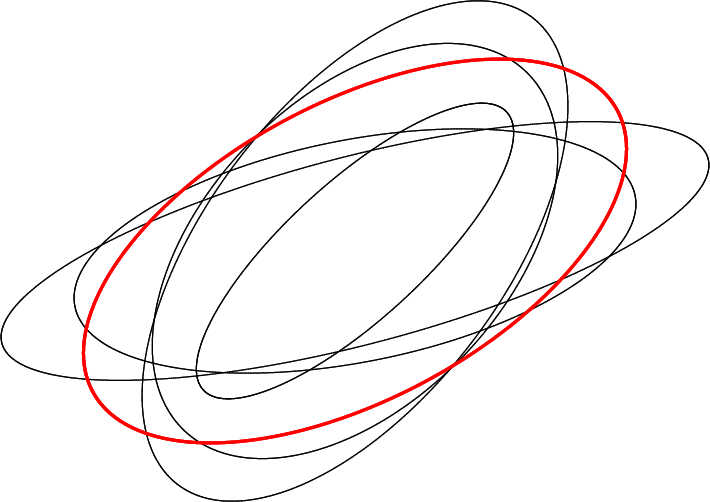
Figure 4: Fine approximation of the smallest enclosing ball (SEB, in red) with respect to the Hilbert VPM distance in 2D of a set of 2D SPD matrices (or equivalently, 2D zero-centered Gaussians, in black).
The ability to enlarge the VPM domain to VPMϵ allows for bounded Hilbert distances even for degenerate matrices, which is advantageous in scenarios involving mixtures of degenerate covariance and precision matrices.
Implications and Future Directions
The geometric characterization of the extended Gaussian family via the VPM bicone and its Hilbert geometry has both theoretical and practical implications:
- Theoretical: Provides a rigorous framework for understanding degeneracies in Gaussian families, duality between covariance and precision, and the structure of isometries in non-symmetric cones.
- Practical: Enables efficient computation of distances and geometric primitives in high-dimensional statistical models, with potential applications in machine learning, signal processing, and diffusion tensor imaging.
Future work may include:
- Extension to full Gaussian families via Calvo-Oller embedding,
- Study of correlation matrix subdomains (elliptopes) within the VPM,
- Facial characterization of the VPM and its boundary structure,
- Algorithmic development for clustering, classification, and optimization in the extended Gaussian setting.
Conclusion
The paper provides a comprehensive study of the Hilbert geometry of the symmetric positive-definite bicone, establishing closed-form metrics, invariance properties, and isometry characterizations. These results deepen the understanding of extended Gaussian families and open avenues for efficient geometric computations in statistical and machine learning applications. The interplay between projective geometry, matrix analysis, and information geometry is leveraged to yield both theoretical insights and practical tools for handling degenerate Gaussian models.