Papers
Topics
Authors
Recent
Search
2000 character limit reached

Effect Identification and Unit Categorization in the Multi-Score Regression Discontinuity Design with Application to LED Manufacturing

Published 21 Aug 2025 in stat.ME, cs.LG, and econ.EM | (2508.15692v1)

Abstract: The RDD (regression discontinuity design) is a widely used framework for identification and estimation of causal effects at a cutoff of a single running variable. Practical settings, in particular those encountered in production systems, often involve decision-making defined by multiple thresholds and criteria. Common MRD (multi-score RDD) approaches transform these to a one-dimensional design, to employ identification and estimation results. However, this practice can introduce non-compliant behavior. We develop theoretical tools to identify and reduce some of this "fuzziness" when estimating the cutoff-effect on compliers of sub-rules. We provide a sound definition and categorization of unit behavior types for multi-dimensional cutoff-rules, extending existing categorizations. We identify conditions for the existence and identification of the cutoff-effect on complier in multiple dimensions, and specify when identification remains stable after excluding nevertaker and alwaystaker. Further, we investigate how decomposing cutoff-rules into simpler parts alters the unit behavior. This allows identification and removal of non-compliant units potentially improving estimates. We validate our framework on simulated and real-world data from opto-electronic semiconductor manufacturing. Our empirical results demonstrate the usability for refining production policies. Particularly we show that our approach decreases the estimation variance, highlighting the practical value of the MRD framework in manufacturing.
Summary

  • The paper introduces a Multi-Score Regression Discontinuity framework that categorizes units to refine causal effect estimation in LED manufacturing.
  • It applies rigorous empirical validation and ML-based adjustments to reduce estimation variance and enhance production decision-making.
  • The framework offers actionable insights for optimizing multi-criteria decision-making in complex industrial environments.

Effect Identification and Unit Categorization in Multi-Score Regression Discontinuity Design with Application to LED Manufacturing

Introduction

The paper explores advancements in the Multi-Score Regression Discontinuity Design (MRD), expanding traditional Regression Discontinuity Design (RDD) frameworks to accommodate multiple decision criteria. This extension addresses real-world scenarios where decision-making hinges on multi-dimensional cut-off rules, such as manufacturing, where these cut-offs influence production outcomes.

Theoretical Framework

The development of the theoretical framework begins with defining key behavior types: complier, alwaystaker, nevertaker, and defier. These categorizations extend to multi-dimensional settings and are crucial for understanding responses to treatment assignments. The paper identifies conditions for the identification of the cutoff effect, notably in removing units that alter the stability of estimation, such as nevertakers and alwaystakers, thereby refining estimates and reducing variance.

Empirical Validation and Simulation

The paper validates its framework through empirical data from the LED manufacturing industry. It demonstrates that the MRD framework, when applied with strategies to identify and eliminate non-compliant units, results in decreased estimation variance, thereby enhancing production policies. Figure 1

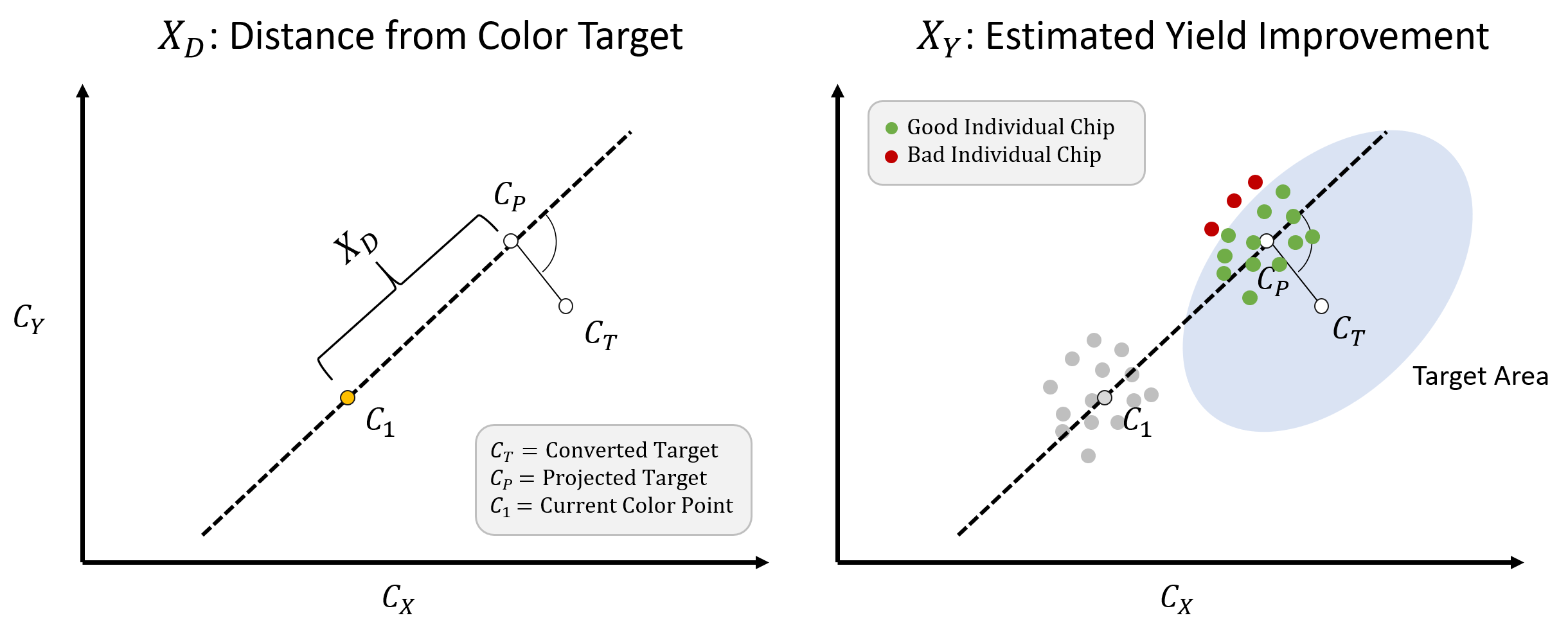
Figure 1: Left: XDX_D represents the distance from the mean color to the closest point technically reachable relative to the target. Right: XYX_Y indicates expected improvement in reaching the specification target.

Figure 2

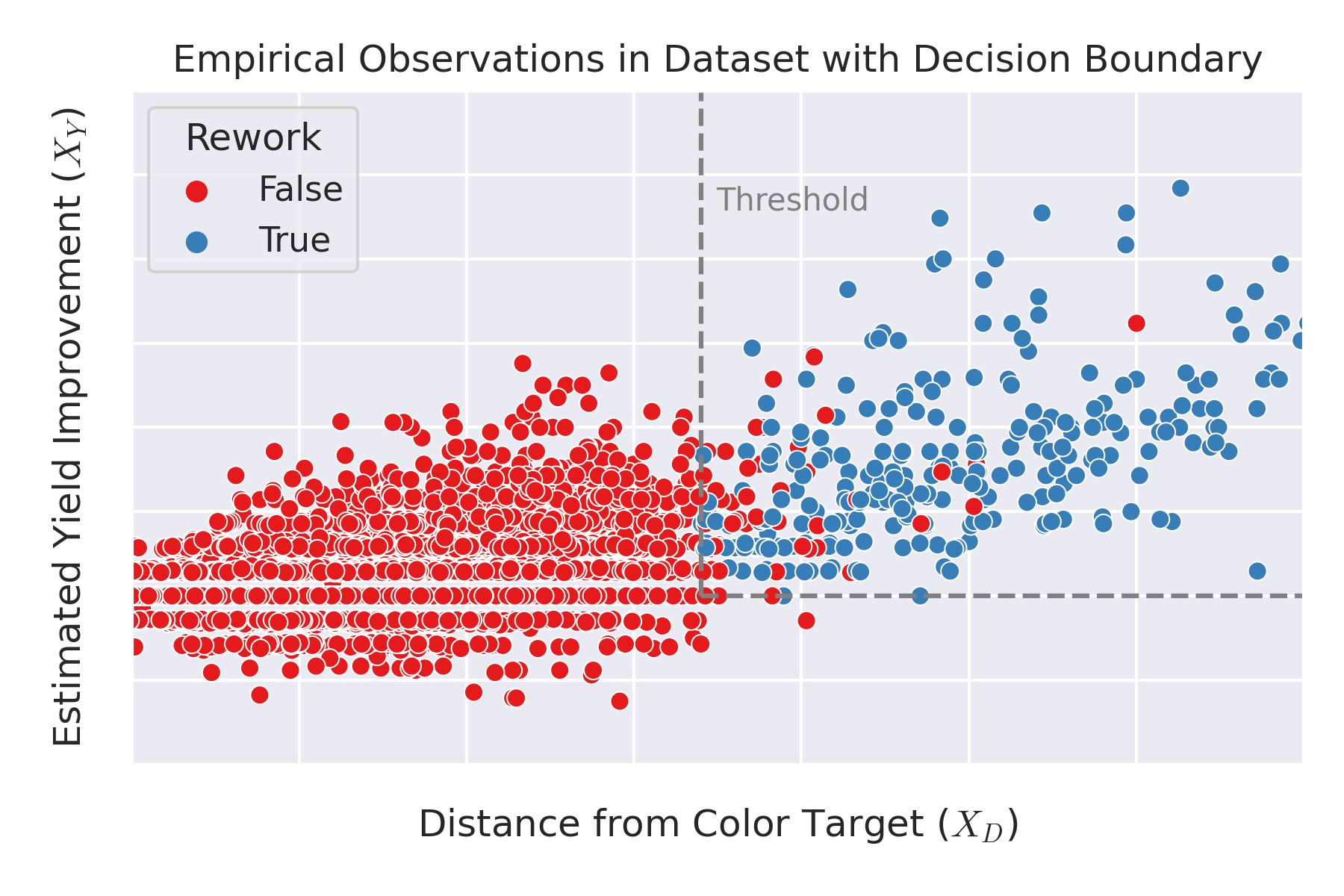
Figure 2: Real data plot showing the score components XDX_D and XYX_Y with respect to treatment assignment.

Practical Implications

The proposed MRD framework has significant implications for operational decision-making in manufacturing. It allows practitioners to refine decision policies based on robust statistical analysis, tailored to multi-criteria decision settings, thus optimizing production efficiency.

The inclusion of ML-based adjustments represents an advancement in refining estimates, reducing bias, and accounting for variances introduced by multi-dimensionality in decision-making frameworks.

Conclusion

By bridging causal machine learning with production systems, the paper contributes valuable insights to the operations research literature. Future work might explore the application of these methodologies in other industries characterized by complex decision matrices, leveraging the MRD framework for policy optimization. Figure 3

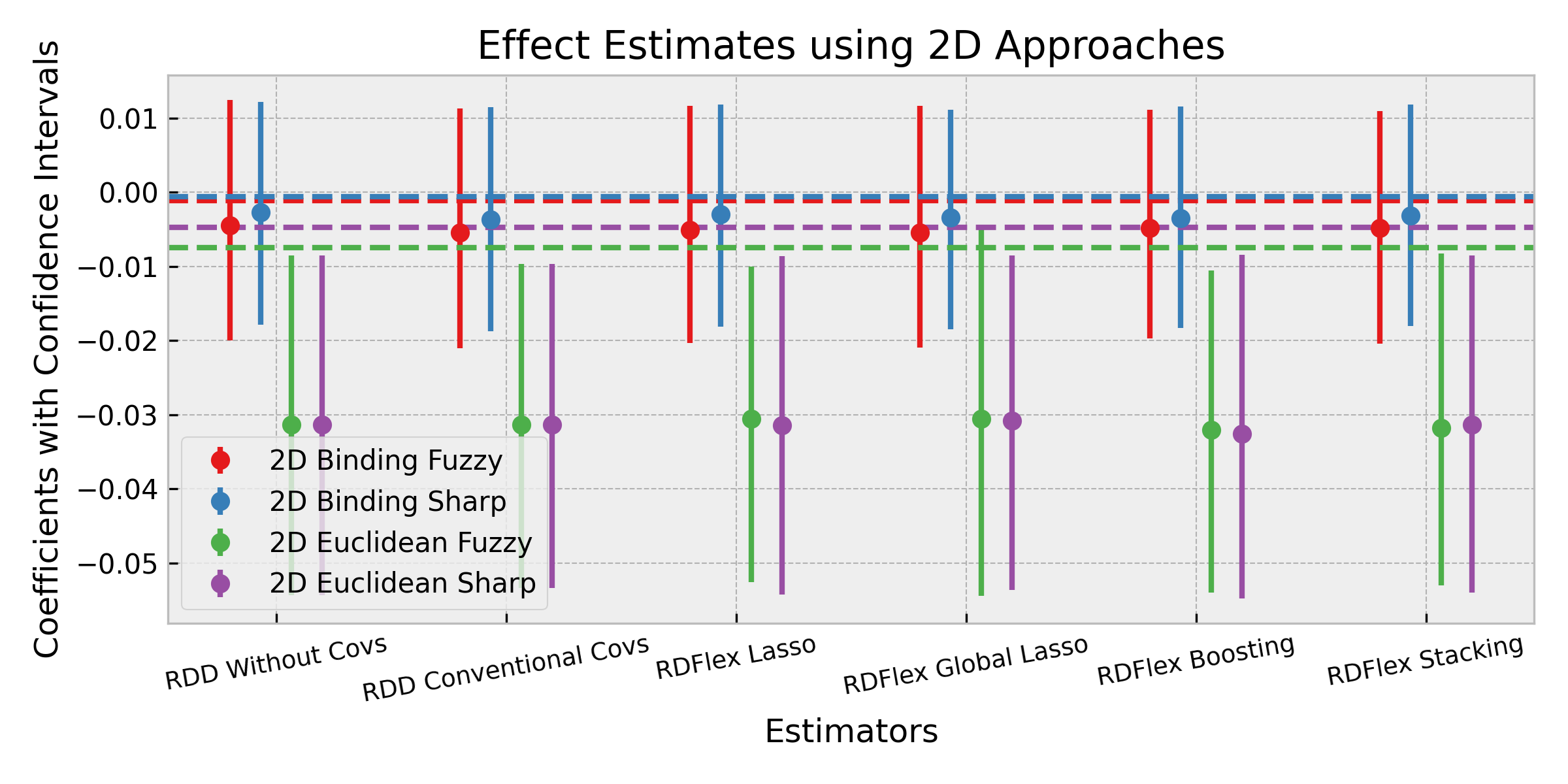
Figure 3: Median estimates with median 95% confidence interval of estimators utilizing two dimensions concurrently.

The insights offered by this study underscore the potential for MRD to inform more nuanced, informed decision-making in complex, multi-criteria environments, reinforcing the applicability of sophisticated statistical frameworks in industrial contexts.

Paper to Video (Beta)

No one has generated a video about this paper yet.

Whiteboard

No one has generated a whiteboard explanation for this paper yet.

Open Problems

We haven't generated a list of open problems mentioned in this paper yet.

Collections

Sign up for free to add this paper to one or more collections.

Tweets

Sign up for free to view the 2 tweets with 7 likes about this paper.