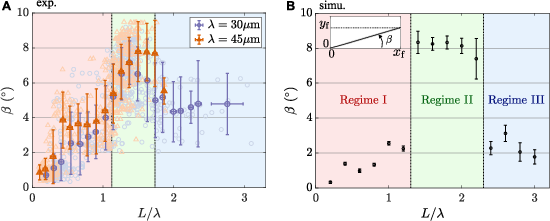
- The paper demonstrates a novel microfluidic design using tilted pillar arrays to achieve selective lateral migration of flexible fibers.
- It employs deterministic lateral displacement with a tension-driven mechanism to filter fibers optimally in the range of 1.3λ to 2.3λ.
- The combined experimental and numerical approach provides actionable design principles for high-resolution microfluidic sorting applications.
Microfluidic Band-Pass Filtering for Flexible Fiber Separation
Introduction
The paper "A microfluidic band-pass filter for flexible fiber separation" (2508.19166) presents a comprehensive experimental and numerical investigation into the deterministic lateral displacement (DLD) of flexible fibers in microfluidic pillar arrays. Unlike classical DLD, which is optimized for rigid, near-spherical particles, this work demonstrates that pillar arrays can be engineered to act as band-pass filters for flexible, anisotropic objects, enabling length-selective separation. The study elucidates the underlying physical mechanisms, quantifies the separation efficiency, and proposes design principles for microfluidic devices targeting fiber suspensions.
Device Architecture and Experimental System
The microfluidic device consists of a square lattice of cylindrical pillars embedded in a PDMS channel. The key geometric parameters are the lattice period λ, pillar radius R, and channel height Hch. The array is oriented at a tilt angle α relative to the main flow direction, which is a critical control parameter for separation performance.
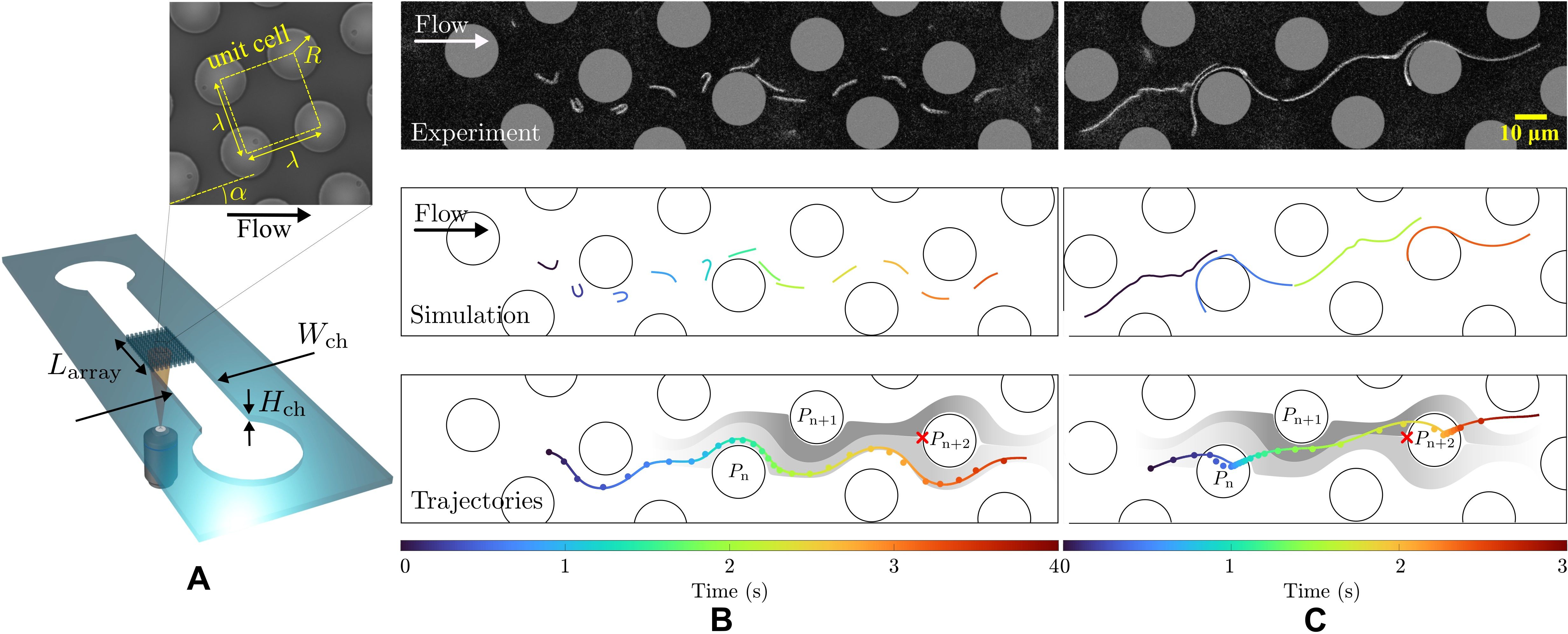
Figure 1: Geometry of the channel and examples of fiber dynamics. (A) 3D schematic of the experimental channel and pillar array. (B, C) Chronophotographs and trajectories of short and long fibers at α=35∘.
Actin filaments, serving as model flexible fibers, are fluorescently labeled and suspended in a viscous sucrose solution. Their lengths span $5$–100μm, with persistence length ℓp≈17μm, ensuring a broad range of flexibility and aspect ratios. The flow is in the Stokes regime, and the elastoviscous number μˉ is typically ≫103, ensuring strong deformation and nontrivial fiber–obstacle interactions.
Flow Field Characterization and Poincaré Mapping
The flow field within the pillar array is characterized both experimentally (via μPIV) and numerically (via LBM). The tilt angle α modulates the symmetry and topology of the streamlines, which in turn governs the accessibility of different migration paths for fibers.
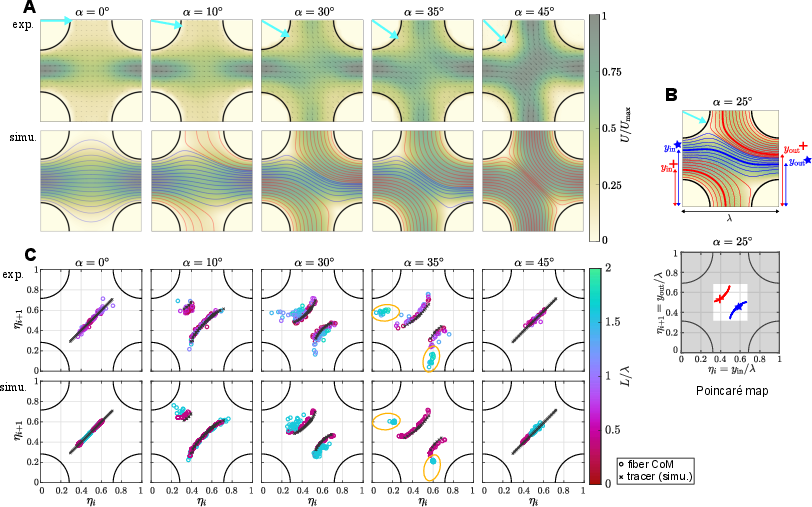
Figure 2: (A) Velocity fields at various tilt angles α from μPIV and LBM. (B) Schematic of the Poincaré map construction. (C) Poincaré maps of fiber center-of-mass (CoM) for different α and fiber lengths.
Poincaré maps are constructed by recording the normalized y-position of the fiber CoM at entry and exit of each unit cell. For α=0∘ and 45∘, all fibers (regardless of length) follow streamlines, and no separation is observed. For intermediate angles (α=30∘, 35∘), fibers with L/λ∼1 deviate from tracer-like behavior, indicating the onset of length-dependent lateral migration.
Mechanism of Band-Pass Filtering: Tension-Driven Cross-Streamline Migration
The central finding is that the pillar array acts as a band-pass filter: only fibers with lengths in a specific range (centered around L/λ∼1.3–$2.3$) undergo significant lateral migration. This is in stark contrast to classical DLD, where the critical size is a sharp threshold.
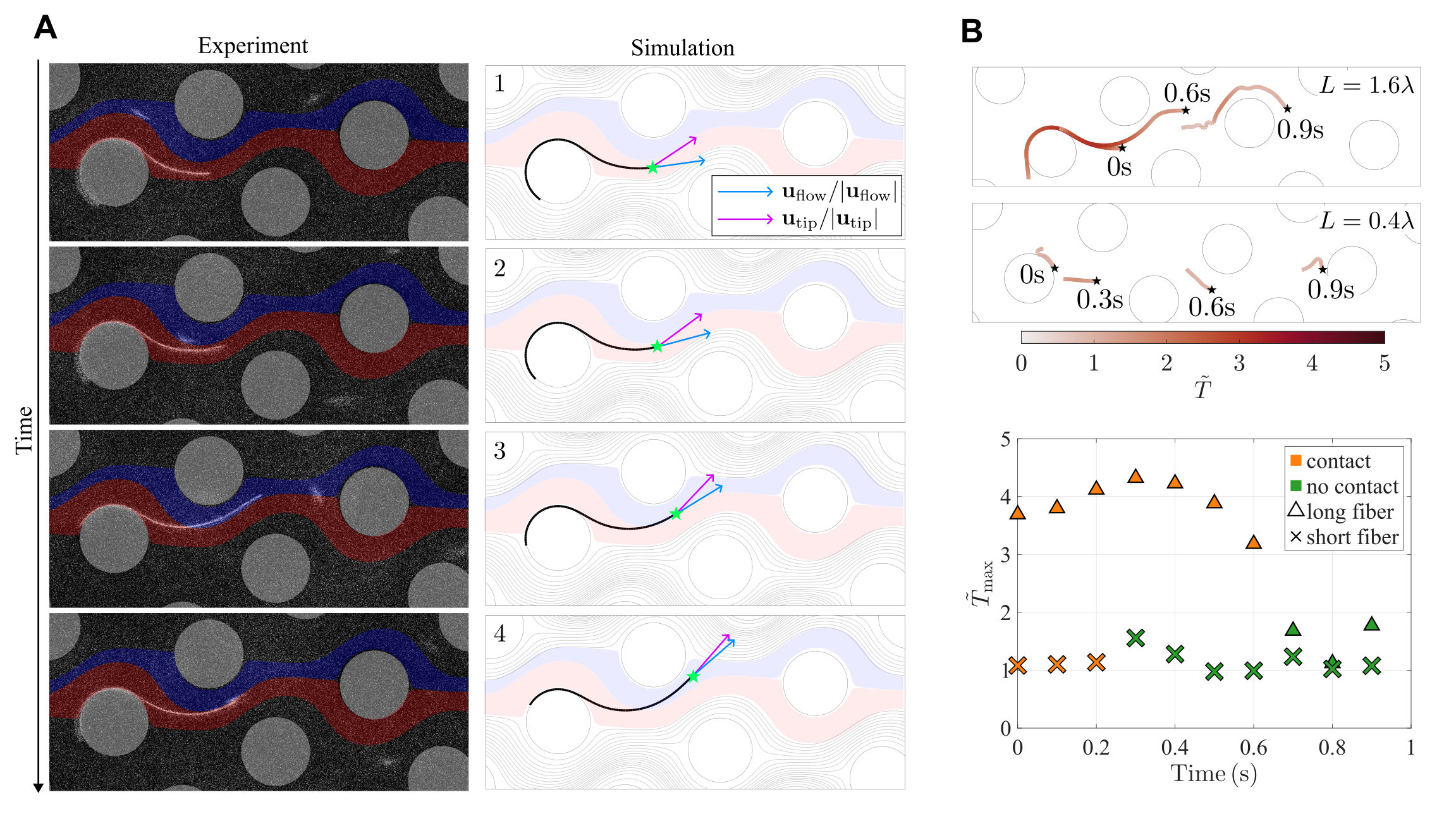
Figure 3: (A) Snapshots of fiber wrapping around a pillar at α=35∘. (B) Chronophotographs and tension profiles for short and long fibers. High tension correlates with cross-streamline migration.
The mechanism is rooted in the interplay between fiber deformation, hydrodynamic forces, and steric interactions with pillars. When a fiber wraps around a pillar, viscous drag on the free end generates internal tension. This tension prevents the fiber from conforming to the local streamline curvature, resulting in a net lateral displacement as the fiber is released. Short fibers do not interact strongly with pillars, while very long fibers are simultaneously deformed by multiple pillars, suppressing net migration.
The migration angle β (defined as arctan(yf/xf)) is used as a quantitative metric for separation. Both experiments and simulations reveal three regimes:
The optimal tilt angle for maximal separation is α=35∘, where the two main flow lanes downstream of a pillar have comparable widths, maximizing the spatial separation of fibers by length.
Migration Modes and Statistical Analysis
The study further classifies fiber dynamics into "zigzag" and "jump" modes. Statistical analysis over many realizations shows that the fraction of jump events peaks in regime II, coinciding with the maximum in migration angle and internal tension.
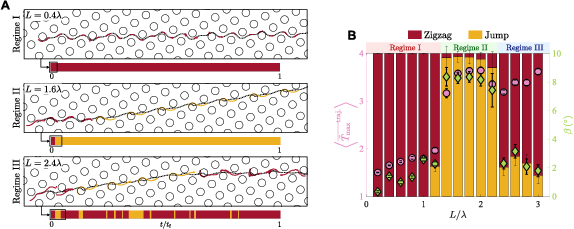
Figure 5: (A) Representative chronophotographs and migration mode time series for the three regimes. (B) Fractions of zigzag and jump modes, average tension, and migration angle as functions of fiber length.
The transition from zigzag to jump mode is abrupt, and the onset of high internal tension is a robust predictor of strong lateral migration. For very long fibers, complex folding and multi-pillar interactions lead to a reentrant decrease in migration efficiency.
Numerical Modeling and Implementation
The numerical framework couples a bead-spring model for the fiber (with stretching and bending elasticity) to a 3D LBM solver for the flow. Lubrication and repulsive forces are included to capture near-field fiber–pillar and fiber–fiber interactions. The Rotne-Prager-Yamakawa mobility matrix is used for hydrodynamic coupling. Simulations are performed in periodic unit cells and at chip scale, with initial conditions sampled from experimental data.
Key implementation details:
- Fiber model: n beads, stretching modulus S, bending modulus B, aspect ratio ϵ.
- Flow: LBM with D3Q19 lattice, no-slip on pillars and walls, periodic in x and y.
- Forces: Elastic (stretching, bending), lubrication (normal/tangential), steric repulsion.
- Integration: Mobility-based update for bead velocities, explicit time stepping.
This approach enables direct comparison with experiments and allows for systematic exploration of parameter space (e.g., λ, R, α, L, μ).
Implications and Future Directions
The demonstration of a band-pass filtering effect for flexible fibers in DLD arrays has several implications:
- Microfluidic sorting: Enables high-resolution, label-free separation of fibers by length, relevant for biopolymer analysis, environmental monitoring (e.g., microplastics), and materials processing.
- Device design: Suggests that combining arrays with different λ and fixed α can yield highly selective collection of fibers within a target length window.
- Fundamental transport: Reveals new regimes of anisotropic object migration in porous media, governed by elastohydrodynamic tension rather than simple size exclusion.
Future work should address optimization of pillar geometry, extension to higher concentrations (hydrodynamic interactions), and the role of fiber flexibility (persistence length) in tuning the band-pass window. Theoretical modeling of the tension-driven migration mechanism could yield predictive design rules for a broader class of deformable objects.
Conclusion
This study establishes that microfluidic pillar arrays, when operated at an optimal tilt angle, can function as band-pass filters for flexible fiber separation. The selectivity arises from a tension-driven cross-streamline migration mechanism, which is absent in classical DLD for rigid particles. The combination of experiment and simulation provides a quantitative framework for device design and opens new avenues for the controlled transport and sorting of anisotropic, deformable objects in microstructured environments.