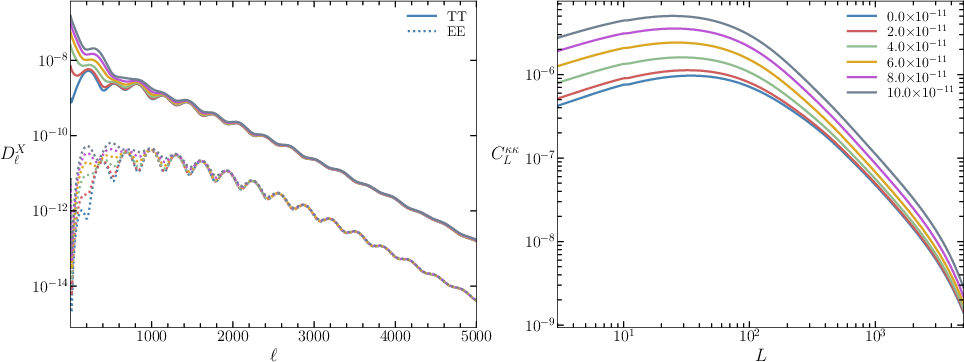
- The paper introduces a two-parameter framework to separate neutrino mass effects on BAO-inferred distances and small-scale clustering suppression.
- It explores how models like long-range dark forces and non-lensing CMB anomalies could reconcile observed deviations in standard cosmology.
- Fisher forecasts and multi-probe analyses suggest that improved CMB and BAO surveys can decisively test these new physical scenarios.
Dark Forces, Neutrino Mass, and Cosmological Tensions
Introduction and Motivation
The paper "Dark Forces Gathering" (2508.20999) addresses persistent tensions in cosmological data, particularly the apparent preference for negative neutrino mass parameters when combining CMB and BAO measurements. The authors systematically dissect the degeneracies between the expansion history and the growth of structure, introducing a two-parameter framework to disentangle the effects of neutrino mass on BAO-inferred distances and on the amplitude of matter clustering. The work further explores a range of physical models—including new long-range dark sector forces, isocurvature perturbations, and modifications to the CMB statistics—that could account for these anomalies, and provides a roadmap for future observational tests.
Two-Dimensional Parameterization: BAO and Clustering
The central methodological advance is the introduction of two independent parameters: BAO, which captures the effect of neutrino mass on the distance-redshift relation as measured by BAO, and clustering, which quantifies the suppression of small-scale power due to neutrino free-streaming. This approach allows the authors to map the observational constraints in a two-dimensional plane, revealing that current data prefer negative values for both parameters—contrary to the expectation from positive neutrino mass.
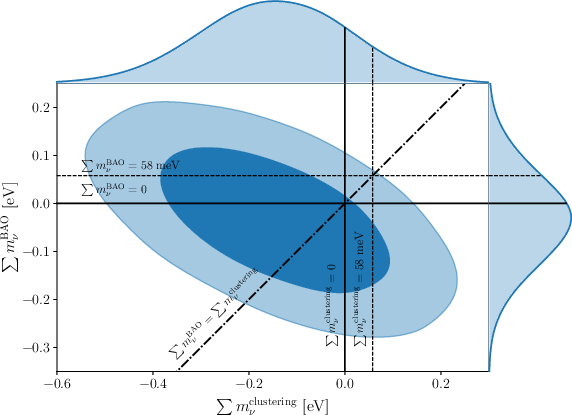
Figure 1: Constraints on BAO and clustering in ΛCDM+BAO+clustering cosmology using Planck+ACT+DESI. The posterior peaks at negative values for both parameters, indicating a preference for modified distances and enhanced clustering compared to a universe with only massless neutrinos.
The degeneracy direction in this plane demonstrates that new physics affecting either the expansion history or the growth of structure could reconcile the data with the minimal neutrino mass required by oscillation experiments. The authors emphasize that the data do not require both parameters to be negative simultaneously, and that models affecting only one can resolve the tension.
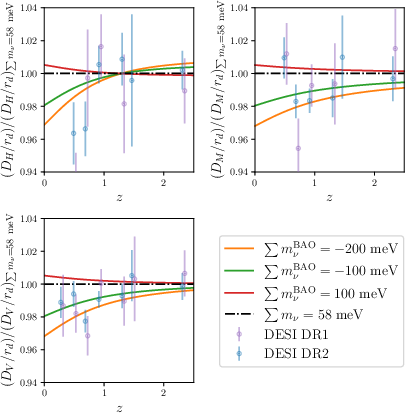
Figure 2: Effect of the BAO parameter on BAO-inferred distances, compared to DESI DR1/DR2 errors, relative to Planck ΛCDM predictions.
Physical Models for the Tension
Lensing and CMB Statistics
The paper explores whether the observed excess in CMB lensing amplitude could be mimicked by non-lensing sources of statistical anisotropy, such as isocurvature perturbations or primordial non-Gaussianity. The analysis shows that scalar modulations can bias the TT lensing estimator but generically fail to produce the B-mode polarization required to bias the EB estimator. This distinction provides a robust test: a genuine lensing signal should appear consistently in both temperature and polarization-based estimators, while non-lensing modulations will not.
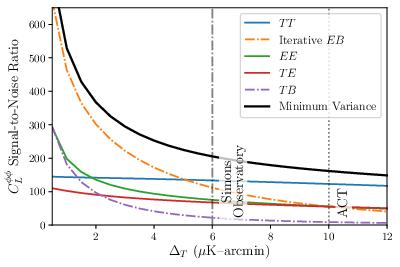
Figure 3: Signal-to-noise ratio of CMB lensing reconstruction as a function of survey depth ΔT for various estimators, highlighting the transition from TT- to EB-dominated regimes in future surveys.
Long-Range Dark Forces
A key focus is on models with new long-range forces in the dark sector, which can enhance the growth of structure and thus the lensing amplitude. The authors show that such forces, when properly accounting for the backreaction of the force mediator on the background cosmology, also modify the expansion history, leading to a correlated shift in both clustering and BAO parameters. The predicted trajectory in the BAO-clustering plane aligns with the observed constraints for a coupling strength β∼0.0025–$0.004$.
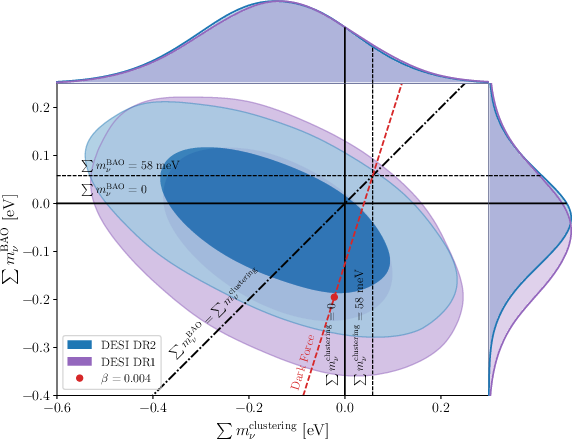
Figure 4: Predictions of the dark force model in the BAO-clustering plane, compared to CMB+DESI constraints. The best-fit β from DESI DR1 is shown.
The model predicts equivalence principle violation in the dark sector, which can be probed via the multi-tracer galaxy bispectrum. The forecasted sensitivity of DESI to this signal is potentially competitive with CMB+BAO constraints, provided sufficient control over tracer biases.
Other Mechanisms
The authors also consider alternative explanations, including:
Forecasts and Future Prospects
The paper provides Fisher forecasts for future CMB and BAO surveys, showing that improved measurements of the optical depth and high-redshift BAO will tighten constraints on both BAO and clustering. The degeneracy between these parameters implies that the physical neutrino mass constraint is tighter than either parameter individually, as the physical line BAO=clustering is nearly orthogonal to the degeneracy direction.
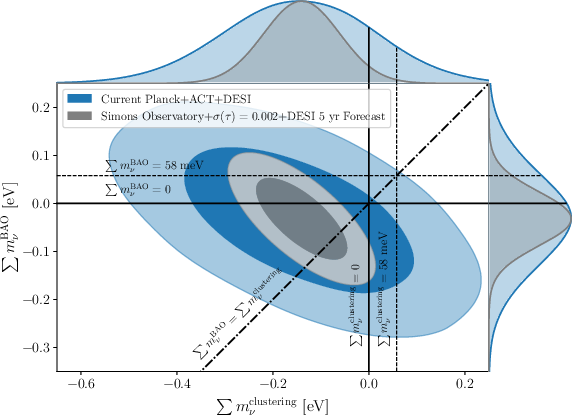
Figure 6: Forecasted constraints on clustering and BAO from a Simons Observatory-like CMB survey and full DESI, compared to current Planck+ACT+DESI constraints.
The authors highlight the importance of multi-probe analyses, including the use of different lensing estimators, the galaxy bispectrum, and improved measurements of τ, to break degeneracies and identify the physical origin of the observed anomalies.
Implications and Outlook
The work demonstrates that the current cosmological preference for negative neutrino mass parameters is not a generic prediction of new physics, but rather points to specific classes of models—such as long-range dark sector forces or non-standard CMB statistics—that can be tested with upcoming data. The analysis underscores the necessity of expanding the parameter space beyond the physical regime to fully exploit the constraining power of cosmological observations and to identify the origin of tensions.
The implications are significant for both cosmology and particle physics. If the anomalies persist and are confirmed by independent probes (e.g., via the galaxy bispectrum or improved CMB polarization), this would provide evidence for new physics beyond the Standard Model, potentially in the form of dark sector interactions or novel early-universe dynamics. Conversely, if future data resolve the tension in favor of the minimal neutrino mass, this would reinforce the robustness of the ΛCDM paradigm and the standard cosmological inference pipeline.
Conclusion
"Dark Forces Gathering" provides a comprehensive and technically rigorous framework for interpreting current cosmological tensions related to neutrino mass, offering a clear path forward for both theoretical model building and observational tests. The two-parameter BAO-clustering approach, combined with detailed modeling of new physics scenarios, sets a new standard for the analysis of cosmological parameter degeneracies and their physical interpretation. The work highlights the critical role of multi-probe, multi-parameter analyses in the era of precision cosmology, and delineates the observational strategies required to distinguish between systematic effects and genuine signals of new physics.