Purely GHZ-like entanglement is forbidden in holography
Published 3 Sep 2025 in hep-th | (2509.03621v1)
Abstract: We show that three-party entanglement signals in holography obey a relation that is not satisfied by generalized Greenberger-Horne-Zeilinger (GHZ) states. This is the first known constraint on the structure of pure three-party holographic states, and shows that time-symmetric holographic states can never have a purely GHZ structure. We also discuss similar relations for four parties.
The paper demonstrates that purely GHZ-like entanglement violates a new holographic inequality, indicating that such states cannot admit semiclassical bulk duals.
It employs geometric methods, using the RT formula, entanglement wedge cross-sections, and minimal brane webs to compute key tripartite entanglement signals R^(3) and GM^(3).
The study extends its analysis to four-party systems, suggesting a broader hierarchy of multipartite entanglement constraints in holographic theories.
Constraints on GHZ-like Entanglement in Holographic States
Introduction
The paper "Purely GHZ-like entanglement is forbidden in holography" (2509.03621) establishes a novel constraint on the structure of multiparty entanglement in holographic quantum states. Specifically, it demonstrates that time-symmetric holographic states cannot exhibit purely GHZ-like entanglement, as quantified by a new inequality involving the residual information R(3) and the genuine multi-entropyGM(3). This result provides the first known restriction on pure three-party holographic states that is not captured by the holographic entropy cone, thereby refining our understanding of the entanglement structures compatible with semiclassical bulk duals.
Multiparty Entanglement Signals: R(3) and GM(3)
The analysis centers on two tripartite entanglement signals:
Residual Information R(3)(A:B): Defined as the difference between the reflected entropySR(A:B) and the mutual information I(A:B) for a reduced density matrix ρAB obtained by tracing out one party from a pure tripartite state. R(3) vanishes for states with only bipartite entanglement and is nonzero for states with genuine tripartite entanglement.
Genuine Multi-Entropy GM(3)(A:B:C): Constructed from the multi-entropy S(3) and the single-party entropies, GM(3) is permutation-invariant and also vanishes for states with only bipartite entanglement.
For generalized GHZ states∣ψgGHZ⟩=i=1∑dλi∣iii⟩, it is found that R(3)=0 while GM(3)>0. This property is central to the main result.
Holographic Computation of Entanglement Signals
In the holographic context, these entanglement signals are computed via geometric prescriptions:
Entanglement Entropy: Given by the Ryu-Takayanagi (RT) formula, S(A)=4GNA(ΓA), where ΓA is the minimal surface homologous to A.
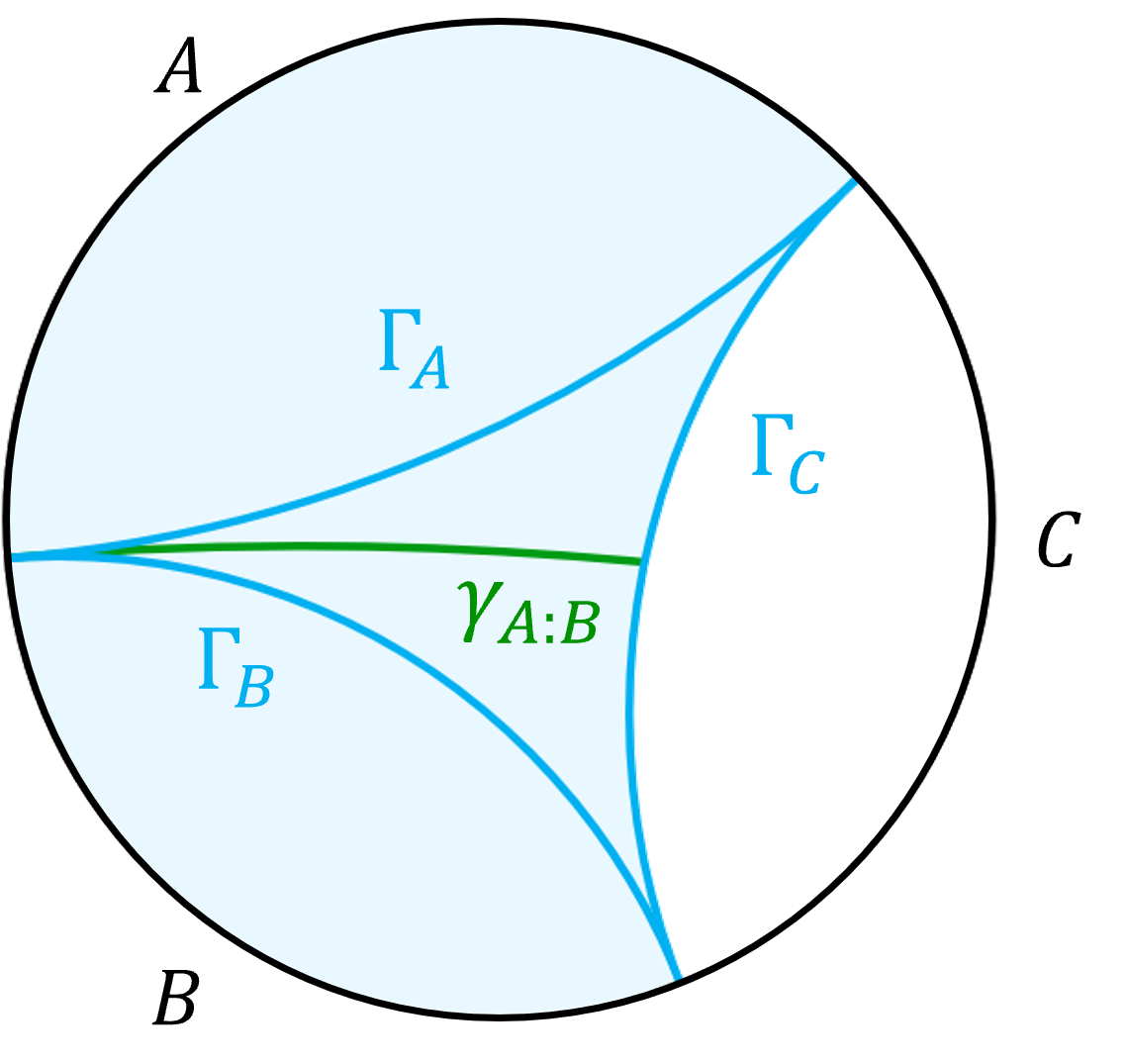
Reflected Entropy: Proposed to be SR(A:B)=24GNA(γA:B), where γA:B is the minimal area surface separating A and B within the entanglement wedge of AB.
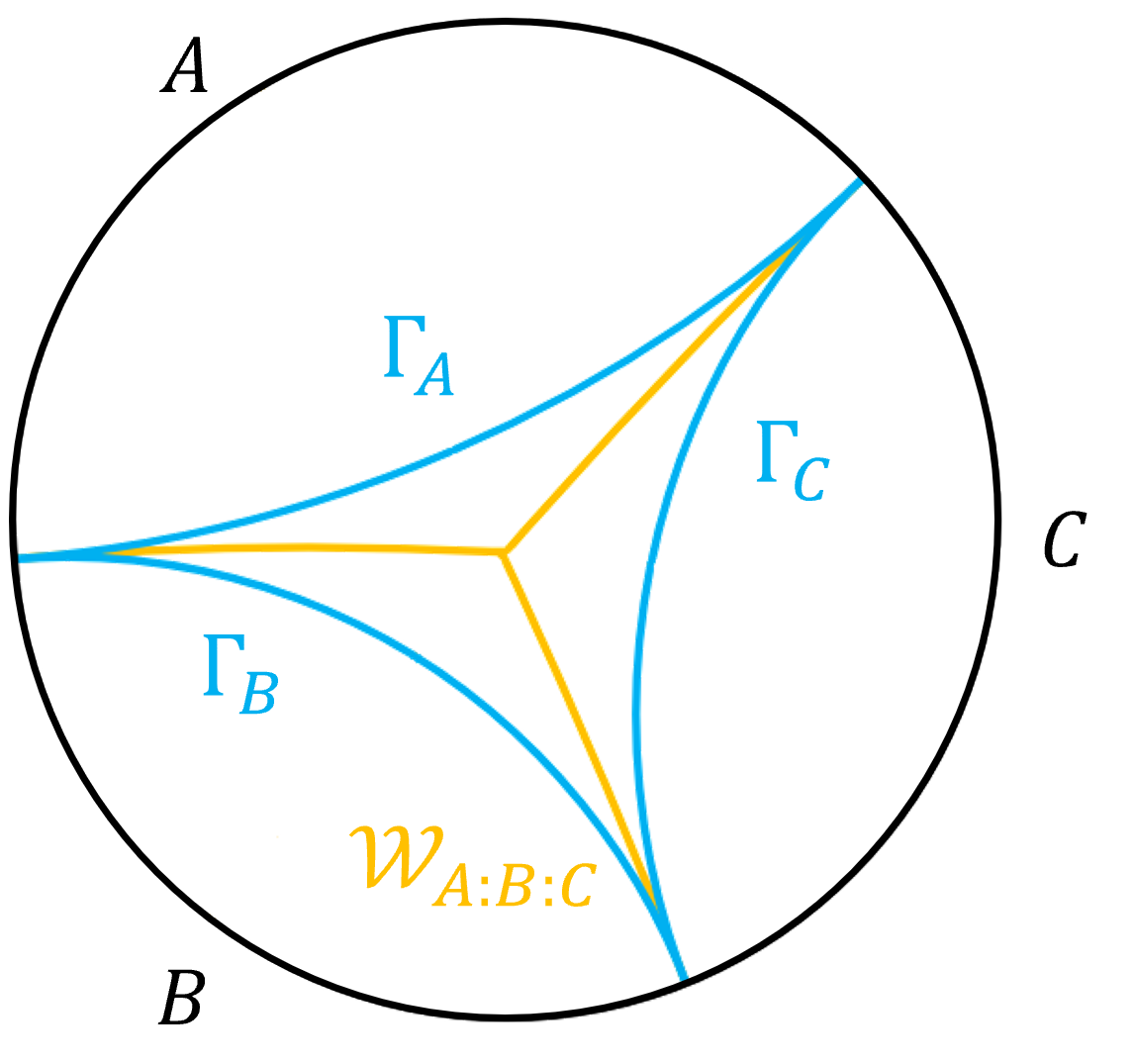
Multi-Entropy: S(3)(A:B:C) is computed by the area of a minimal brane web WA:B:C anchored to the boundaries of A, B, and C, with sub-webs homologous to each region.
Figure 1: The shaded blue region bounded by the boundary subregion AB and the minimal surface ΓC=ΓAB is the entanglement wedge EW(AB). The entanglement wedge cross-sectionγA:B separates A and B within EW(AB).
Figure 2: The multi-entropy S(3) is computed by the minimal brane web WA:B:C that separates all boundary subregions A,B,C from each other.
The Holographic Inequality and Its Consequences
The central result is the derivation of the inequality
21R(3)(A:B)≥GM(3)(A:B:C)
for time-symmetric holographic states. The proof exploits the geometric structure of the minimal brane web and the entanglement wedge cross-section, showing that the union of the RT surface and the cross-section provides an upper bound on the area of the minimal brane web.
This inequality is not satisfied by generalized GHZ states, for which R(3)=0 and GM(3)>0. Therefore, purely GHZ-like entanglement is forbidden in holographic states. More generally, any holographic state with a GHZ-like tensor factor must be supplemented by other entanglement structures that contribute sufficiently to R(3) to satisfy the bound.
This result is not implied by the holographic entropy cone, which only constrains combinations of von Neumann entropies and does not restrict pure three-party GHZ states. The new inequality thus provides a strictly stronger constraint in this context.
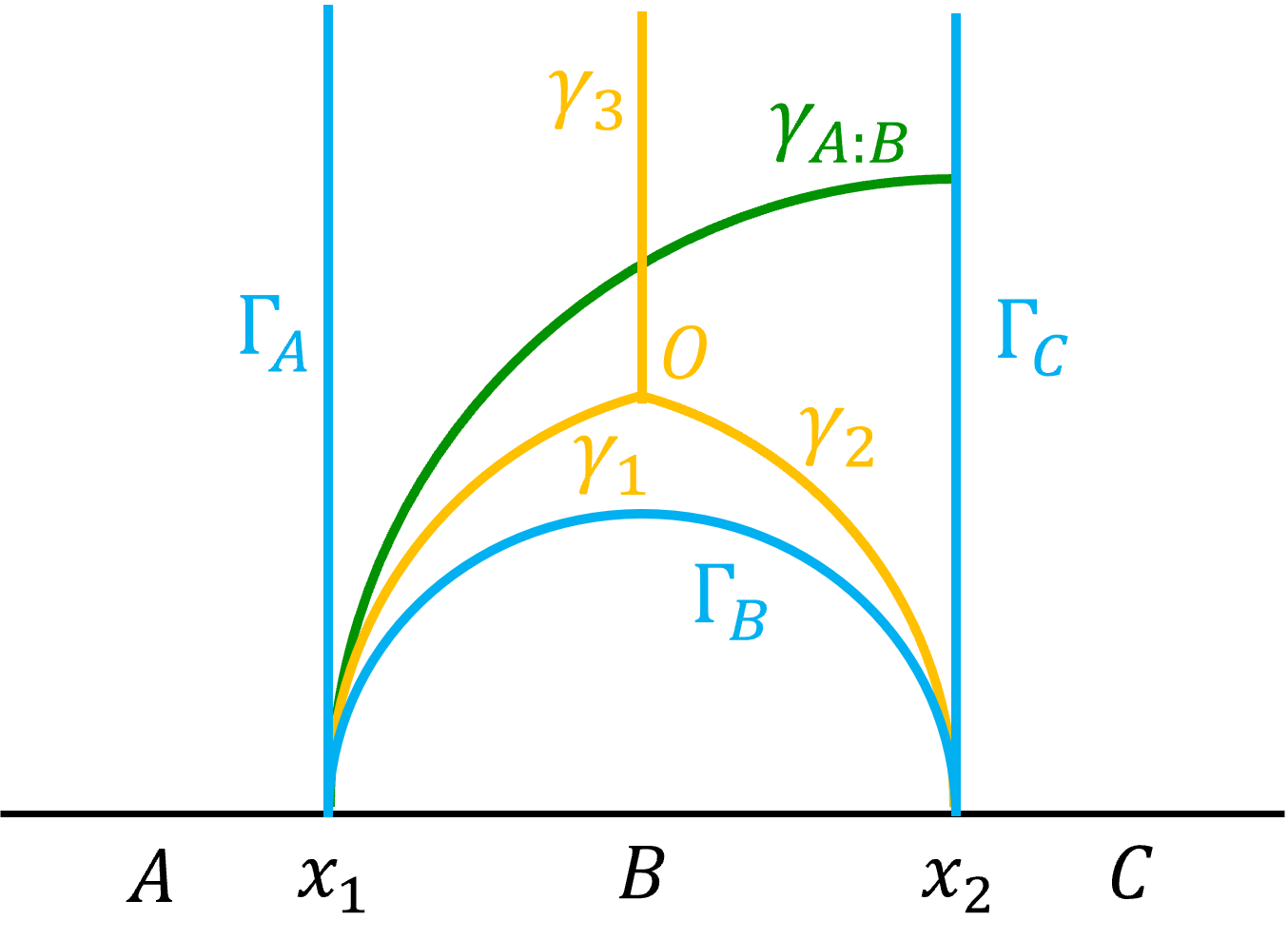
Figure 3: The upper-half plane representation of the hyperbolic disc, showing the minimal surfaces involved in the computation of R(3) and the brane web WA:B:C for GM(3).
Explicit Example: Vacuum AdS3
In vacuum AdS3, the explicit computation yields
R(3)(A:B)=4GN1log4,GM(3)(A:B:C)=4GN3log32
which are both constant due to conformal invariance. The inequality is satisfied, confirming the general result in a concrete setting.
Four-Party Generalization
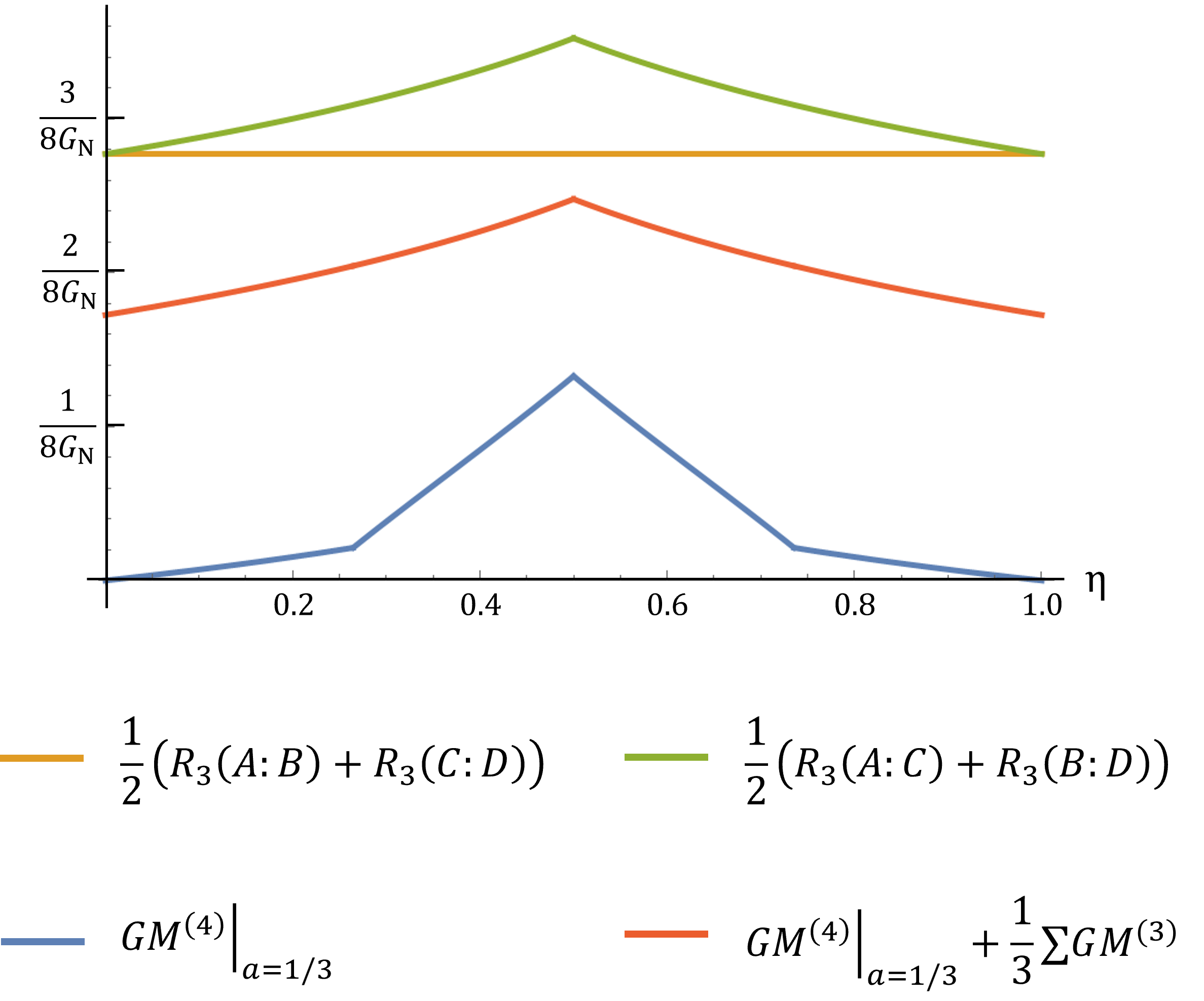
The analysis extends to four-party systems, where a one-parameter family of genuine multi-entropies GM(4) is defined. The authors derive a holographic inequality of the form
21(R(3)(A:B)+R(3)(C:D))≥GM(4)(A:B:C:D)+31∑GM(3)
where the sum runs over all tripartitions. For the four-party GHZ state, this inequality is violated, further supporting the exclusion of purely GHZ-like entanglement in holography.
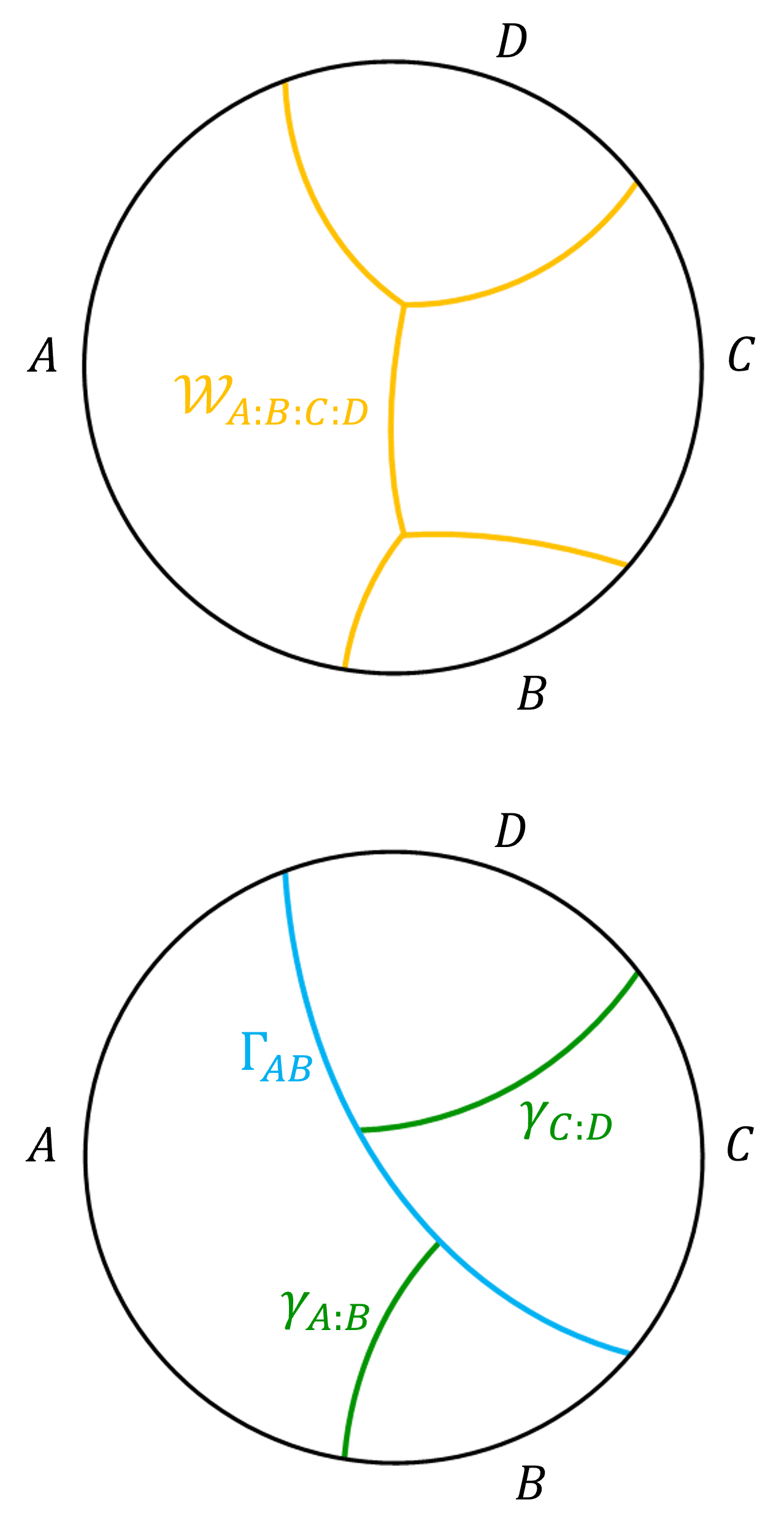
Figure 4: The top figure shows the minimal area brane web WA:B:C:D that computes S(4)(A:B:C:D). The bottom figure shows a brane web consisting of the RT surface and the entanglement wedge cross-sections.
Figure 5: A plot showing the tripartite and quadripartite entanglement quantities for vacuum AdS3 as a function of the conformal cross ratio η. The inequalities are satisfied throughout.
Implications and Future Directions
The exclusion of purely GHZ-like entanglement in holographic states has several implications:
Refinement of Holographic State Space: The result demonstrates that the set of quantum states admitting semiclassical holographic duals is more restricted than previously understood from the entropy cone alone.
Multipartite Entanglement Structure: Holographic states must possess multipartite entanglement structures beyond the GHZ class, with nontrivial contributions to R(3).
Generalization to Higher Parties: The methodology suggests a hierarchy of constraints for higher-party systems, potentially leading to a more complete characterization of holographic entanglement.
Bulk Geometry and Entanglement: The geometric origin of the inequalities further elucidates the interplay between bulk minimal surfaces and boundary entanglement structure.
Future work should address the generalization to time-asymmetric spacetimes, the systematic study of higher-party constraints, and the exploration of the full set of multipartite entanglement structures compatible with holography.
Conclusion
This work establishes a new class of constraints on the entanglement structure of holographic states, showing that purely GHZ-like entanglement is incompatible with time-symmetric semiclassical bulk duals. The derived inequalities involving R(3) and GM(3) provide a sharper tool for distinguishing holographic states from generic quantum states, with significant implications for the study of quantum gravity, the AdS/CFT correspondence, and the classification of multipartite entanglement in quantum field theory.