- The paper demonstrates that non-standard hypercharge embedding in heterotic string theory imposes strict bounds on the axion-photon coupling through detailed anomaly cancellation and threshold correction analyses.
- The paper shows that non-perturbative effects, including IR and UV instantons, critically govern the axion mass generation and modify the effective coupling relative to QCD expectations.
- The paper implies that the discovery of ALPs with coupling-to-mass ratios above the derived bounds would challenge conventional heterotic models and favor alternative string constructions like F-theory.
Axion-Photon Coupling Constraints in Heterotic String Theory
Overview and Motivation
This paper rigorously investigates the axion-photon coupling in the context of heterotic string theory, focusing on compactifications with non-standard hypercharge embedding. The central question is whether axion-like particles (ALPs) with coupling-to-mass ratios gaγ/ma far above the QCD axion line can exist in perturbative heterotic string models, and what such a discovery would imply for string theory as a UV completion of the Standard Model (SM). The analysis is motivated by the robust prediction of axions in string theory, their role in solving the strong CP problem, and the possibility of using axion phenomenology to constrain or falsify large classes of string compactifications.
Axions in Heterotic String Compactifications
Heterotic string theory, with its restricted 10d gauge groups (E8×E8 or SO(32)), naturally predicts axions via the dimensional reduction of higher-form fields. The model-independent axion arises from integrating the dual B6 over the compact space, while model-dependent axions originate from B2 integrated over 2-cycles. The couplings of these axions to gauge bosons are topologically determined by the Green-Schwarz mechanism and anomaly cancellation, leading to quantized, robust predictions for axion-gauge interactions.
In standard GUT-like embeddings, only the QCD axion couples to photons via the anomaly, and any other ALP's coupling is suppressed by mixing, yielding the well-known bound:
magaγ≲2παem(NE−1.92)fπmπ1
where E/N is the ratio of electromagnetic to QCD anomaly coefficients. This bound is saturated by the QCD axion and is robust against intermediate-scale physics.
Non-Standard Hypercharge Embedding: Loopholes and Constraints
The paper explores a potential loophole: non-standard embedding of U(1)Y into both E8 factors, allowing for axions that couple to photons without coupling to gluons. In such models, SU(3)C and SU(2)w are embedded in one E8, while hypercharge receives contributions from both. This setup can, in principle, yield two ALPs (θ2 and φ) with photon couplings decoupled from QCD.
However, the analysis demonstrates that even in these more general constructions, the coupling-to-mass ratio gaγ/ma is tightly constrained by the structure of the string compactification, the requirement of anomaly cancellation, and the need to reproduce the measured gauge couplings and weak mixing angle at low energies. Achieving phenomenological viability requires sizeable one-loop threshold corrections from string states and/or new charged matter at intermediate scales, which generically reduce the leading-order estimates for gaγ/ma.
Instanton Effects and Axion Mass Generation
The mass generation for ALPs in these models is controlled by non-perturbative effects:
- IR instantons: If the hidden sector contains a confining non-abelian group, the associated axion (θ2) acquires a large mass, yielding a coupling-to-mass ratio much smaller than the QCD axion.
- UV instantons (NS5-brane effects): In models where the hidden sector is fully broken to U(1)s, Euclidean NS5-branes (interpreted as small gauge instantons) generate an ALP potential. The suppression is controlled by the abelian gauge couplings, which are themselves determined by the compactification geometry and threshold corrections.
- Worldsheet instantons: Model-dependent axions (bi) can receive large masses from worldsheet instantons, especially when the compactification has small 2-cycles or large h11, further reducing their phenomenological relevance.
The interplay of these effects ensures that, except in regimes where perturbative control is lost, ALPs with gaγ/ma far above the QCD line are excluded.
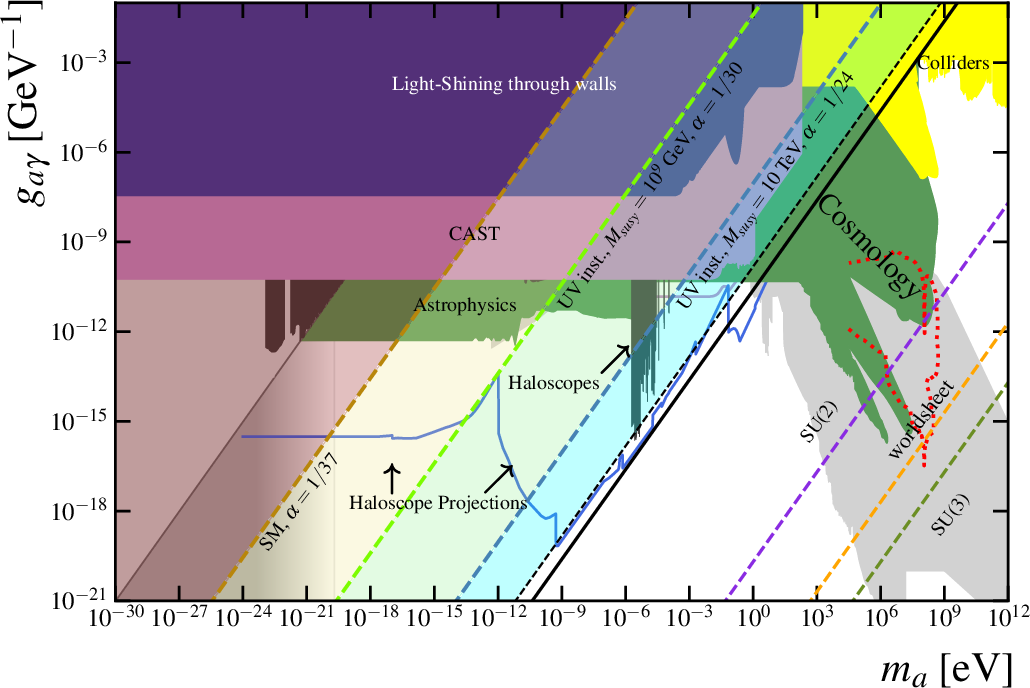
Figure 1: Axion parameter space for the heterotic string axiverse with non-standard embedding of hypercharge. Experimental constraints and theoretical bounds on gaγ/ma for various scenarios.
Threshold Corrections and Phenomenological Viability
The paper provides a detailed analysis of how threshold corrections and intermediate-scale matter affect the axion-photon coupling:
- Small threshold corrections: Achieved via small gs or small level of embedding k1(2), these scenarios yield heavy ALPs with suppressed gaγ/ma.
- Large threshold corrections: Required to match observed gauge couplings in some models, but only possible at the expense of losing perturbative control. In such cases, the effective field theory analysis breaks down, and a duality frame (e.g., F-theory) is needed.
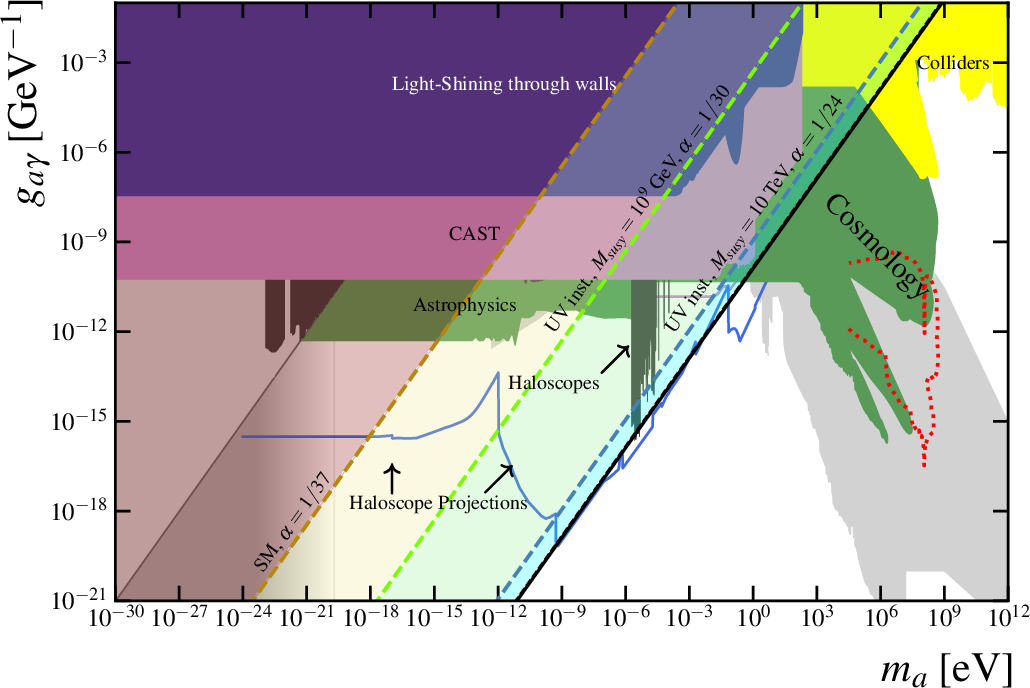
Figure 2: Same as Figure 1, illustrating the impact of small level of U(1)Y embedding into the second E8 (k1(2)=1/9) on the axion parameter space.
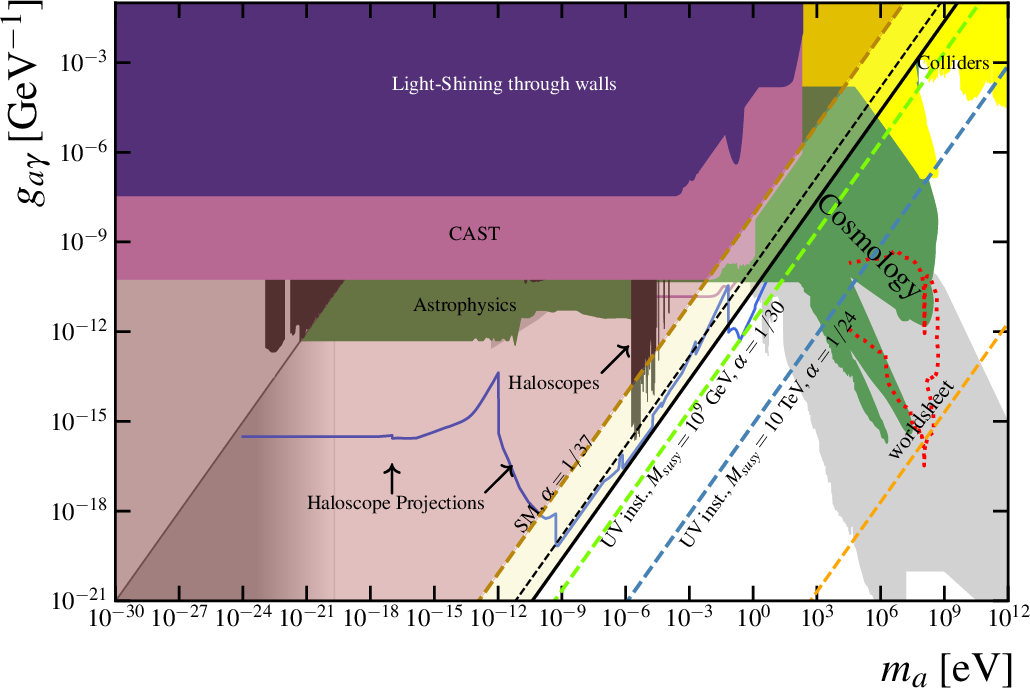
Figure 3: Same as Figure 1, but including negative threshold corrections, showing the further reduction in gaγ/ma for ALPs.
Implications and Future Directions
The main implication is that the discovery of an ALP with gaγ/ma violating the derived bounds would rule out large classes of string models, including perturbative heterotic SO(32) and E8×E8 string, type-I string, and certain heterotic M-theories. Only non-unified type-II string models, F-theory, or other constructions without a GUT origin of the SM would remain viable.
Conversely, the heterotic axiverse generically predicts heavy ALPs with unsuppressed couplings to photons, which may have significant cosmological and astrophysical consequences. The paper highlights the need for further quantitative studies of these scenarios, especially regarding the impact of worldsheet instantons and the scaling of axion masses with h11.
Conclusion
This work provides a comprehensive and technically detailed analysis of axion-photon couplings in heterotic string theory with non-standard hypercharge embedding. It establishes robust, model-independent bounds on gaγ/ma for ALPs, showing that only in regimes where perturbative control is lost can these bounds be violated. The results have direct implications for experimental axion searches and the viability of string theory as a UV completion of the SM, offering a concrete framework for testing quantum gravity via axion phenomenology.