Eikonal quasinormal modes of highly-spinning black holes in higher-curvature gravity: a window into extremality
Published 10 Sep 2025 in gr-qc and hep-th | (2509.08664v1)
Abstract: We carry out the first computation of gravitational quasinormal modes of black holes with arbitrary rotation in a theory with higher-derivative corrections. Our analysis focuses on a recently identified quartic-curvature theory that preserves the isospectrality of quasinormal modes in the eikonal limit and that is connected to string theory. We find a master equation that governs large-momentum gravitational perturbations in this theory. By solving this equation with WKB methods, we provide complete results for the corrections to the Kerr quasinormal mode frequencies for arbitrary spin and arbitrary $\mu=m/(\ell+1/2)$, where $\ell$ and $m$ are the harmonic numbers. Our results show that the corrections become orders of magnitude larger when the spin is close to extremality, with the modes close to the critical value of $\mu$ that separates damped and zero-damped modes being particularly sensitive. We also perform a geometric-optics analysis of gravitational-wave propagation around black holes and relate the equatorial ``graviton-sphere'' orbits to quasinormal mode frequencies with $\ell=m$. We find that the usual correspondence between the Lyapunov exponent of those orbits and the imaginary part of the frequency is modified.
The paper presents a detailed derivation of a master scalar equation governing large-momentum gravitational perturbations, ensuring isospectrality for QNMs in rotating black hole backgrounds.
It employs a WKB approximation and projection onto spheroidal harmonics to solve the modified Teukolsky radial equation, with corrections scaling as L^4 that become significant near extremality.
The results indicate that highly-spinning black holes serve as sensitive probes of higher-curvature corrections, with observable impacts on gravitational wave signals in the extreme spin regime.
Eikonal Quasinormal Modes of Highly-Spinning Black Holes in Higher-Curvature Gravity
Introduction and Theoretical Framework
This paper presents a comprehensive analysis of gravitational quasinormal modes (QNMs) for rotating black holes in a quartic-curvature extension of General Relativity (GR), focusing on the eikonal regime and the extremal spin limit. The chosen theory is motivated by effective field theory (EFT) and string theory, specifically type II string compactifications, and is characterized by a unique quartic curvature term that ensures non-birefringent gravitational wave (GW) propagation in the high-momentum limit. The action is:
S=16πG1∫d4x∣g∣[R+α(C2+C~2)]
where C and C~ are quadratic invariants of the Riemann tensor and its dual, and α is a dimensionful coupling.
The central technical advance is the derivation of a master scalar equation governing large-momentum gravitational perturbations, which, in the eikonal limit, preserves isospectrality for QNMs. This property is crucial for tractable analysis and is confirmed for rotating backgrounds in this work.
Geometric Optics and Graviton-Sphere Orbits
The geometric optics limit is exploited to relate eikonal QNMs to properties of unstable circular GW orbits (the "graviton-sphere") in the Kerr background. The dispersion relation for GWs is modified by the higher-curvature term, leading to non-null, non-geodesic propagation. The correspondence between the real part of the QNM frequency and the orbital frequency of these orbits is maintained, but the imaginary part is no longer simply proportional to the Lyapunov exponent of the orbit instability. Instead, the decay rate is determined by the instability of a bundle of GW orbits, reflecting the higher-derivative nature of the theory.
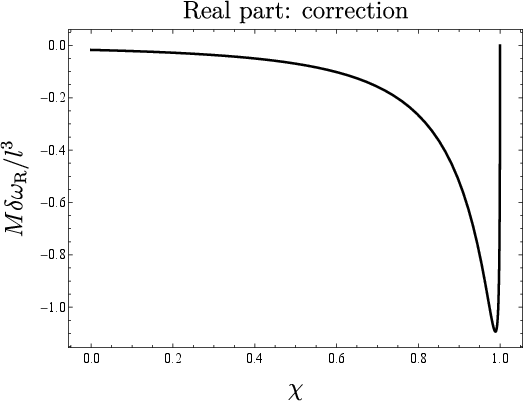
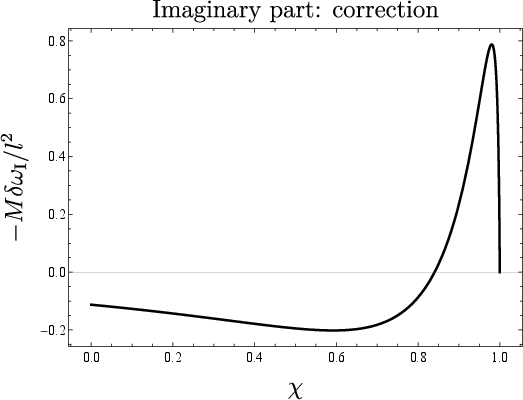
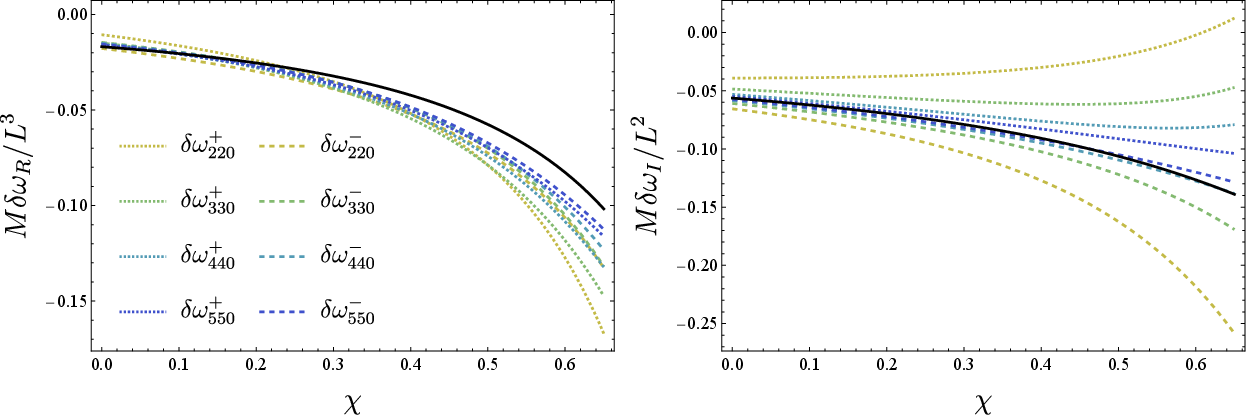
Figure 1: Kerr QNM frequencies with ℓ=m (top row) and their corrections (bottom row) as a function of the spin parameter χ ranging from zero rotation up to extremality. The imaginary part shows the fundamental mode n=0.
Master Equation and WKB Analysis
The effective scalar equation is projected onto spheroidal harmonics, yielding a modified Teukolsky radial equation with an explicit correction to the potential. The correction term involves an integral over spheroidal harmonics, which is analytically tractable in the eikonal limit. The radial equation is solved using the WKB approximation, which is asymptotically exact for large ℓ.
The correction to the potential scales as L4 (with L=ℓ+1/2), and the regime of validity is 1≪L≪∣α^∣−1/6, ensuring the EFT remains applicable. The analysis reveals that the corrections to QNM frequencies become orders of magnitude larger near extremality, especially for modes with μ=m/L close to the critical value μcr≈0.744, which separates damped modes (DMs) from zero-damped modes (ZDMs).
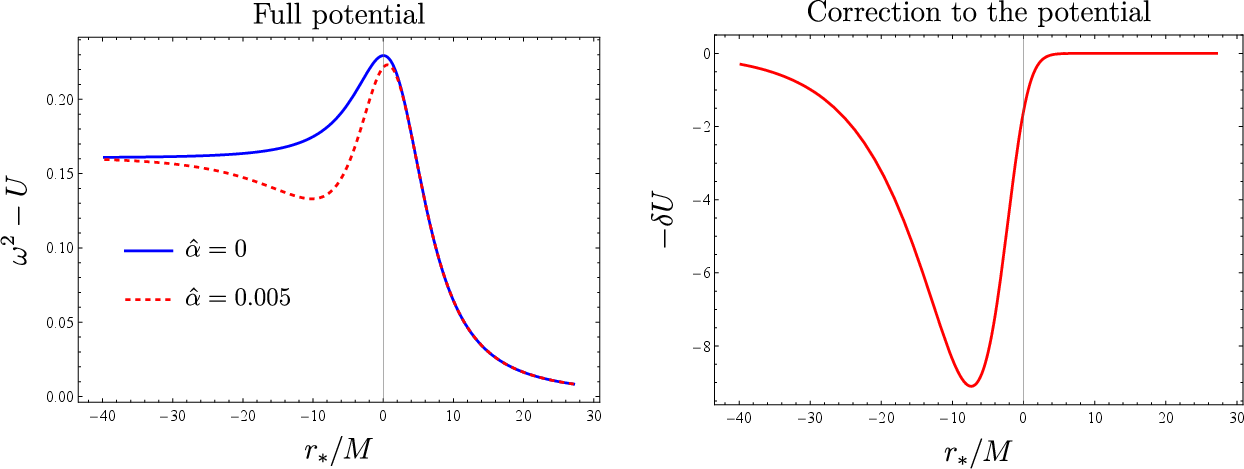
Figure 2: Potential as a function of the tortoise coordinate. Left: full potential for α^=0 (GR) and for α^=0.005. Corrections introduce a local minimum near the horizon for large spin. Right: correction to the potential, exhibiting a minimum close to the horizon.
Numerical Results and Isospectrality
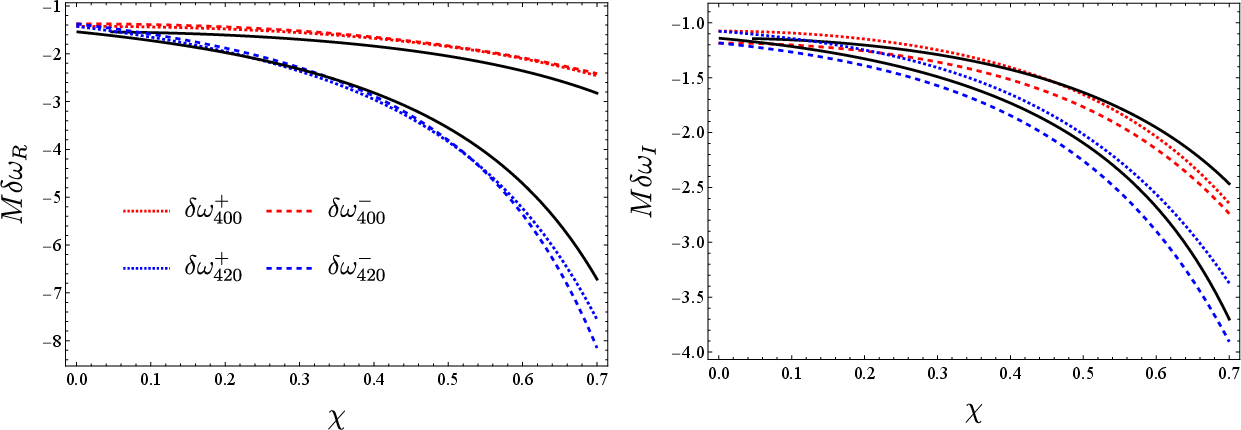
The eikonal predictions are benchmarked against results from the modified Teukolsky equation for moderate rotation and finite ℓ. The agreement is strong, with isospectrality breaking being mild and the eikonal approximation providing accurate results even for ℓ∼4.
Figure 3: Corrections to the Kerr QNM frequencies for (ℓ,m,n)=(4,0,0),(4,2,0). The colored lines are predictions from the modified Teukolsky equation, showing mild isospectrality breaking. The solid black lines are the eikonal computation.
Figure 4: Convergence towards the eikonal regime for ℓ=m modes. Colored lines are modified Teukolsky predictions for (ℓ,m,n)=(2,2,0),(3,3,0),(4,4,0),(5,5,0). The solid black lines are the eikonal computation.
Extremality, Critical Modes, and Scaling Behavior
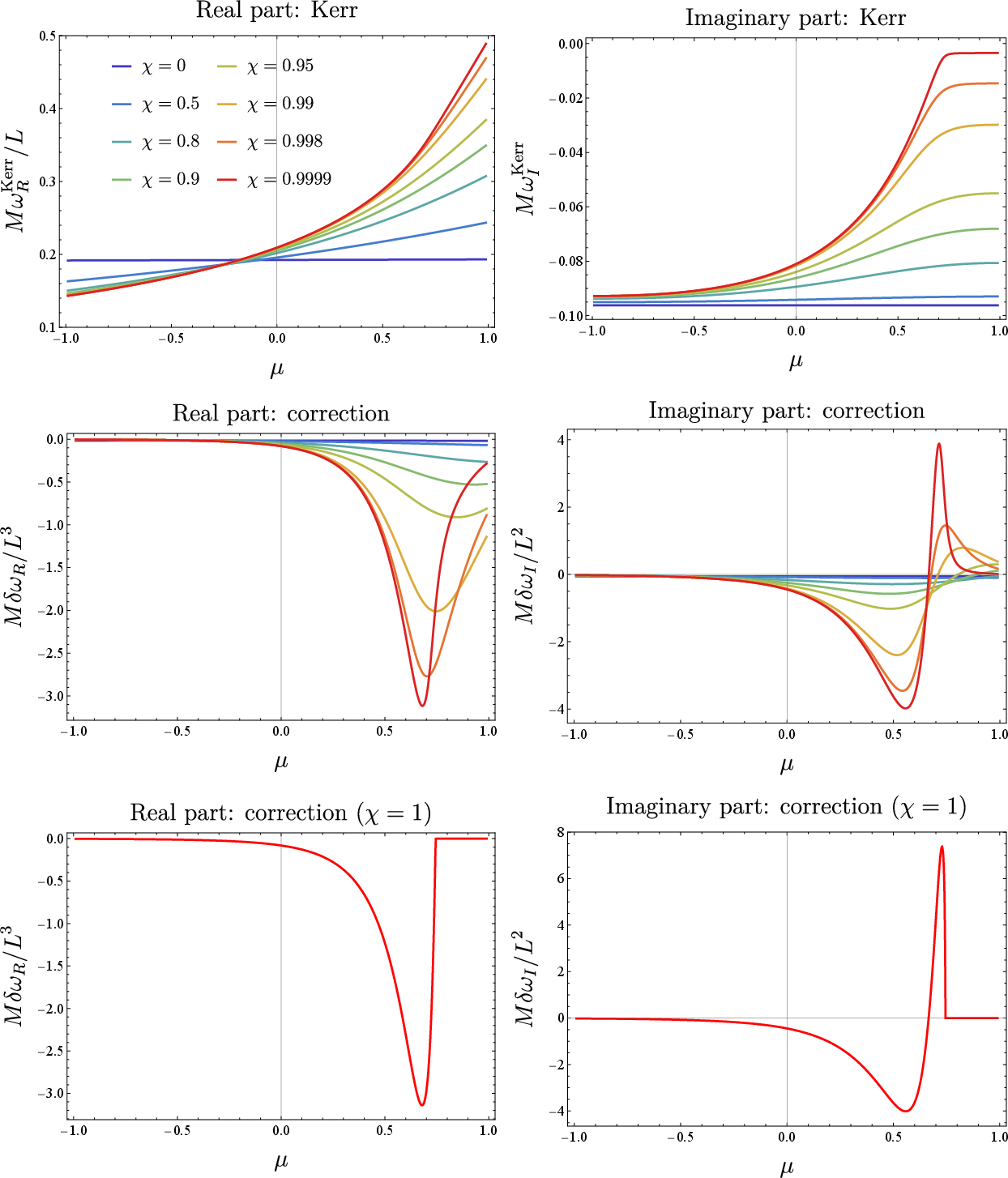
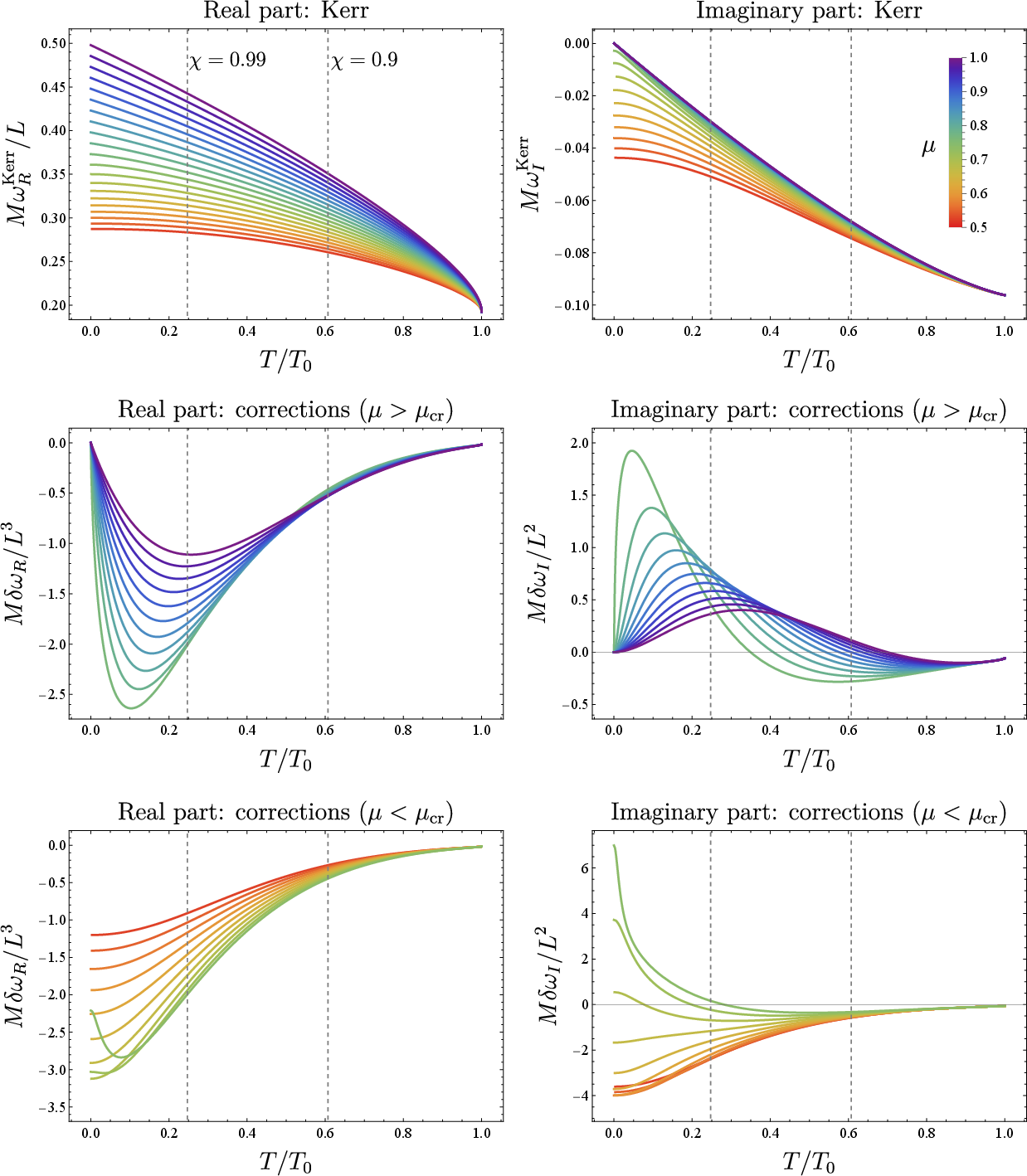
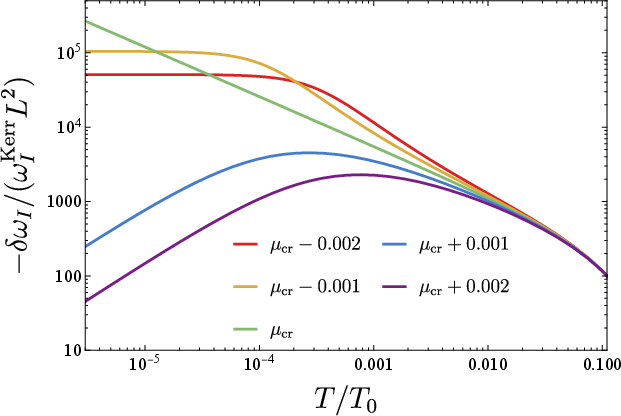
A key finding is the dramatic enhancement of corrections near extremality (χ→1) and for μ≈μcr. The imaginary part of the QNM frequency for Kerr tends to zero for ZDMs, while the correction term can diverge as T−2/3 (with T the black hole temperature), leading to potentially order-one modifications within the EFT regime for sufficiently large L and small T.
Figure 5: Kerr QNM frequencies (top row) and their corrections (middle and bottom row) as a function of μ=m/L for different values of the black hole rotation χ. Corrections at extremality are shown in the bottom row.
Figure 6: Kerr QNM frequencies and their corrections as a function of black hole temperature for different values of μ. Corrections for μ>μcr and μ<μcr are shown separately.
Figure 7: Relative corrections to the imaginary part of the Kerr QNM frequencies for small temperature and for values of μ close to the critical value. Corrections diverge as T−2/3 for μ=μcr.
The analysis of the phase boundary between DMs and ZDMs shows that higher-curvature corrections can shift μcr, potentially changing the nature of modes near the boundary. The sensitivity of QNMs in this regime to new physics is highlighted, with the possibility of large corrections depending on number-theoretic properties of μ.
Implications and Future Directions
The results have direct implications for black hole spectroscopy and GW observations. Highly-spinning black holes, especially those near extremality, are shown to be far more sensitive probes of higher-curvature corrections than moderately spinning ones. The corrections to QNM frequencies can be orders of magnitude larger for χ∼0.99 than for χ∼0.7, suggesting that future GW detectors should prioritize such events for tests of GR and searches for new physics.
Theoretically, the work demonstrates the utility of isospectral EFT extensions for tractable QNM analysis and motivates further study of non-isospectral theories, the full spectrum including ZDMs with μ<μcr, and the impact of double-peaked potentials on the QNM spectrum. The connection between QNM sensitivity and number theory (rational approximations to μcr) is a novel aspect with potential implications for mode selection in observational campaigns.
Conclusion
This paper provides the first detailed computation of eikonal QNMs for highly-spinning black holes in a higher-curvature gravity theory, elucidating the scaling and sensitivity of corrections near extremality and the critical phase boundary. The results establish that corrections to QNM frequencies can be dramatically enhanced in this regime, with practical consequences for GW-based tests of gravity. The analytic and numerical techniques developed here set the stage for further exploration of QNMs in more general EFTs and for the interpretation of future high-precision GW data.