- The paper introduces optimal bounds for energy extraction (max-WCEE) and injection (max-WCIE) using only the mean energy of a quantum system.
- It employs linear programming to characterize minimum ergotropy and anti-ergotropy, revealing unique behaviors of passive and antipassive states.
- Results suggest that practical protocols, including random unitary operations, can saturate these bounds, advancing quantum battery and energy management applications.
Extracting and Charging Energy into Almost Unknown Quantum States
The paper "Extracting and charging energy into almost unknown quantum states" (2509.08899) explores the fundamental limits of work extraction using unitary operations from quantum systems when there is only partial information about the system's state. The research delineates new methodologies and theoretical frameworks to assess energy extraction and injection capabilities under minimal information constraints, specifically when only the mean energy of the system is known.
Introduction to Quantum Thermodynamics and Ergotropy
Quantum thermodynamics has brought forth a unique perspective in manipulating energy at quantum scales, often relying on the concepts of ergotropy and anti-ergotropy. Ergotropy quantifies the maximum work extractable from a quantum state given complete knowledge, while anti-ergotropy refers to the maximum energy that can be injected into a state. The practical application of these theories is limited in real-world scenarios where full state knowledge is typically inaccessible.
This work sets a new precedent by determining the energy extraction limits knowing only the system's mean energy, reflecting a realistic constraint where state tomography is unfeasible due to its high resource demands.
Derivation and Characterization of Bounds
The paper develops optimal upper bounds for the work that can be unitarily extracted or injected, assuming only the mean energy is known. This involves defining new measures: the maximal worst-case extractable energy (max-WCEE) and maximal worst-case injectable energy (max-WCIE). The authors provide a complete characterization of the minimum ergotropy and anti-ergotropy for states with fixed average energy. Notably, these bounds are determined to be functions of the system's Hamiltonian properties and can be computed via a linear programming approach.
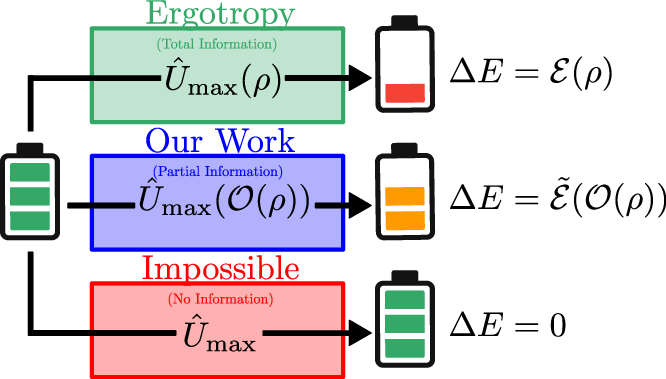
Figure 1: Maximal work extraction through unitary operations (ergotropy) requires full knowledge of the state. This work characterizes the extractable and chargeable energies when minimal information, specifically the mean energy, is known.
Particularly, the characterization reveals that passive and antipassive states uniquely achieve these minimum values. This characterization, supported by linear programming, illuminates key insights into the nature of such states and their ergotropy-related properties.
Saturation of Bounds and Practical Protocols
A significant finding is the identification of scenarios where the theoretical bounds on extractable and injectable energies can be reached. Specifically:
- Antisymmetric Hamiltonians: Systems with such Hamiltonians, like angular momentum operators or large spin systems, exhibit a direct relationship between energy and ergotropy, allowing straightforward achievement of bounds.
- Diagonal States: When the quantum states are diagonal in the Hamiltonian's eigenbasis, or when decoherence resources produce a diagonal effect, the theoretical bounds can be effectively reached.
- Random Unitary Protocols: Employing random unitary operations allows the mitigation of unknown quantum coherences, thus ensuring the bounds' saturability probabilistically.
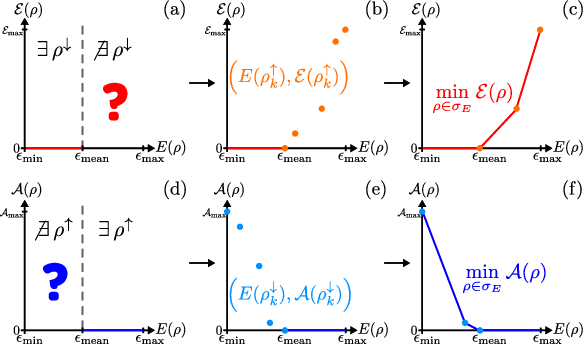
Figure 2: Characterization of the minimum ergotropy and anti-ergotropy versus mean energy, illustrating regions where passive and antipassive states exist, and bounds are attainable.
The authors further explore a qutrit example to illustrate the practical applications of these theories and highlight the significance of correctly handling quantum coherences in energy manipulation protocols.
Implications and Future Prospects
This research transcends traditional quantum thermodynamic boundaries by effectively managing energy extraction with limited state information. It suggests a nuanced balance between quantum coherence and energy management in quantum systems. The implications extend to various practical applications, including the design of efficient quantum batteries and energy storage systems, where full system knowledge is impractical.
The insights suggest future research directions focusing on the minimal information required to exploit quantum coherence fully and the development of energy-manipulation protocols that reduce the detrimental effects of coherence ignorance. Furthermore, they provide a foundation for experimental validation and implementation in quantum technologies.
Conclusion
In conclusion, this work offers a comprehensive theoretical framework for extracting and injecting energy in quantum systems with incomplete state information. By establishing clear theoretical limits and characterizing practical scenarios where these limits can be attained, it significantly advances the field of quantum thermodynamics. The methodologies proposed hold promise for real-world applications where quantum systems need to be efficiently managed with limited information.